What you’ll learn:
- How Oakcha and Dossier actually differ in formula, concentration, and price
- Which brand wins on scent accuracy for popular designer dupes
- How longevity and projection compare between the two
- Which brand is the smarter buy depending on what you’re looking for
Introduction
If you’ve spent any time in the fragrance corner of TikTok, you’ve seen the debate: Oakcha vs Dossier, and which one actually deserves a spot on your shelf. Both brands built loyal followings by promising the same warm, musky, or powdery notes as luxury bottles, minus the luxury price tag.
But “dupe brand” doesn’t mean identical business model. Oakcha and Dossier take genuinely different approaches to formulation, pricing, and even where their juice gets made. One leans into ultra-high oil concentration. The other leans into French perfumery credentials.
I tested bestsellers from both brands side by side, sprayed them on skin (not just paper), and tracked how they held up over a full day. This isn’t a quick sniff-and-guess. It’s a real comparison of what you’re actually paying for.
Let’s dive in.
Why the Perfume Dupe Boom Even Happened
Designer and niche perfume prices have climbed dramatically over the past decade, with many prestige eau de parfums now retailing well above $150 for a standard bottle. A single bottle of Maison Francis Kurkdjian’s Baccarat Rouge 540, for example, runs around $325 for 70ml — a price that’s kept it firmly in “special occasion only” territory for most fragrance fans.
That gap between what a scent costs to formulate and what it retails for opened the door for dupe brands. Direct-to-consumer companies realized they could cut out the celebrity endorsement fees, glossy ad campaigns, and heavy packaging markups that inflate designer pricing, and instead sell fragrance-forward, notes-first products.
Oakcha and Dossier both emerged from that gap, but they solved it differently.
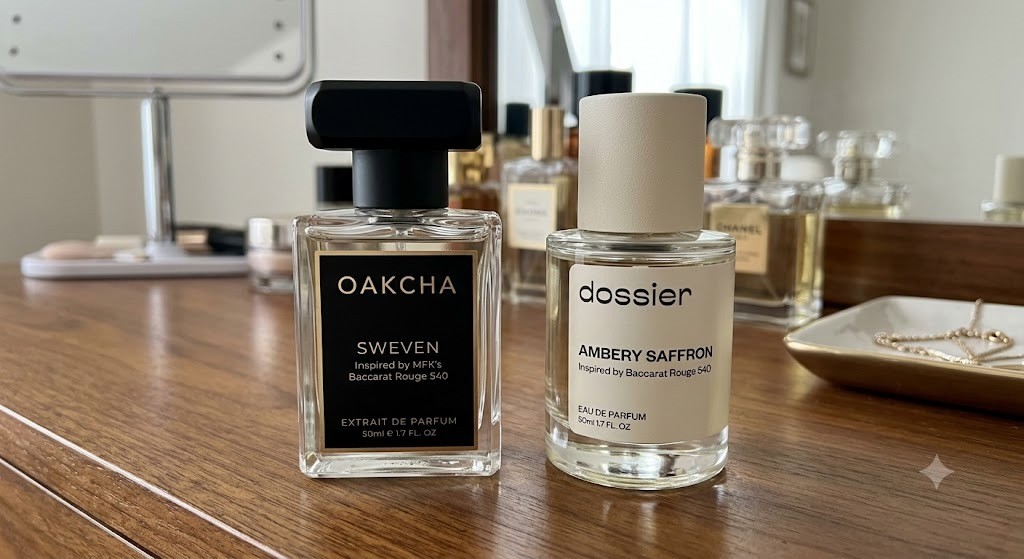
Oakcha vs Dossier: How the Formulas Actually Compare
This is where the two brands genuinely split paths, and it matters more than most dupe comparisons let on.
Concentration and Oil Percentage
Oakcha formulates almost its entire line as extrait de parfum, typically sitting around a 30% fragrance oil concentration. That’s notably higher than most designer eau de parfums, which usually land in the 15–20% range, and it’s a big reason Oakcha fans report scents that feel rich from the very first spray.
Dossier, by contrast, mostly sells at eau de parfum strength. That doesn’t mean it’s weak — Dossier’s EDPs are formulated to be concentrated enough to hold their own through a workday — but on paper, Oakcha is pushing a heavier oil load into every bottle.
Where They’re Made
Dossier leans hard into its Grasse, France production, marketing itself as being crafted in what’s widely considered the historic capital of perfumery, with formulas developed through back-and-forth refinement with a dedicated perfumer until the scent match feels right.
Oakcha, meanwhile, is a New York–based brand that focuses less on provenance storytelling and more on ingredient transparency, explicitly listing which iconic fragrance inspired each of its more than 70 scents.
Clean Formulation Claims
Both brands market themselves as vegan and cruelty-free. Oakcha specifically highlights that its formulas skip parabens and phthalates, two ingredients some consumers try to avoid. Dossier makes a similar clean-beauty pitch, describing its perfumes as non-toxic, vegan, and eco-friendly, right down to donating returned bottles rather than tossing them.
Neither brand is reinventing perfumery here. But if “clean formulation” is a priority for you, you’re not sacrificing anything by picking either one.
Step-by-Step: How I Compared Them
Here’s the exact process I used to test both brands fairly, so you can replicate it if you’re deciding between the two yourself.
- Pick matching inspirations. I chose scents from each brand that dupe the same category of designer fragrance — for example, an amber-vanilla dupe from each brand inspired by YSL’s Black Opium.
- Apply to skin, not paper. Fragrance behaves differently on skin chemistry than on a paper strip, so every test was a skin spray on a clean wrist.
- Track the opening (0–15 minutes). This is where a dupe usually reveals itself. I noted whether the top notes felt sharp, synthetic, or genuinely close to the original.
- Check the heart notes (30 minutes–2 hours). This is the “true” scent of the fragrance, once the initial alcohol burn-off fades.
- Track longevity every 2 hours. I noted when the scent became a close-skin scent versus when it faded entirely.
- Compare final impression to the designer original, worn from memory and from recent testing.
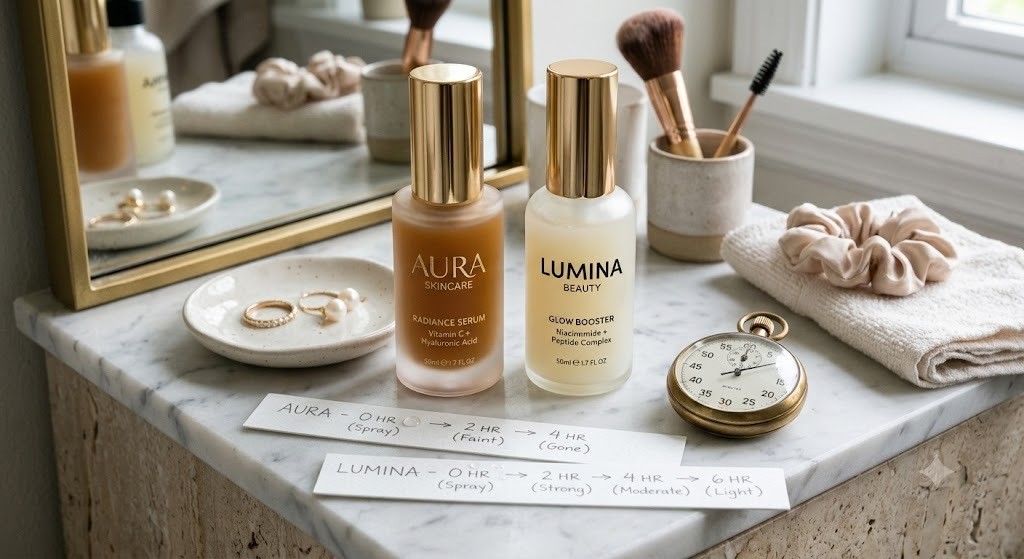
Across this process, Oakcha’s higher oil concentration consistently translated into a stronger, longer opening. Dossier’s scents felt slightly softer on application but held a close-to-skin presence for a respectable stretch of the day.
Common Mistakes People Make When Buying Perfume Dupes
Before you decide between Oakcha and Dossier, avoid these common missteps.
Assuming “dupe” means “identical.” Even the best dupes are inspired by, not chemically identical to, the original. Expect something close and satisfying, not a molecule-for-molecule clone.
Ignoring concentration when comparing prices. A $29 eau de parfum and a $40 extrait de parfum aren’t the same product category, even if they smell similar on first spray. Always check the concentration listed on the bottle.
Buying full-size before sampling. Both brands offer discovery or sample sets. Skipping that step means risking money on a scent that reads differently on your specific skin chemistry.
Judging longevity from paper testers only. Skin oils, dryness, and even the weather change how long a fragrance lasts. Always test wear time on skin.
Storing bottles in the bathroom. Heat and humidity break down fragrance oils over time. Keep both Oakcha and Dossier bottles in a cool, dark drawer instead of a steamy bathroom shelf.
Expert Tips for Getting the Most Out of Either Brand
A few extras that make a real difference once you’ve picked your bottle:
- Layer with an unscented lotion first. This helps both Oakcha’s and Dossier’s formulas cling longer, especially on dry skin.
- Spray, don’t rub. Rubbing your wrists together after applying breaks down top notes faster and can make a fragrance smell “off” sooner than it should.
- Buy a travel atomizer. If you land on a Dossier scent, whose EDP formulas can run a touch lighter than Oakcha’s extraits, a midday reapplication from a small atomizer keeps things going without needing a heavier hand.
- Match concentration to occasion. Save Oakcha’s higher-oil extraits for cooler weather or evenings, when you want more projection; lighter Dossier EDPs can work well for daytime office settings.
So, Which One Actually Wins?
Here’s the honest breakdown. If scent strength, projection, and longevity are your top priority, Oakcha’s higher fragrance-oil concentration gives it a real edge — its extraits genuinely behave more like the pricier originals they’re inspired by.
If you care most about the story behind the bottle, minimalist design, and a slightly softer, more office-friendly wear, Dossier’s Grasse-made eau de parfums are the better fit, especially for daytime scents.
Neither brand is a flat-out loser here. They’re built for slightly different fragrance lifestyles, and the “win” depends on what you actually want from a bottle.
Conclusion
At the end of the day, the Oakcha vs Dossier debate isn’t about which brand is objectively better — it’s about which formula matches how you want to wear fragrance. Oakcha brings bolder concentration and longer-lasting projection, while Dossier offers a softer, more refined daily-wear option backed by its Grasse, France roots.
Either way, you’re getting a legitimate alternative to $300 department store bottles without giving up quality or clean ingredients. Try a sample set from each before committing to a full bottle, and let your own skin chemistry make the final call.
Did you find this helpful? Drop a comment below or share this with a fellow fragrance lover!
Frequently Asked Questions
Q1: Is Oakcha or Dossier a better dupe for designer perfumes? A: It depends on the scent category. Oakcha’s higher oil concentration tends to produce a closer match for bold, warm fragrances like amber or gourmand scents, while Dossier’s lighter EDP formulas can feel closer to fresher, more citrus-forward designer originals.
Q2: Which brand lasts longer on skin, Oakcha or Dossier? A: Oakcha’s extrait de parfum formulas, with roughly 30% oil concentration, generally outlast Dossier’s eau de parfum offerings, which sit at a lower concentration but still deliver solid all-day wear for most skin types.
Q3: Are Oakcha and Dossier perfumes considered clean or non-toxic? A: Both brands market themselves as vegan and cruelty-free, and both specifically avoid parabens and phthalates in their formulas, making them comparable choices if clean ingredients matter to your buying decision.
Q4: Is Dossier or Oakcha cheaper? A: Pricing is close between the two, with both brands typically landing in the $28–$50 range per bottle depending on size and concentration, though Oakcha’s higher oil percentage can make it feel like better value per spray.
Q5: Where are Oakcha and Dossier perfumes made? A: Dossier formulates its fragrances in Grasse, France, historically known as the perfume capital of the world, while Oakcha is a New York–based brand that develops its dupe formulas in-house.
Q6: Can I sample Oakcha and Dossier before buying a full bottle? A: Yes, both brands offer discovery or sample sets, which is the smartest way to test how a dupe performs on your specific skin chemistry before committing to a full-size bottle.
Dossier Perfumes Honest Review: Are Luxury Dupes Worth Buying?
Leave a Reply