What you’ll learn:
- What labdanum actually is and where it comes from
- Why so many luxury perfumes rely on this resin for depth and warmth
- How to recognize labdanum in a fragrance’s scent profile
- Common mistakes and myths people get wrong about labdanum
Introduction
What is labdanum? It’s one of perfumery’s oldest secrets, a sticky, fragrant resin harvested from a scraggly Mediterranean shrub, and it’s probably sitting in the base notes of several bottles on your shelf right now.
If you’ve ever caught a warm, honeyed, slightly leathery undertone in a perfume and couldn’t quite name it, there’s a good chance labdanum was behind it. This resin has been prized since antiquity, and it still forms the backbone of countless “amber” perfumes today, even though true amber (the fossilized tree resin) has almost no scent at all.
Perfumers reach for labdanum because nothing else quite replicates its combination of sweetness, smokiness, and skin-like warmth. Once you learn to recognize it, you’ll start noticing it everywhere, from cozy oriental fragrances to sharp, modern chypres.
Let’s dive in.
Background: Why Labdanum Matters in Perfumery
Labdanum comes from the Cistus ladanifer shrub, more commonly known as rockrose, which grows wild across the Mediterranean basin, particularly in Spain, Portugal, Morocco, and Cyprus.
The plant secretes a dark, sticky resin from its leaves and stems as a natural defense against heat and insects. For centuries, this resin was collected using an unusual method: shepherds would comb it directly from the beards of goats that had grazed among the shrubs.
Today, labdanum is harvested more conventionally, either by boiling the leaves and skimming the resin that rises to the surface, or by using solvent extraction to produce a rich, dark absolute.

This amber resin fragrance material has a scent profile that’s genuinely hard to pin down: part sweet, part smoky, part leathery, with a warmth that seems to sit right on the skin. That complexity is exactly why perfumers value it so highly.
The Main Educational Content: Understanding Labdanum’s Role
1: The Original “Amber” Note
Most fragrances labeled with an “amber” accord aren’t actually using fossilized amber at all. Real amber, the fossilized tree resin used in jewelry, has almost no fragrance once it hardens.
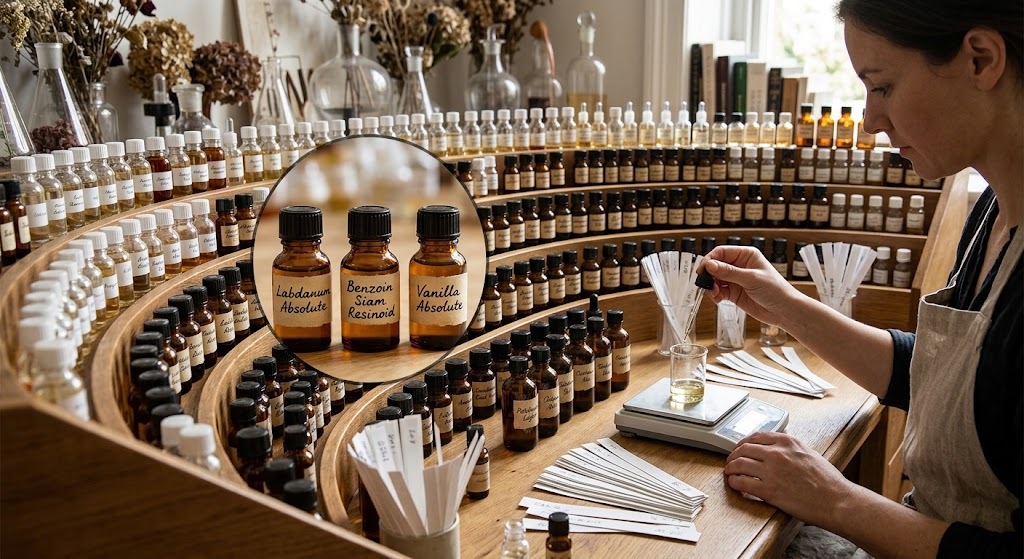
Instead, perfumers built the classic “amber” accord using labdanum as the foundation, often blended with vanilla, benzoin, and sometimes a touch of animalic musk. This combination dates back over a century and remains one of the most recognizable bases in perfumery.
According to industry sourcing reports, Spain alone supplies a significant share of the world’s labdanum resin and absolute, making it one of the most commercially important resins in fine fragrance production today.
2: The Scent Profile, Broken Down
Labdanum’s smell is layered, which is part of why it’s so useful to perfumers. At first sniff, it’s sweet and honeyed, almost like dried fruit macerating in syrup.
Underneath that sweetness sits something darker: smoky, leathery, even slightly animalic, reminiscent of warm skin or worn leather. Some perfumers describe it as having a “dirty” quality that keeps a fragrance from smelling flat or one-dimensional.
That combination of sweet and smoky-leathery is why labdanum shows up so often in oriental, chypre, and fougère fragrance families, where it adds richness without adding obvious sweetness on its own.
3: Where You’ll Actually Smell It
Labdanum rarely stars alone; it works in the background, anchoring a composition’s base notes. It’s found in classics like Guerlain’s Shalimar and Habit Rouge, where it contributes to that signature warm, resinous depth.
It also appears in many modern niche releases built around “amber” or “leather” themes, since houses like Serge Lutens and Amouage frequently lean on labdanum to achieve that lived-in, sensual warmth.
Even fragrances that don’t market themselves as “amber” scents often use small amounts of labdanum simply to add richness and longevity to the base, since resins tend to be excellent fixatives that help lighter top notes last longer on skin.
Practical Tips: How to Spot Labdanum in a Fragrance
Learning to identify labdanum takes practice, but these steps make it easier:
- Start with known amber fragrances. Try something built explicitly around an amber accord, then focus on the warm, honeyed base once the top notes fade.
- Wait for the dry-down. Labdanum is a base note, so it typically emerges 30 minutes to a few hours after application, not in the opening spray.
- Compare side by side. Smell two fragrances marketed as “amber” or “oriental” back to back; the shared warm, leathery-sweet thread is usually labdanum.
- Check the notes list. Some brands list “labdanum” directly, while others hide it under “amber accord” or “cistus.”
- Pay attention to skin warmth. Labdanum has a way of smelling like it’s coming from your own skin rather than sitting on top of it — that’s a strong clue.
Common Mistakes and Myths About Labdanum
Myth: Labdanum and amber are the same thing. They’re not. Fossilized amber has essentially no scent, while labdanum is a fragrant plant resin. “Amber” in perfumery is a stylized accord, not a literal ingredient.
Myth: Labdanum smells purely sweet. People expecting only sweetness are often surprised by its smoky, leathery undertone, which is actually what gives it depth.
Mistake: Assuming all “amber” perfumes smell the same. Because labdanum blends differently depending on what it’s paired with (vanilla, patchouli, oud, musk), amber fragrances can range from gourmand-sweet to dark and smoky.
Mistake: Overlooking labdanum in “clean” or fresh fragrances. Even airy scents sometimes use a small amount of labdanum absolute purely as a fixative, without it registering as an obvious note.
Expert Tips: Getting the Most Out of Labdanum Fragrances
If you’re drawn to labdanum’s warmth, look specifically for fragrances categorized as “oriental,” “amber,” or “chypre,” since these families rely on it most heavily.
Application matters, too. Because labdanum-heavy fragrances tend to bloom on warm skin, applying to pulse points (wrists, neck, chest) rather than clothing will let that resinous warmth develop more fully over the course of the day.
Layering can also help. A labdanum-based amber fragrance paired with a lighter citrus or floral scent often creates a more complex, personal signature than either worn alone.
Summary: Why Labdanum Deserves Your Attention
Labdanum is one of perfumery’s quiet workhorses: rarely front and center, but essential to countless fragrances you already love.
Its warm, honeyed, slightly smoky character is what gives “amber” perfumes their signature depth, and its fixative properties help entire compositions last longer on skin.

Once you know what to smell for, you’ll start spotting labdanum’s fingerprint in fragrance after fragrance, and that recognition makes wearing (and shopping for) perfume a lot more rewarding.
Conclusion
So, what is labdanum? It’s an ancient Mediterranean resin that quietly shapes some of the most beloved luxury perfumes on the market, lending them warmth, sweetness, and a soft leathery depth that’s genuinely hard to replicate.
Next time you catch that cozy, honeyed base note in a fragrance and can’t quite place it, there’s a good chance labdanum is doing the work behind the scenes.
Did you find this helpful? Drop a comment below or share this with a fellow fragrance lover!
Frequently Asked Questions
Q1: What is labdanum used for in perfume? A: Labdanum is used as a base note that adds warmth, sweetness, and a smoky-leathery depth to fragrances. It’s the foundation of most “amber” accords and also works as a natural fixative, helping other notes last longer on the skin.
Q2: Is labdanum the same as amber? A: No. True amber is fossilized tree resin with little to no scent, while labdanum is a fragrant resin from the rockrose shrub. The “amber” smell in perfumes actually comes primarily from labdanum blended with ingredients like vanilla and benzoin.
Q3: What does labdanum smell like? A: Labdanum smells sweet and honeyed at first, with deeper smoky, leathery, and slightly animalic undertones. Many people compare it to warm skin, dried fruit, or worn leather.
Q4: Which perfumes contain labdanum? A: Many oriental and amber fragrances contain labdanum, including classics like Guerlain Shalimar and Habit Rouge. Numerous niche “amber” and “leather” releases from houses like Serge Lutens and Amouage also lean heavily on this resin.
Q5: Where does labdanum resin come from? A: Labdanum comes from the Cistus ladanifer shrub, commonly known as rockrose, which grows wild across Mediterranean regions like Spain, Portugal, Morocco, and Cyprus. The resin is harvested from the plant’s sticky leaves and stems.
Q6: Is labdanum a synthetic or natural ingredient? A: Labdanum is entirely natural, extracted directly from the rockrose plant through boiling or solvent extraction. Some modern fragrances do use synthetic amber-accord molecules alongside or instead of natural labdanum for cost and consistency reasons.
The Minimalist Fragrance Wardrobe — 3 Bottles That Cover Everything
Leave a Reply