

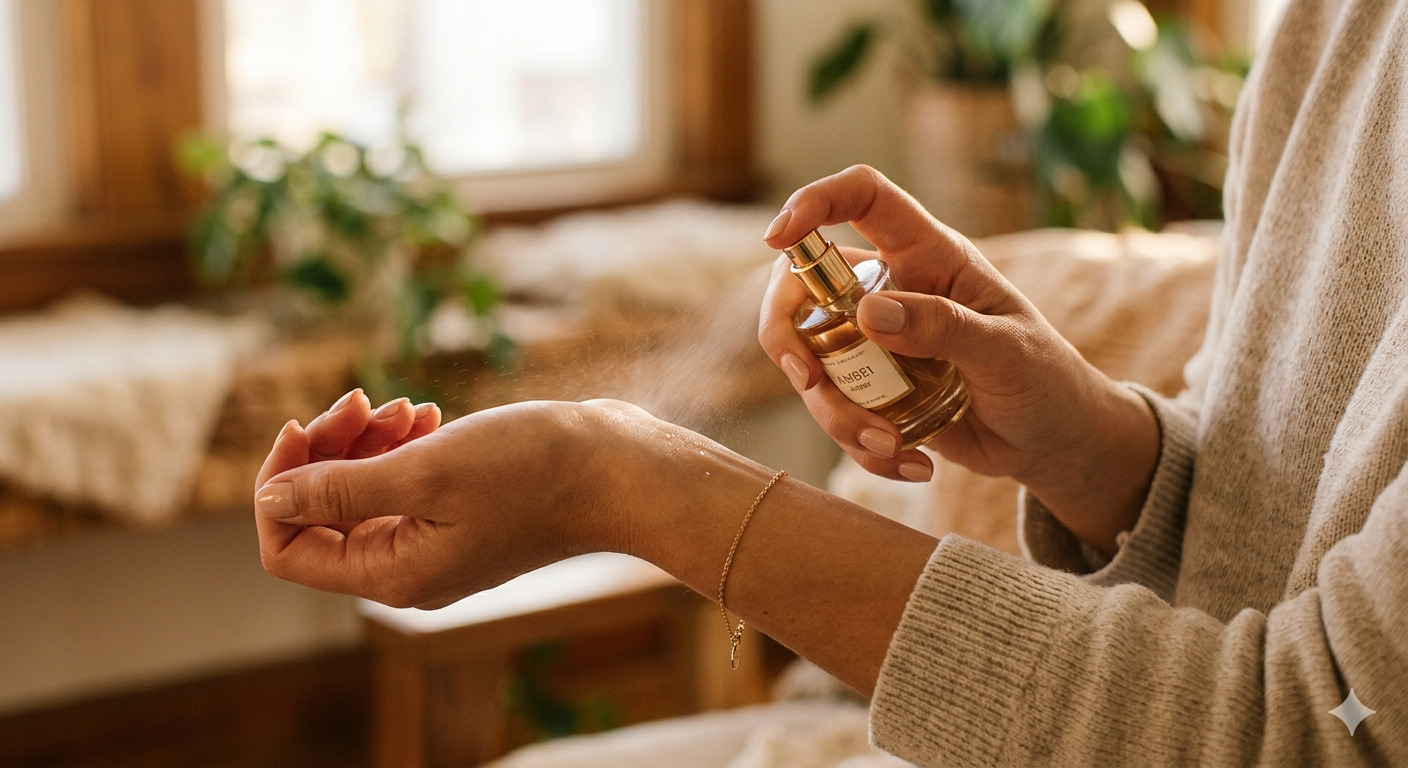
What you’ll learn:
- What a “signature scent” actually means and why it matters
- How fragrance families work so you can shop smarter
- How your skin chemistry changes the way a perfume smells on you
- Step-by-step strategies to test, try, and commit to your perfect scent
Introduction
You walk into a department store, hit a wall of 300 perfumes, spray three things on your wrist, and leave completely overwhelmed — buying nothing. Sound familiar? Finding your signature scent can feel like searching for a needle in a very fragrant haystack.
But here’s the thing: discovering how to find your signature scent doesn’t have to be a guessing game. With the right framework, it’s actually one of the most enjoyable personal style journeys you can go on. The global fragrance market is worth over $50 billion, which means there are thousands of options — but it also means the tools and language for navigating that world have never been more accessible.
Your signature scent is the fragrance that feels like you — the one that people associate with your presence, that you reach for without thinking, and that makes you feel complete as you head out the door.
Let’s dive in.
What Is a Signature Scent (and Do You Really Need One)?
Before we get into the how, let’s clear up the what. A signature scent isn’t just a perfume you like — it’s the fragrance that becomes part of your personal identity. It lingers on your scarves, gets recognized by your closest friends, and triggers memory in people who catch a whiff of it years later.
Psychologists have long documented the powerful link between smell and memory. Scent bypasses the rational brain and goes straight to the limbic system — the part of the brain that processes emotion and long-term memory. In practical terms, that means the right fragrance can make you feel confident, grounded, or instantly at ease.
Do you need a signature scent? No. Plenty of fragrance lovers rotate through a wardrobe of perfumes the way they rotate through outfits. But if you’ve never had a “go-to,” finding one can be transformative.
Signature Scent vs. Fragrance Wardrobe
A signature scent is your anchor — the one you wear most often, the one that represents you. A fragrance wardrobe is a collection you build around moods, seasons, and occasions. You can absolutely have both. But if you’re starting from scratch, finding that one core scent first gives you a reference point for everything that comes after.
Understanding Fragrance Families: The Map Before the Journey
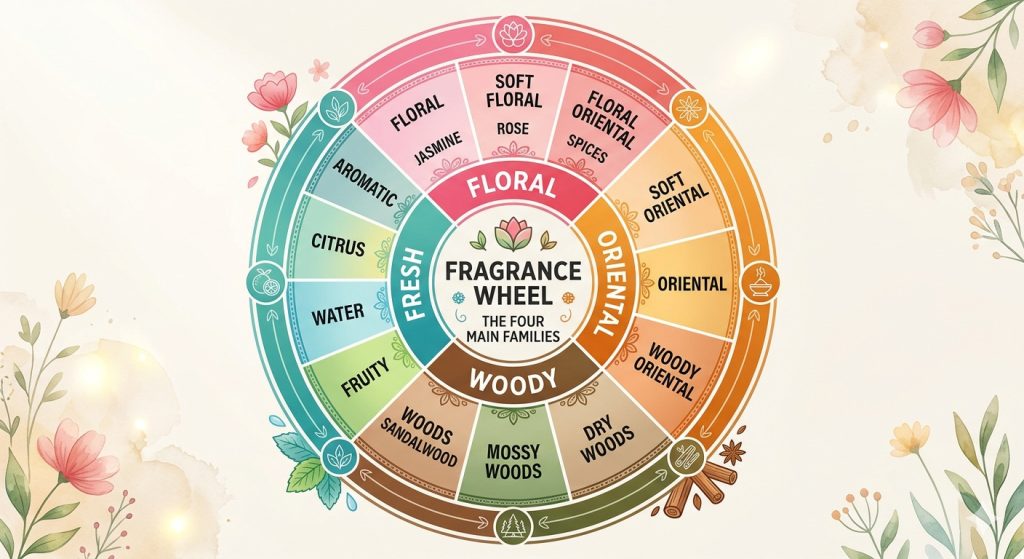
Shopping for perfume without knowing fragrance families is like walking into a restaurant without knowing whether you want Italian or Japanese. The fragrance wheel — developed by perfumer Michael Edwards in the 1980s — organizes all perfumes into four broad families, each with distinct character.
Floral
Florals are the most popular fragrance family in the world, and for good reason — they range from light and fresh to deep and intoxicating. Think rose, jasmine, peony, and lily of the valley. A soft floral like Chloé Eau de Parfum feels airy and romantic. A heady soliflore like Lancôme La Vie Est Belle leans richer and more enveloping.
Best for you if: You love the smell of a blooming garden, fresh-cut flowers, or warm floral candles.
Fresh / Citrus
Fresh fragrances are clean, bright, and immediately uplifting. They lean on citrus notes (bergamot, lemon, grapefruit), green notes (cut grass, cucumber), or aquatic elements that evoke ocean air. Acqua di Giò by Giorgio Armani is probably the world’s most recognizable fresh scent.
Best for you if: You gravitate toward light, clean scents — something that smells like just-showered skin or a breezy seaside morning.
Oriental / Amber
Rich, warm, and sensual, oriental fragrances lean on resins, vanilla, amber, musk, and spice. They last longest on skin and tend to project the most. Yves Saint Laurent Black Opium and Tom Ford Black Orchid live in this neighborhood.
Best for you if: You love warmth and depth, prefer perfumes that make a statement, and enjoy the idea of something that lingers.
Woody / Earthy
Woody fragrances are built on sandalwood, cedarwood, vetiver, oud, and patchouli. They feel grounded, sophisticated, and often gender-neutral. Le Labo Santal 33 became a cultural phenomenon in this family.
Best for you if: You love the smell of a forest, a wooden library, or aged leather.
How to Find Your Signature Scent: A Step-by-Step Process
Finding your perfect perfume isn’t a single trip — it’s a method. Here’s how to do it properly.
[IMAGE: A flatlay of fragrance testing strips, a small notebook, and a few mini perfume bottles on a marble surface]
1: Identify Your Scent Memories
Before you smell a single bottle, think backward. What smells do you already love in your life?
- Fresh laundry left in the sun? → Fresh/clean fragrances
- Warm vanilla desserts and baked goods? → Gourmand/oriental fragrances
- Walking through a pine forest? → Woody/green fragrances
- A flower market in spring? → Floral fragrances
- The ocean or rain on warm pavement? → Aquatic/fresh fragrances
Write down 3–5 smells that genuinely make you happy. This list is your compass.
2: Shop With Your Nose, Not Your Eyes
This might sound obvious, but most people pick perfume with their eyes — drawn in by the bottle design, the celebrity endorsement, or the brand name. Resist this. A stunning bottle means nothing if the scent doesn’t resonate with you.
At a fragrance counter, ask to smell the raw blotter first before spraying anything on skin. Spray on skin only when something genuinely interests you.
3: The Three-Skin-Spot Rule
Spray on the inside of your wrist, the inside of your elbow, and the back of your hand. Each area has slightly different warmth and skin texture, which can subtly change how a fragrance opens. Give it 10–15 minutes before making any judgment — let the top notes settle into the heart.
4: Never Test More Than Three Fragrances Per Visit
Your nose fatigues quickly. After three or four sprays, everything starts to smell the same. If you’re doing a serious scent hunt, visit fragrance counters like a slow ritual — two to three stops, no more. Come back rested on a different day for the next round.
5: The 24-Hour Test
Never buy on the day you first try something. Take a sample or discovery set home and wear it for a full day. Does it still smell beautiful six hours after application? Does it feel like you by evening? If yes, go back and buy the bottle.
6: Trust Your Gut (Not the Salesperson)
If you feel the urge to compliment a scent but wouldn’t want to wear it, that’s a gift fragrance, not a signature scent. Your signature should feel like slipping into your favorite sweater — immediately right.
5 Common Mistakes People Make When Choosing a Perfume
Avoiding these pitfalls can save you a lot of expensive trial and error.
1: Smelling the Bottle Cap, Not the Skin
Fragrance in the bottle is just alcohol and concentrate — it doesn’t smell the same way it will on your body. Always test on warm skin before buying.
2: Buying Because Someone Else Loves It
“My friend wears this and smells incredible” is not a reason to buy a perfume. Your body chemistry is completely unique. The same fragrance can smell like a warm caramel dream on one person and a medicinal mess on another — and that’s not a flaw, it’s biology.
3: Choosing Based on the Name or Bottle
“Midnight Velvet” sounds romantic. “Driftwood Soleil” sounds like a spa getaway. But marketing language has zero bearing on how a fragrance will smell. Let your nose decide, always.
4: Applying Too Much
More is not more with perfume. Two to three sprays on pulse points — wrists, neck, inner elbows — is almost always sufficient. Applying to over-moisturized skin (unscented lotion) actually helps the scent last longer without overdoing it.
5: Ignoring Longevity and Projection
A fragrance might smell gorgeous on first spray but disappear within 30 minutes — or vice versa, a deep oriental may last so long it becomes overpowering in a small meeting room. Pay attention to both the quality of the dry-down and the duration when evaluating a scent.
Expert Tips for Narrowing Down Your Signature Scent
Once you’ve tested a few families and found some favorites, these pro strategies help you land on the one.
Try a Discovery Set or Sample Service
Fragrance houses like Maison Margiela, Diptyque, Jo Malone, and Byredo all offer discovery sets — small samplers of their full range, usually $30–$60, often redeemable against a full bottle. This is the smartest investment in fragrance education you can make. Subscription services like Scentbird or Scentbox let you test one new perfume per month for a low monthly fee.
Research the Notes, Not Just the Name
Every perfume has three layers of notes: top notes (what you smell first, lasting 15–30 minutes), heart notes (the core character, lasting 2–4 hours), and base notes (the lingering dry-down that stays on skin for hours). When you find something you like, look up its notes on Fragrantica — a free fragrance database and community — and use those notes to search for similar perfumes.
Consider the Occasion and Season
Signature scents can absolutely shift with context. A bright citrus like Hermès Un Jardin Sur Le Nil feels perfect in summer; a warm amber like Guerlain Shalimar suits cold-weather evenings beautifully. Many people find a warm-weather signature and a cold-weather signature, and alternate seasonally.
Ask for Samples Boldly
Any reputable fragrance counter will give you samples if you ask. A few drops in a small vial let you wear the scent for two to three days — enough time to know if it’s really yours. Don’t feel shy about asking. Sampling before committing to a $150+ bottle is just good sense.
How Skin Chemistry Affects Your Signature Scent
This is one of the most underrated factors in fragrance, and it changes everything.
Your skin’s natural pH, hydration level, and even your diet can alter how a perfume smells on you versus on the paper blotter. Drier skin tends to absorb fragrance faster and project less. Oilier skin holds scent longer and amplifies it.
Hormones play a role too — many people notice their fragrance preferences shift during seasons of hormonal change. Temperature matters: warm skin activates fragrance molecules more aggressively, which is why a subtle perfume in winter can feel overwhelming in August heat.
The practical upshot: always trust how you smell wearing a perfume, not how it smells on someone else or on the blotter strip. A signature scent is a collaboration between the fragrance and your skin.
Finding Your Signature Scent: A Warm Recap
So, how do you find your signature scent from scratch? You start by knowing yourself — your scent memories, your lifestyle, your mood. Then you educate your nose on fragrance families. You sample slowly, test on skin, and give your top candidates a full 24 hours before deciding.
You avoid the traps: no impulse buying, no letting bottle design or celebrity marketing make the call for you, no testing when your nose is tired.
And when the right fragrance lands? You’ll know. There’s a specific feeling — somewhere between recognition and delight — when a scent just clicks. It feels like it was always yours.
The world of fragrance is extraordinary. It is one of the last art forms that can’t be rushed or outsourced. Take your time, explore with curiosity, and enjoy every step of the process.
Conclusion
Finding your signature scent is one of the most personal and rewarding things you can do for your sense of style. It requires no fashion knowledge, no makeup skills — just a willingness to slow down and smell. Armed with an understanding of fragrance families, skin chemistry, and a tested strategy for sampling, your perfect perfume is closer than you think.
Whether you end up with a timeless floral, a bold woody oriental, or a quietly stunning citrus, the best signature scent is simply the one that makes you feel like the most authentic version of yourself every time you wear it.
Did you find this helpful? Drop a comment below or share this with a fellow fragrance lover!
Frequently Asked Questions
Q1: How do I know if a fragrance is right for me as my signature scent? A: A true signature scent feels immediately comfortable and right — not just pleasant, but personal. You should want to wear it every day, not just on special occasions. Wear a sample for at least 24 hours before deciding. If you keep reaching for it and feel like yourself when you wear it, you’ve found your match.
Q2: How many sprays of perfume should I apply to make it last all day? A: Two to three sprays on pulse points — wrists, inner elbows, or the base of your neck — is ideal for most Eau de Parfum concentrations. Applying to lightly moisturized skin (with an unscented lotion) helps the fragrance last noticeably longer without needing to reapply constantly.
Q3: Can my signature scent change over time? A: Absolutely. Fragrance preferences often evolve with age, lifestyle changes, and even seasons. Many people who loved light florals in their twenties find themselves drawn to deeper, richer woods and ambers later in life. Think of your signature scent as something that grows with you — not a lifelong commitment.
Q4: What’s the difference between Eau de Parfum and Eau de Toilette? A: The difference is fragrance concentration. Eau de Parfum (EDP) contains roughly 15–20% fragrance oil, making it longer-lasting and more intense. Eau de Toilette (EDT) contains around 5–15%, making it lighter and more fleeting. For a signature scent you want to last through the day, EDP is usually the better choice.
Q5: Is it okay to wear the same perfume every single day? A: Yes — that’s precisely what a signature scent is for. Wearing a fragrance daily can actually cause temporary olfactory fatigue (you stop noticing it), but the people around you will still catch it beautifully. If you worry about going nose-blind to your own scent, occasional breaks or a complementary second scent can help.
Q6: Where are the best places to buy perfume samples before committing to a full bottle? A: Discovery sets from the brand itself are a great start — Diptyque, Jo Malone, Byredo, and Maison Margiela all offer them. Fragrance subscription services like Scentbird provide monthly samples. For rare or niche fragrances, Fragrantica’s community often links to decant sellers. Department store counters will give you samples free if you ask.

Pingback: How to Find Your Signature Scent From Scratch - Fragrantip