What you’ll learn
- The official definition of a fragrance family and why it matters for your signature scent journey.
- A detailed breakdown of the four primary scent families: Fresh, Floral, Oriental, and Woody.
- How to use the famous Michael Edwards Scent Wheel to decode any perfume instantly.
- Practical, step-by-step tips to identify your personal fragrance preferences and shop smarter.
Introduction
Walking into a luxury perfume boutique can feel incredibly overwhelming. Row after row of glittering glass bottles promise different sensory experiences, yet everything starts to blend together after three sniffs. You might find yourself drawn to a crisp, summery citrus scent one day, only to fall in love with a rich, smoky vanilla the next.
If you want to master the art of choosing the perfect perfume, you need to ask one fundamental question: What is a fragrance family? Understanding this concept is the ultimate shortcut to finding scents you love without wasting hundreds of dollars on blind buys.
Once you learn how perfumes are grouped, you can decode any fragrance label on the market with total confidence. Let’s dive in.
The Origin and Importance of Fragrance Families
To truly understand perfume, we have to look at how the modern fragrance industry organizes its creations. The global perfume market, valued at over $48 billion, relies on a standardized classification system to help consumers and perfumers communicate.
A fragrance family is simply a classification system that groups scents based on their dominant olfactory characteristics. Think of it like music genres. Just as you can group songs into rock, jazz, pop, or classical based on their instruments and rhythms, perfumes are grouped by their core aromatic ingredients and structural vibes.
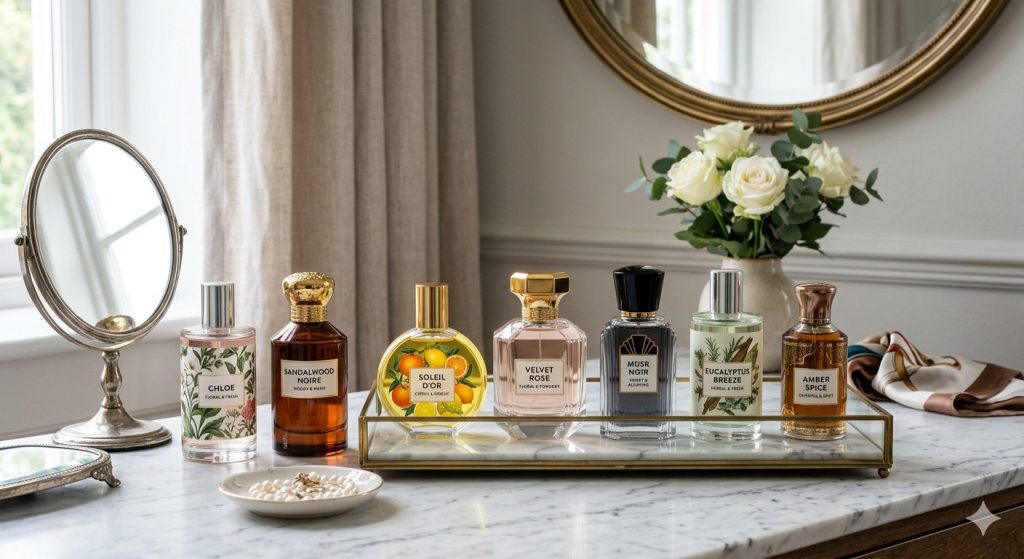
Historically, the concept of formal scent classification gained massive traction in 1983. Olfactory expert Michael Edwards introduced the Fragrance Wheel, a revolutionary tool that changed how the world categorizes perfume. This wheel mapped out the relationships between different scent notes, creating a universal language for fragrance lovers globally.
Breaking Down the Four Primary Fragrance Families
The entire universe of perfume sits upon four foundational pillars. Every single scent you encounter, from cheap drugstore body sprays to ultra-exclusive niche extraits, belongs to one of these core groups. Let’s look at each primary family in detail.
The Fresh Fragrance Family
The Fresh family is the most vibrant, uplifting, and energetic category in perfumery. If you love the smell of sliced lemons, cut grass, or a crisp ocean breeze, this family is your spiritual home. Fresh scents are incredibly versatile and excel during warm spring and summer days.
Within this category, you will find several distinct sub-families. Citrus scents utilize zesty notes like bergamot, grapefruit, and green mandarin. Green sub-families smell like crushed leaves, galbanum, and morning dew. Water or aquatic notes mimic the clean, salty air of the coastline, often using a synthetic molecule called Calone to capture that marine magic.
Famous examples of Fresh fragrances include Dolce & Gabbana Light Blue, Davidoff Cool Water, and the iconic Acqua di Parma Colonia. These scents feel breezy, clean, and effortlessly casual.
The Floral Fragrance Family
The Floral family is arguably the most popular and expansive category in the entire perfume industry. It captures the essence of blooming flowers, ranging from light, powdery single-note creations to rich, heady bouquets. Floral perfumes are traditionally associated with feminine fragrances, though modern perfumery is beautifully breaking down these gender barriers.
Standard florals focus on classic notes like romantic rose, delicate jasmine, lily of the valley, and peony. If you prefer something softer, the soft floral sub-family incorporates powdery notes like iris, musk, and violet, which mimic the comforting scent of luxury face powder.
For a classic floral experience, look no further than Dior J’adore, Chanel No. 5 (with its sparkling, soapy aldehydes), or Gucci Bloom. These fragrances evoke elegance, romance, and timeless sophistication.
The Oriental (Amber) Fragrance Family
Rich, sensual, and unapologetically bold, the Oriental family—increasingly referred to as the Amber family—is all about warmth and spice. These fragrances are highly concentrated, long-lasting, and absolutely perfect for cozy winter nights or glamorous evening events.
The defining notes of an amber fragrance include sweet vanilla, warm cinnamon, cardamon, benzoin, and resinous incense. When combined with floral notes, they create “Soft Oriental” scents like orange blossom mixed with nutmeg. When mixed with heavy spices, they become deep, mysterious powerhouses.
If you want to explore this opulent family, smell Yves Saint Laurent Black Opium, Tom Ford Tobacco Vanille, or the legendary Guerlain Shalimar. They are sweet, spicy, exotic, and incredibly comforting.
The Woody Fragrance Family
The Woody family is grounded, earthy, and deeply sophisticated. These perfumes evoke the aroma of a dense forest, dry sawdust, or a crackling campfire. Woody fragrances provide incredible depth and longevity, which is why they are frequently used as base notes across all perfume genres.
Key players in the woody category include creamy sandalwood, sharp cedarwood, earthy patchouli, and smoky vetiver. Mossy woods introduce damp, green oakmoss into the mix, creating the classic “Chypre” accord, while dry woods often lean into leathery, charred, and tobacco-like aromas.
Timeless examples of the Woody family include Maison Margiela Replica By the Fireplace, Chanel Bleu de Chanel, and the cult-favorite Le Labo Santal 33. They feel steady, confident, and textured.
How to Find Your Signature Fragrance Family
Now that you can answer the question, “what is a fragrance family,” it is time to apply this knowledge to your own vanity. Finding your signature profile does not have to involve endless trial and error. Follow this step-by-step guide to narrow down your preferences.
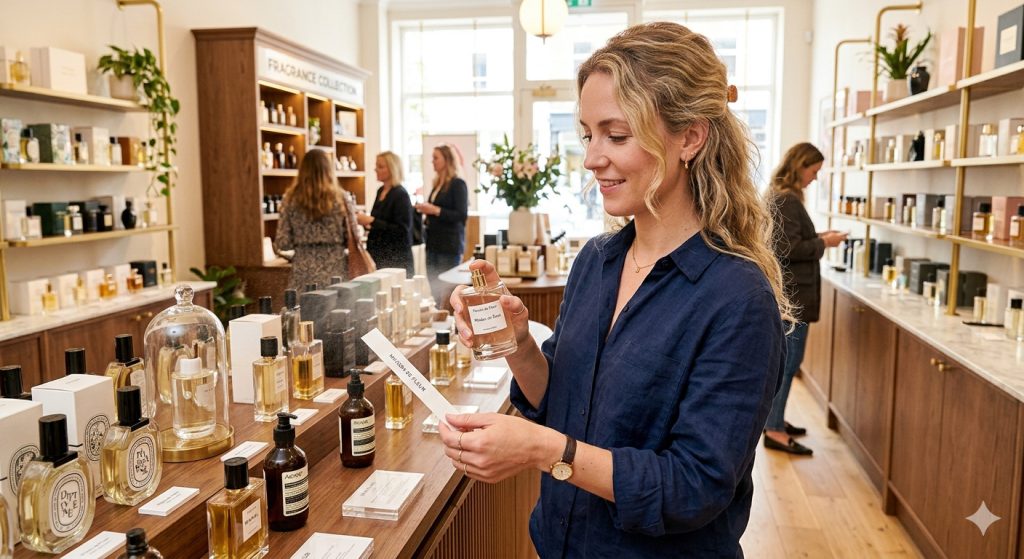
- Audit your real-world scent preferences: Look around your home. What scented candles do you burn? What does your favorite shower gel smell like? If you love lavender and eucalyptus candles, you lean toward Fresh or Floral. If you love vanilla or pumpkin spice plug-ins, Amber is your lane.
- Decode your current collection: Line up any perfumes you currently own and enjoy. Look them up on a database like Fragrantica. Note which family they belong to. You will likely see a clear pattern emerge among your favorites.
- Test across the wheel: When visiting a store, pick one fragrance from each of the four main families. Spray them on separate paper strips, write the names down, and take them home. Sniff them over 24 hours to see how they evolve.
- Test on skin: Never buy a bottle based on a paper strip alone. Chemistry alters how notes develop. Spray your top choice on your wrist, wear it for a full day, and see how the dry-down treats your skin.
Common Myths About Perfume Categories
The world of scent is filled with misinformation that can confuse beginners. Let’s bust a few common myths so you can shop with clarity.
1: Floral scents are only for women, and Woody scents are only for men. This is entirely marketing. Fragrance notes do not have a gender. Some of the most stunning modern masculine fragrances feature heavy rose and iris notes, while many women rock deep, smoky cedarwood and vetiver profiles. Wear what makes you feel fantastic.
Another massive misconception is that a perfume only contains notes from its designated family. In reality, a perfume is a complex tapestry. A fragrance classified as a “Woody Amber” will have fresh citrus top notes to open the scent, floral heart notes to give it body, and a heavy woody-amber base that lingers for hours. The classification simply tells you what the fragrance smells like for the majority of its lifespan.
Pro Tips for Navigating Fragrance Shopping Like an Expert
To truly elevate your scent game, you must understand how concentration affects the fragrance family experience. The concentration of perfume oil changes how intense a scent profile feels on your skin.
An Eau de Cologne (EDC) has about 2-4% oil, making it ideal for the volatile, fast-evaporating notes of the Fresh family. Conversely, an Eau de Parfum (EDP) boasts 15-20% oil concentration, which allows heavy Amber and Woody notes to project beautifully for eight hours or more. Keep this in mind when matching your chosen family to the right occasion.
When you are ready to expand your collection further, consider learning about [how to layer perfumes effectively]. By layering a simple Fresh citrus scent over a heavy Woody base, you can create a completely customized, bespoke fragrance family of your own.
Final Recommendations for Your Scent Journey
Navigating the world of perfumery becomes an absolute joy once you possess the right vocabulary. You are no longer guessing blindly in the department store aisle; you are hunting for specific olfactory experiences.
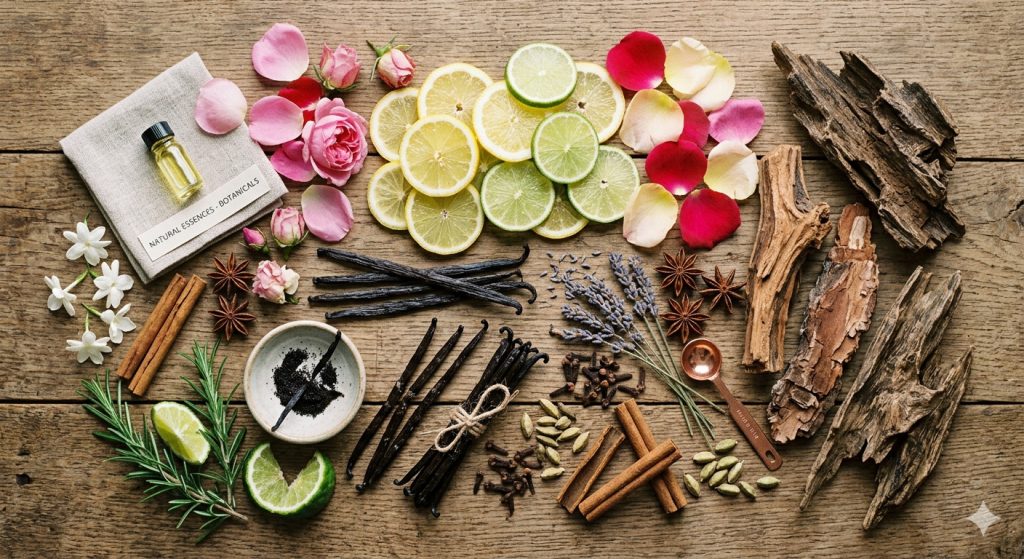
If you are a complete beginner, we recommend starting your collection with two contrasting bottles. Pick up a bright, uplifting fragrance from the Fresh or Floral family for daytime wear, casual outings, and warm weather. Then, invest in a richer, deeper bottle from the Amber or Woody family for evenings, special dates, and colder months. This simple strategy gives you a versatile wardrobe for any scenario.
Conclusion
Demystifying the question, “what is a fragrance family,” is the ultimate key to unlocking your personal style. Fragrance is a powerful form of invisible communication. It evokes memories, boosts your confidence, and leaves a lasting impression on everyone you meet.
By understanding the unique traits of Fresh, Floral, Amber, and Woody scents, you can curate a beautiful fragrance wardrobe that truly represents who you are. Take your time, sample broadly, and enjoy the beautiful process of exploring new scents.
Did you find this helpful? Drop a comment below or share this with a fellow fragrance lover!
Frequently Asked Questions
Q1: What is a fragrance family exactly? A: A fragrance family is a formal classification system used by the perfume industry to group scents based on their dominant olfactory characteristics. The system divides all scents into four main categories: Fresh, Floral, Oriental (Amber), and Woody. These families help consumers predict what a perfume smells like before spraying it.
Q2: Can a perfume belong to more than one fragrance family? A: Yes, absolutely. Most modern perfumes are cross-categorical blends. Perfumers combine elements from different groups to create complex scents, resulting in hybrid sub-families. For example, a perfume can be classified as a “Floral Woody Musk” or a “Fresh Citrus,” meaning it bridges the gap between two distinct worlds.
Q3: Why does the same fragrance smell different on different people? A: This happens because of your unique skin chemistry. Factors like your skin’s pH level, oiliness, diet, skin temperature, and even the medications you take interact with the perfume oils. A woody scent might dry down sweet on one person but turn intensely smoky on another.
Q4: What is the rarest fragrance family profile? A: Pure, authentic Chypres and traditional Fougeres are rarer in modern mainstream releases. True Chypres rely heavily on natural oakmoss, which faces strict raw-material restrictions today due to allergy regulations. Modern perfumers use clever synthetic alternatives to recreate these classic, mossy, sophisticated vibes.
Q5: How many sub-families exist within the Fragrance Wheel? A: While the four primary families remain constant, Michael Edwards’ official Fragrance Wheel breaks those categories down into 14 distinct sub-families. These include specific variations like Fruity, Green, Water, Soft Floral, Floral Amber, Woody Amber, and Dry Woods, offering highly precise descriptions.
Q6: Does the color of the perfume liquid indicate its fragrance family? A: Often, yes! While not a strict rule, brands use juice color as a visual cue. Pale blue, green, or clear liquids usually signify Fresh or Aquatic scents. Soft pink or lilac tones generally represent Florals. Deep gold, amber, or brown liquids almost always point to rich Amber or Woody formulations.
Leave a Reply