
What you’ll learn:
- Why some perfumes disappear within an hour while others linger until bedtime
- How top, heart, and base notes evaporate at different speeds
- The role your skin, weather, and fragrance concentration play in longevity
- Simple, science-backed ways to make any scent last longer
Introduction
You spritz your favorite perfume in the morning, and by lunchtime, it’s gone. Meanwhile, your friend’s signature scent seems to follow her into every room, hours after she applied it. If you’ve ever asked why perfume fades fast while another bottle seems to last forever, the answer isn’t luck — it’s chemistry.
Fragrance is a delicate balance of molecules, each with its own evaporation rate, weight, and relationship with your skin. Understanding that balance changes how you shop, apply, and even store your perfume.
In this guide, we’re breaking down exactly what happens on a molecular level when perfume meets skin — and why that determines whether your scent lasts three hours or twelve. Let’s dive in.
Why Fragrance Longevity Actually Matters
Longevity isn’t just a nice bonus — it’s often the deciding factor between a fragrance you love and one you regret buying. A bottle that fades within an hour can feel like wasted money, especially with niche perfumes often priced well above $150.
The global fragrance market is projected to surpass $80 billion by the late 2020s, and longevity is consistently one of the top three concerns cited by shoppers before purchase, right alongside scent profile and price.
Understanding fragrance longevity, sometimes called “scent throw” or “sillage” in perfume circles, helps you choose smarter and get more value from every bottle.
The Science Behind How Scents Evaporate
At the heart of every fragrance is volatility — a fancy word for how quickly a molecule turns from liquid into vapor. This single property explains almost everything about why perfume fades fast or clings to your skin for hours.
Top, Heart, and Base Notes Explained
Every fragrance is built in three layers, often called the fragrance pyramid.
Top notes are the lightest, smallest molecules — think citrus, bergamot, or light herbs. They evaporate almost immediately, which is why your first impression of a perfume fades within 15 to 30 minutes.
Heart notes, sometimes called middle notes, are heavier compounds like florals or spices. They emerge as the top notes fade and typically last one to three hours, forming the “true” character of the scent.
Base notes are the heaviest, slowest-evaporating molecules — woods, musks, resins, and amber. These are what you smell hours later, and they’re the main reason some perfumes last well into the evening.
Molecular Weight Is the Real MVP
Smaller, lighter molecules like citrus terpenes evaporate quickly because they need less energy to turn into vapor. Heavier molecules like sandalwood or oud compounds have a much higher boiling point, so they release slowly over time.
This is why a citrus cologne fades fast by design — it’s built almost entirely from top notes with little heavy base material to anchor it.
Concentration Changes Everything
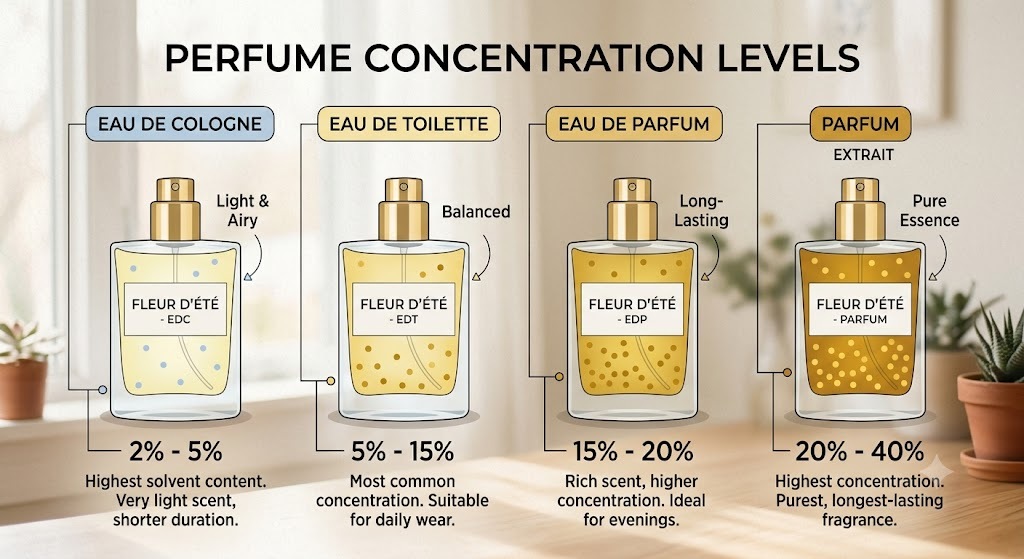
The percentage of aromatic oils in a bottle massively affects how long it lasts. Eau de cologne typically contains 2–4% oil concentration, eau de toilette sits around 5–15%, and eau de parfum ranges from 15–20%. Pure parfum or extrait de parfum can exceed 20%, which is why a few drops often outlast a full spray of EDT.
Brands like Chanel and Tom Ford often release the same fragrance in multiple concentrations for exactly this reason — to give wearers control over intensity and staying power.
How to Make Any Perfume Last Longer
Even a fast-fading fragrance can be coaxed into lasting longer with the right technique.
- Moisturize before spraying. Dry skin has fewer oils to trap fragrance molecules, so scent evaporates faster on parched skin.
- Apply to pulse points. Wrists, neck, and behind the ears generate warmth, which helps release the scent gradually rather than all at once.
- Don’t rub your wrists together. Rubbing breaks down top-note molecules through friction and heat, causing them to fade faster.
- Layer with matching products. Using a scented body lotion or oil underneath creates a base that holds the fragrance longer.
- Store perfume away from light and heat. UV exposure and temperature swings degrade fragrance molecules over time, weakening both scent and longevity.
- Target hair carefully. Hair holds fragrance beautifully, but alcohol-based sprays can dry out strands, so a light mist from a distance works best.
Common Mistakes That Make Perfume Fade Faster
Even fragrance lovers fall into habits that quietly sabotage longevity.
Spraying only on clothes. Fabric doesn’t hold onto fragrance oils the way warm skin does, so scent dissipates faster and unevenly.
Storing perfume in the bathroom. Steam and humidity accelerate the breakdown of fragrance molecules, shortening a bottle’s shelf life and daily performance.
Assuming more sprays equal more longevity. Over-application can actually cause “nose blindness,” where you stop smelling your own perfume even though others still can.
Ignoring skin type. Oily skin tends to hold fragrance longer, while dry skin causes faster evaporation — a detail most people never adjust for.
Buying based on the in-store strip alone. Paper testers don’t interact with skin chemistry or body heat, so they can’t accurately predict real-world longevity.
Expert Tips for Choosing Long-Lasting Fragrances
If longevity matters most to you, shop with intention. Look for fragrances built around heavy base notes like oud, amber, vanilla, or musk — these compounds naturally resist evaporation.
Perfumers often add fixatives, ingredients like ambroxan or iso e super, specifically to slow down the release of lighter notes and extend wear time. Fragrances marketed as “extrait” or “parfum” strength are formulated with this longevity in mind from the start.
Testing on skin — not paper — for at least four hours before buying is the single most reliable way to judge true performance.
Final Takeaways on Scent Longevity

The difference between a fragrance that fades fast and one that lasts all day comes down to molecular weight, concentration, and how you apply it. Lighter top notes vanish quickly by design, while heavier base notes are built to endure.
Once you understand this chemistry, you can shop smarter, test more accurately, and get far more wear time out of every bottle you own.
Conclusion
Fragrance longevity isn’t magic — it’s molecular science playing out on your skin in real time. From the fleeting brightness of top notes to the slow-burning warmth of base notes, every stage of a perfume’s life is dictated by evaporation rate, concentration, and how you apply it.
Now that you understand why perfume fades fast on some skin and lingers on others, you can make smarter choices at the counter and get noticeably more mileage from every spray.
Did you find this helpful? Drop a comment below or share this with a fellow fragrance lover!
Frequently Asked Questions
Q1: Why does my perfume fade fast even though it smells strong in the bottle? A: Fragrance smells strongest in the bottle because concentrated vapor is trapped inside. Once sprayed, lighter top-note molecules evaporate quickly, especially on dry skin or in warm weather, which is why the scent seems to disappear faster than expected.
Q2: Does higher concentration always mean longer-lasting perfume? A: Generally, yes. Eau de parfum and parfum concentrations contain more aromatic oil than eau de toilette or cologne, so they release scent more slowly and last longer, though individual skin chemistry can still cause variation.
Q3: Why does the same perfume last longer on one person than another? A: Skin pH, oil production, hydration levels, and even diet affect how fragrance molecules bind and evaporate. Oily, well-moisturized skin typically holds scent longer than dry skin.
Q4: Should I reapply perfume during the day if it fades? A: Light reapplication on pulse points is fine, but layering with a matching lotion beforehand usually extends wear more effectively than repeated spraying.
Q5: Does storing perfume in the fridge make it last longer on skin? A: Refrigeration can slightly slow ingredient degradation over time, but it won’t change how long the scent lasts once applied to skin — that depends on the fragrance’s own molecular makeup.
Q6: Are natural perfumes less long-lasting than synthetic ones? A: Often, yes. Many natural essential oils evaporate faster than lab-created fixative molecules like ambroxan, which is why synthetic components are commonly used to extend wear time in modern perfumery.