


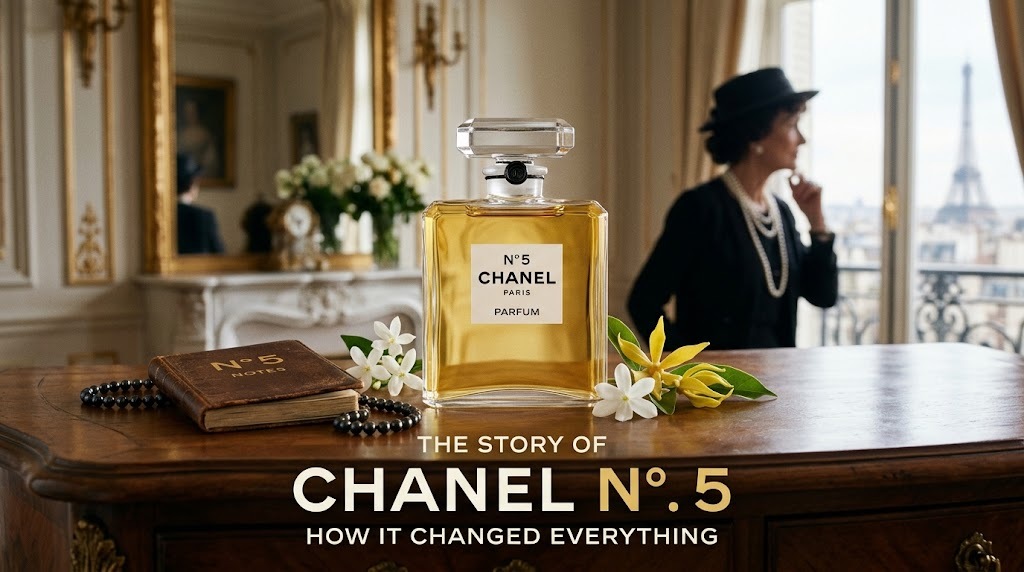
What you’ll learn
- How Gabrielle “Coco” Chanel broke 1920s social rules to invent a revolutionary synthetic-natural scent profile.
- The secret behind Ernest Beaux’s heavy accidental dose of aldehydes that created its sparkling, golden aura.
- Why the minimal, glass flask bottle design shattered ornate Victorian perfume aesthetics overnight.
- Practical wearing techniques to preserve, layer, and experience the modern formulation at its absolute best.
Introduction
Picture entering a high-end boutique in Paris during the roaring 1920s, where heavy, single-flower perfumes dominated every shelf. The story of Chanel No. 5 begins in this exact landscape of predictable, overly sweet floral waters. Gabrielle “Coco” Chanel wanted something radically different—a scent that smelled like a constructed composition rather than a simple rose or solitary jasmine bud.
When perfumer Ernest Beaux presented his experimental samples in 1921, the fifth glass vial contained a breathtaking, sparkling overdose of synthetic aldehydes. That single formulation changed the course of fragrance history forever. Today, industry estimates confirm that a bottle of this legendary elixir sells somewhere in the world every 30 seconds, generating hundreds of millions in global annual revenues.
It remains the ultimate benchmark for luxury, elegance, and olfactory daring. Whether you own a classic bottle or are simply curious about fragrance origins, understanding its journey reveals how modern perfumery was born. Let’s dive in.
The Birth of a Revolution: Fragrance Before 1921
To truly appreciate the story of Chanel No. 5, one must understand how rigid the perfume world was at the turn of the 20th century. Women were strictly divided by societal norms into specific olfactory categories. Respectable high-society women wore simple, light single-floral scents like violet, rose, or lily of the valley.
Meanwhile, heavier animalic musks, rich amber resin, and provocative jasmine oils were reserved exclusively for courtesans and bohemian artists. Coco Chanel despised these rigid societal boundaries. She envisioned a clean, complex, and liberated fragrance that embodied the modern, independent woman of the 1920s.
She sought a scent that wouldn’t fade into the background after an hour. She wanted a multi-layered profile that projected confidence, warmth, and pristine sophistication.


The Vision of Coco Chanel
Gabrielle Chanel was already disrupting women’s fashion by ditching painful corsets for comfortable jersey fabrics and tailored trousers. She viewed perfume as an essential, invisible accessory that should complement her rebellious fashion philosophy.
Her goal was to create “a woman’s perfume with the scent of a woman”—something abstract, clean, and impossible to pin down to a single flower garden.
She required a master artist to bring this vision to life. That artist was Ernest Beaux, a former French-Russian perfumer to the Tsars who had escaped the Russian Revolution.
The Legendary Creation in Grasse
In late 1920, Chanel and Ernest Beaux met in Côte d’Azur near Grasse, the historic perfume capital of France. Beaux began experimenting with complex formulas, combining rare natural ingredients with innovative chemical compounds known as aldehydes.
Aldehydes are synthetic organic compounds that boost natural floral notes, giving them an airy, effervescent quality akin to champagne bubbles or crisp winter air.
Beaux prepared ten glass sample vials numbered 1 through 5 and 20 through 24 for Chanel to evaluate in his laboratory.
Deconstructing the Masterpiece: How Ernest Beaux Built the Formula
When Coco Chanel sampled vial number five, she immediately selected it without hesitation. The story of Chanel No. 5 holds that a laboratory assistant may have inadvertently added an unprecedented dose of aldehydes to that specific test batch.
Whether a lucky accident or deliberate genius, that high concentration of aldehydes transformed a traditional floral accord into a shimmering, abstract masterpiece.
The fragrance opened up with an unmistakable burst of crisp, clean energy before settling into a creamy, luxurious heart.


The Shimmering Top Notes: Aldehydes and Citrus
The initial spray delivers a brilliant rush of aliphatic aldehydes mixed with sparkling Italian bergamot, neroli, and fresh lemon. This opening creates a soapy, clean, and icy atmosphere that instantly commands attention.
Unlike traditional perfumes of the era that smelled immediately like crushed petals, No. 5 creates an abstract veil of pure brightness.
This airy opening acts like a spotlight, lifting the heavier floral heart notes into a multidimensional, radiant projection.
The Rich Floral Heart: May Rose and Jasmine
At the core of the composition lies an extravagant bouquet of May rose (Rosa centifolia) and rare jasmine harvested from the sun-drenched fields of Grasse, France.
Chanel insisted on using the absolute highest quality natural harvests available, complemented by delicate ylang-ylang from the Comoros Islands and powdery iris.
This dense floral heart balances the synthetic sharpness of the top notes, adding lush depth, romance, and opulent texture to the skin.
The Warm, Sensual Base: Vetiver and Sandalwood
As the floral heart slowly evolves over hours, the fragrance settles into an enduring, seductive dry-down. Warm Mysore sandalwood, earthy Haitian vetiver, creamy vanilla, and soft amber anchor the composition.
In its original formulation, natural civet and musk provided an intoxicating, intimate warmth that lingered on clothes for days.
Modern iterations utilize sustainable, cruelty-free synthetic musks that maintain this legendary warmth while honoring modern ethical sourcing standards.
Deciphering the Icon: The Bottle, the Name, and the Strategy
Every element of this perfume was designed to break the rules of its era. Beyond the revolutionary liquid itself, the naming convention and packaging strategy shattered conventional retail norms.
While competitors used elaborate crystal bottles with ornate filigree, Chanel chose extreme minimalism inspired by laboratory flasks and whiskey decanters.
This clean, rectangular glass bottle placed the golden liquid front and center, signaling pure modernism and effortless luxury.
The Magic of the Number Five
When Beaux asked Chanel what she intended to name the perfume, her answer was characteristically direct and pragmatic. “I show my collection on the fifth day of the fifth month, May 5th,” she replied. “We will let this fifth sample keep the name it has; it will bring good luck.”
The simple, numeric name was a brilliant marketing stroke. It required no translation across global markets and felt sleek, memorable, and avant-garde.
The number five became Coco Chanel’s personal lucky charm, embedded forever into her fashion house’s DNA.
Unconventional Marketing and Word-of-Mouth Surprises
Chanel did not launch the fragrance with a traditional ad campaign. Instead, she invited Ernest Beaux and a group of influential high-society friends to an upscale restaurant in Cannes to celebrate.
She quietly sprayed the perfume around the table. Passing women instantly stopped to inquire about the mysterious, intoxicating scent wafting through the dining room.
She gifted early bottles exclusively to elite socialites, creating an immediate aura of scarcity, desire, and word-of-mouth obsession across Europe.
The Cultural Impact: From Marilyn Monroe to Pop Art History
The cultural footprint of this fragrance extends far beyond the beauty counter. During World War II, American soldiers queued for hours outside the Chanel boutique on Rue Cambon in Paris to bring bottles home to their sweethearts.
In 1952, when an interviewer asked Marilyn Monroe what she wore to bed, her candid response became immortalized: “Just a few drops of Chanel No. 5.”
That single quote cemented the fragrance as the ultimate symbol of glamour, intimacy, and timeless Hollywood allure.


Later, pop artist Andy Warhol celebrated the perfume’s legendary bottle design in a famous 1985 series of silk-screen prints, placing it alongside Campbell’s soup cans as a definitive icon of American consumer culture.
Over the decades, cinematic ad campaigns directed by visionaries like Baz Luhrmann and starring icons like Nicole Kidman, Catherine Deneuve, and Marion Cotillard have kept the brand at the peak of global fashion relevance.
How to Wear and Preserve Chanel No. 5 Today
Owning a bottle of this historic elixir is an experience every fragrance enthusiast should savor. However, because aldehydes and natural floral absolutes are sensitive to environmental factors, proper application and storage are crucial.
Follow these proven steps to maximize performance, longevity, and freshness:
- Store in a cool, dark place: Keep your bottle away from direct sunlight, humidity, and temperature fluctuations. Avoid storing it in warm bathrooms; a bedroom vanity drawer or dedicated cabinet is ideal.
- Moisturize your skin first: Fragrance molecules evaporate rapidly on dry skin. Apply an fragrance-free body lotion or the matching Chanel No. 5 body cream before spraying to lock in the scent notes.
- Target key pulse points: Spray twice on warm pulse zones—such as the inner wrists, base of the neck, and behind the earlobes—where blood circulation naturally diffuses the scent upwards.
- Never rub your wrists together: Rubbing creates friction and heat that break down delicate top-note aldehydes prematurely, altering the intended opening profile.
- Layer with matching body products: Utilize the bath soap, body lotion, or hair mist from the line to create a subtle, all-day fragrance aura that trails elegantly behind you.
If you enjoy discovering new fragrance layering techniques and iconic scent guides, explore our full collection of to elevate your daily routine.
4 Common Myths About Chanel No. 5 Busted
Despite its global fame, several persistent misconceptions continue to swirl around this historic creation. Let’s clear up the confusion with clear facts.
- 1: It is strictly an “old lady” perfume.Fact: While its powdery aldehyde opening can feel vintage to young noses accustomed to sugary gourmet scents, its complex, woody-floral dry-down remains deeply sophisticated, unisex, and timeless when applied with a light hand.
- 2: The current formula is identical to the 1921 original.Fact: Due to evolving IFRA industry regulations regarding natural ingredients like oakmoss, civet, and nitro-musks, the modern formulation has been carefully adjusted by house perfumers while preserving the original scent profile.
- 3: Perfume never expires if kept sealed.Fact: Citrus and aldehyde top notes naturally degrade over time due to oxidation. Proper storage extends a bottle’s life for many years, but natural oils inevitably shift after a decade.
- 4: You can wear it the same way in all seasons.Fact: Heavy aldehyde and floral accords project intensely in hot, humid weather. The Eau de Parfum performs best in cooler autumn and winter months, while lighter concentration flankers excel during spring.
Which Concentration Should You Choose?
Understanding the subtle differences between available concentrations ensures you select the perfect bottle for your personal preference and lifestyle.
| Concentration | Fragrance Oil % | Key Characteristics | Best Occasion |
| Parfum (Extrait) | 20% – 30% | Deep, rich, intimate projection; heavy on Grasse jasmine and May rose absolutes. | Formal evening events, romantic dinners |
| Eau de Parfum (EDP) | 15% – 20% | Created in 1986 by Jacques Polge; prominent aldehyde opening with strong projection. | Daily signature wear, cooler seasons |
| Eau de Toilette (EDT) | 10% – 15% | Lighter, brighter, and more wood-forward with pronounced vetiver and neroli notes. | Daytime wear, office environments |
| L’Eau | 5% – 10% | Modern 2016 interpretation by Olivier Polge; crisp citrus-forward with airy florals. | Casual summer wear, younger scent lovers |
Summary of Legacy and Key Takeaways
The story of Chanel No. 5 is far more than a tale of a successful luxury product; it is the founding narrative of modern synthetic-natural perfumery.
By taking a daring risk on synthetic aldehydes, Coco Chanel and Ernest Beaux proved that a perfume could be an abstract work of high art rather than a simple imitation of nature.
Its timeless combination of sparkling top notes, opulent Grasse florals, and warm sandalwood continues to set the gold standard for elegance over a century later.
Conclusion
From its rebellious origins in a Grasse laboratory to its status as an immortal cultural artifact, the story of Chanel No. 5 demonstrates the incredible power of olfactory innovation. It transformed how perfumes were formulated, packaged, marketed, and experienced by women across the globe.
Whether you wear the rich Eau de Parfum on special occasions or prefer the breezy freshness of No. 5 L’Eau for daily wear, applying this legendary scent connects you directly to over one hundred years of pure luxury history.
Did you find this history helpful? Drop a comment below with your personal memories of this classic scent, or share this post with a fellow fragrance lover!
Frequently Asked Questions
Q1: What makes the story of Chanel No. 5 so famous in fragrance history?
A: The fragrance revolutionized the industry in 1921 by being the first major luxury perfume to rely heavily on synthetic aldehydes. This created an abstract, sparkling scent profile rather than mimicking a single flower, forever altering how modern perfumes were formulated and packaged.
Q2: Why is it called Chanel No. 5?
A: Coco Chanel chose the name because she selected the fifth test sample prepared by perfumer Ernest Beaux. Furthermore, Chanel considered the number five to be her personal lucky number, famously launching her fashion collections on May 5th (the fifth month of the year).
Q3: What does Chanel No. 5 actually smell like?
A: It opens with a bright, soapy rush of sparkling aldehydes, neroli, and bergamot. It then transitions into a rich, powdery floral heart of May rose, Grasse jasmine, and iris, before drying down into a warm, woodsy base of sandalwood, vetiver, and subtle vanilla.
Q4: Was Chanel No. 5 the very first perfume to use aldehydes?
A: No, earlier perfumes like Guerlain’s Après L’Ondée (1906) utilized aldehydes in small amounts. However, Ernest Beaux was the first perfumer to use an unprecedented overdose of aldehydes, making them the defining feature of a global blockbuster fragrance.
Q5: Is Chanel No. 5 suitable for young adults to wear today?
A: Yes, absolutely! While the classic Eau de Parfum features a nostalgic powdery profile, modern variations like Chanel No. 5 L’Eau offer a lighter, crisp, citrus-forward interpretation that appeals directly to younger fragrance enthusiasts seeking an easy-to-wear signature scent.
Q6: How can I tell if my vintage bottle of Chanel No. 5 is still good?
A: Check the top notes upon initial application. If you detect a sharp, vinegar-like, or oxidized sour smell that doesn’t dissipate after a few minutes, the top aldehydes have degraded. However, if the warm floral and sandalwood heart remains pleasant on the skin, the bottle is still usable.
Best Fall Fragrances for Women 2026 — Warm & Cozy Favorites for Every Occasion
