


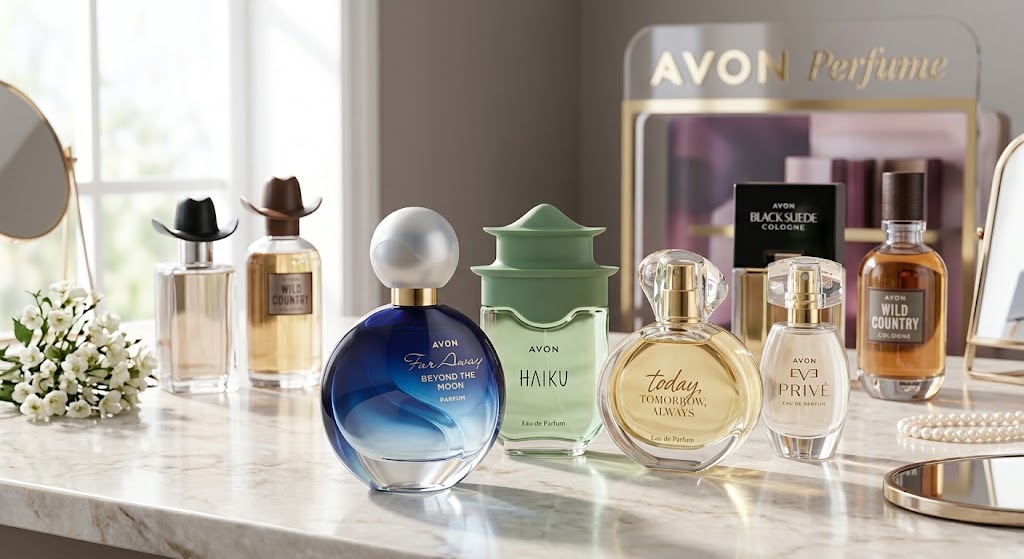
What you’ll learn:
- How a failed book salesman accidentally built one of America’s biggest perfume companies
- Why Avon was originally called the California Perfume Company
- The real story behind the “Avon Lady” and how she changed the fragrance industry
- What happened to Avon’s perfume legacy and why it still matters today
Introduction
The history of Avon perfume doesn’t start in a fancy Parisian atelier. It starts on a doorstep, with a nervous book salesman trying to hold a housewife’s attention for just one more minute.
That small, almost accidental gesture turned into one of the most influential fragrance companies America has ever produced. Long before influencers and department store counters, Avon was already putting scent into the hands of everyday women, one home visit at a time.
If you’ve ever caught a whiff of an old, dusty perfume bottle in your grandmother’s dresser drawer, there’s a good chance Avon was involved. This brand quietly shaped how millions of American women first experienced fragrance.
So how did a struggling salesman with zero perfume training end up building a fragrance empire? Let’s dive in.
Background: Why Avon’s Story Matters to Fragrance Lovers
To understand modern American perfume culture, you have to understand direct-selling brands like Avon. Before Sephora, before Ulta, before online fragrance marketplaces, there was the Avon Lady ringing your doorbell.
Avon’s business model — women selling directly to women — was genuinely revolutionary. It gave financial independence to people who had almost no other paths to earning income of their own at the time.
This matters for fragrance history because Avon didn’t just sell perfume. It normalized perfume as an everyday, accessible product rather than a luxury reserved for the wealthy few.

Main Story: How Avon Perfume Was Actually Born
A Book Salesman’s Accidental Perfume Business
David H. McConnell wasn’t dreaming of becoming a perfumer. In the 1880s, he was a young door-to-door book salesman in New York, struggling to get women to even open the door for him.
To sweeten the pitch, he started handing out small samples of a rose-scented perfume he’d mixed up himself, as a free gift for listening to his sales pitch. It was meant to be a hook, nothing more.
The twist nobody saw coming: customers cared far more about the free perfume than the books he was actually trying to sell. McConnell noticed the pattern quickly, and by 1886 he’d made the leap — abandoning publishing entirely to launch a perfume business instead.
The Birth of the California Perfume Company
McConnell named his new venture the California Perfume Company, even though it was based in New York. The name was chosen simply to evoke the romantic image of California’s abundant flowers and fragrant landscape.
The very first product line was called the Little Dot Perfume Set, and it contained five distinct scents: Violet, White Rose, Heliotrope, Lily of the Valley, and Hyacinth. Simple, floral, and instantly recognizable — a formula that would define drugstore perfume for decades.
By 1897, the company had outgrown its tiny New York office and McConnell built a proper factory in Suffern, New York, positioned conveniently along the railroad for easy shipping. This move let the company start scaling production for a growing national customer base.
Mrs. Albee and the Rise of the “Avon Lady”
Here’s where the Avon story gets genuinely groundbreaking. McConnell recruited a woman named Mrs. P.F.E. Albee to sell his perfumes door-to-door, and she became remarkably successful at it — so successful that she began recruiting other women to join her.
This was decades before American women had the right to vote. Very few respectable income opportunities existed for women outside the home at the time. Avon’s direct-sales model offered something rare: flexible, independent work that women could build around their own lives.
By the early 1900s, the company had thousands of sales representatives spread across the country. This army of saleswomen became the backbone of Avon’s growth and, in many ways, the heartbeat of the brand’s identity for the next century.
Practical Timeline: Key Milestones in Avon’s Fragrance Journey
Here’s a quick-reference timeline of how the brand evolved from a perfume side hustle into a household name:
- 1886 — David H. McConnell founds the California Perfume Company after his perfume samples outshine his book sales.
- 1897 — The company opens its first dedicated factory in Suffern, New York.
- Early 1900s — Mrs. Albee builds a nationwide network of women sales representatives.
- 1920s — Products begin appearing under the “Avon” name, inspired by the English countryside around Stratford-upon-Avon.
- 1939 — The company officially renames itself Avon Products, Inc.
- 1972 — Avon crosses the $1 billion sales mark, cementing its place as a fragrance and beauty giant.
- 1989 — Avon becomes the first major cosmetics company to end animal testing.

Common Myths About Avon Perfume
1: Avon was always called Avon. Not true. For over 40 years, the company operated as the California Perfume Company. The Avon name only became official in 1939, borrowed from the English region near Shakespeare’s hometown.
2: Avon was a “cheap” or lesser fragrance brand. This undersells its impact. Avon perfumes were affordable, yes, but that accessibility is exactly what introduced millions of Americans to fragrance as a daily ritual rather than an occasional luxury.
3: Avon perfumes have no real value or collectibility. Vintage Avon bottles, especially the whimsical novelty decanters that started appearing in the 1960s, are genuinely collected today. Shapes ranging from classic cars to animals have made certain bottles sought-after among collectors.
4: Avon only sold perfume for women. Avon’s fragrance catalog eventually expanded to include colognes and grooming products marketed toward men as well, growing well beyond its original floral lineup.
Expert Tips: What Fragrance Fans Can Learn from Avon’s Legacy
Avon’s story offers a genuinely useful lesson for anyone who loves fragrance: scent is emotional before it’s technical. McConnell wasn’t a trained perfumer, yet he built an empire because he understood that a simple, pleasant scent could create connection and trust.
If you’re building your own fragrance collection today, that same principle still holds. A scent doesn’t need to be rare or expensive to feel meaningful — it needs to feel like you.
For readers curious about how direct-to-consumer perfume brands operate today, it’s worth comparing Avon’s model to newer indie fragrance houses that skip department stores entirely and sell straight to customers online.
Final Recommendation: Why Avon Still Deserves a Place in Fragrance History
Avon may not dominate glossy perfume counters the way niche and designer houses do today, but its influence on American fragrance culture is hard to overstate. It made perfume personal, approachable, and part of everyday life for generations of women.
If you come across a vintage Avon bottle at a flea market or in a family collection, it’s worth a second look. That little glass bottle carries more fragrance history than most people realize.

Conclusion
The history of Avon perfume is proof that some of the biggest fragrance stories don’t start with luxury or glamour — they start with a good idea and a little bit of luck. What began as a free perfume sample to soften a book pitch turned into a company that reshaped how ordinary Americans experienced scent.
From the California Perfume Company’s five original floral fragrances to the door-to-door army of Avon Ladies, this brand quietly built the fragrance habits of an entire nation. Its legacy still lingers, one dusty vintage bottle at a time.
Did you find this helpful? Drop a comment below or share this with a fellow fragrance lover!
Frequently Asked Questions
Q1: What was Avon perfume originally called? Avon was originally called the California Perfume Company when it launched in 1886. The company didn’t officially adopt the Avon name until 1939, even though “Avon” branding had started appearing on select products years earlier in the 1920s.
Q2: Who founded Avon perfume and why? David H. McConnell founded Avon. He was a struggling door-to-door book salesman who started giving away homemade rose-scented perfume samples to get women’s attention, and eventually realized the perfume was more popular than his books.
Q3: Why is it called Avon? The name Avon was inspired by the English countryside near Stratford-upon-Avon, Shakespeare’s birthplace. McConnell felt the area around his company’s Suffern, New York laboratory resembled that English landscape.
Q4: Who was the first Avon Lady? Mrs. P.F.E. Albee is widely credited as the original Avon Lady. She became the company’s first standout sales representative and later helped recruit and train a growing national network of women sellers.
Q5: Are vintage Avon perfume bottles worth anything? Some vintage Avon bottles, especially novelty decanters shaped like cars, animals, or other collectibles from the 1960s onward, do hold value among collectors. Value depends heavily on condition, rarity, and whether the original fragrance and packaging remain intact.
Q6: Does Avon still make perfume today? Yes, Avon continues to produce fragrances as part of its broader beauty and personal care lineup, though it has changed ownership and corporate structure several times since its original American founding.
Wellness Perfumes — Can Your Fragrance Actually Boost Your Mood?
