

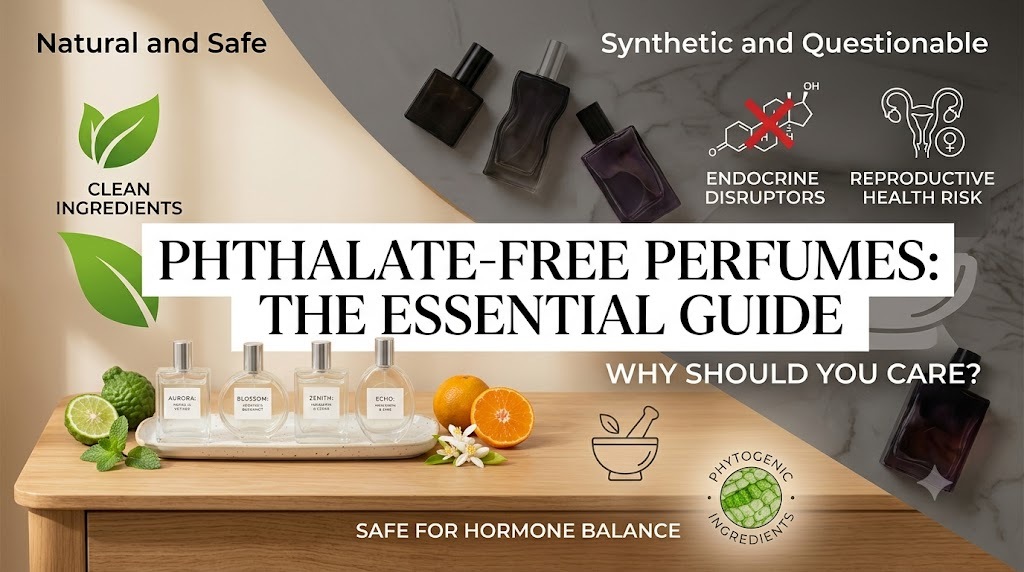
What you’ll learn:
- What phthalates actually do inside a bottle of perfume
- Why more fragrance houses are going phthalate-free
- How to spot phthalate-free perfumes when you’re shopping
- Common myths about “clean” fragrance, debunked
Introduction
Grab your favorite bottle of perfume and check the label. Chances are, you won’t find the word “phthalate” anywhere — and that’s exactly the problem. Phthalate-free perfumes have become one of the fastest-growing categories in the fragrance world, as shoppers start asking what’s really behind that beautiful scent.
For decades, phthalates quietly did their job as an invisible ingredient in countless colognes and eau de parfums, and most of us never gave it a second thought. Now that’s changing.
If you’ve ever wondered why some bottles proudly say “phthalate-free” on the box while others say nothing at all, you’re about to get the full picture. Let’s dive in.
Why This Matters: A Quick Background on Phthalates in Fragrance
Phthalates are a family of chemical compounds that have been used in manufacturing for decades, most commonly as plasticizers that keep plastics flexible. In the fragrance world, one specific type — diethyl phthalate, or DEP — has traditionally been used as a solvent and fixative.
DEP helps a fragrance last longer on skin by slowing down how quickly the scent molecules evaporate. It’s colorless, nearly odorless, and cheap to produce, which made it a go-to ingredient for decades.
The catch is that phthalates as a chemical family have drawn scrutiny from researchers and regulators, particularly around hormone activity and long-term exposure. That’s the secondary keyword worth remembering here: clean fragrance is no longer a niche request — it’s a mainstream expectation.

The Main Educational Content: What You Actually Need to Know
Not All Phthalates Are Created Equal
When people hear “phthalates,” they often picture one villain. In reality, there are dozens of phthalate compounds, and DEP — the one most relevant to fragrance — has a different safety profile than industrial phthalates used in vinyl flooring or medical tubing.
That said, regulatory bodies in the European Union have restricted or banned several phthalates in cosmetics, and California’s Proposition 65 requires warning labels on products containing certain phthalates above set thresholds. This regulatory pressure is a major reason brands started reformulating.
Understanding this nuance matters because it helps you read ingredient claims critically instead of panicking at any mention of the word “phthalate.”
Why Perfumers Started Removing Them
Perfumers didn’t just wake up one day and decide phthalates were bad. Consumer demand shifted first. Brands like Phlur, Skylar, and Henry Rose built entire identities around “clean” fragrance, listing phthalate-free formulas as a core selling point.
Bigger legacy houses noticed. Even mass-market brands began quietly reformulating their fixative systems, swapping DEP for alternatives like isopropyl myristate or other non-phthalate solvents that perform a similar function without the same regulatory baggage.
The shift also reflects a broader “clean beauty” movement that started in skincare and cosmetics before spreading naturally into fragrance, since perfume sits on skin just like a moisturizer does.
What “Phthalate-Free” Actually Changes in the Bottle
Here’s the part most articles skip: removing phthalates does affect performance, at least slightly. DEP was popular because it’s an excellent, nearly invisible fixative.
Modern phthalate-free formulas rely on alternative fixatives and higher-quality aromatic compounds to achieve similar longevity. This is one reason phthalate-free perfumes sometimes carry a higher price tag — the substitute ingredients simply cost more.
The good news is that fragrance chemistry has advanced enough that a well-formulated phthalate-free perfume can absolutely rival traditional formulas in both sillage and staying power.
Practical Tips: How to Shop for Phthalate-Free Perfumes
Ready to actually apply this? Here’s a simple step-by-step approach:
- Check the brand’s official ingredient page. Reputable brands now disclose full fragrance formulas or at least confirm phthalate-free status directly on their site.
- Look for third-party certifications, such as EWG Verified or MADE SAFE, which independently vet formulas.
- Search “[brand name] phthalate-free” before buying, since many companies publish clean-ingredient statements in press releases or FAQs.
- Email customer service if information isn’t public — most niche and indie perfume houses respond quickly to ingredient questions.
- Read reviews from fragrance communities like Fragrantica, where enthusiasts often discuss reformulations and ingredient changes.

Common Mistakes and Myths About Phthalate-Free Fragrance
Myth 1: “Phthalate-free means hypoallergenic.” Not true. A perfume can be completely phthalate-free and still trigger skin sensitivities from essential oils or other aromatic compounds.
Myth 2: “Natural perfumes are automatically phthalate-free.” Not necessarily. “Natural” refers to ingredient sourcing, not the absence of specific synthetic additives — always check separately.
Myth 3: “If it’s not labeled, it definitely contains phthalates.” Fragrance formulas are often protected as trade secrets, so silence on the label doesn’t confirm anything either way — it just means you should dig a little deeper.
Mistake: Assuming price equals purity. A high price doesn’t guarantee a phthalate-free formula. Some luxury houses have been slower to reformulate than budget-friendly indie brands.
Expert Tips for Building a Cleaner Fragrance Collection
If you’re serious about transitioning your collection, start by auditing what you already own rather than tossing everything at once. Reach out to the brands directly — this single habit will teach you more about ingredient transparency than any general guide.
Consider layering scents from smaller, transparent indie houses with your existing favorites, so you’re not overhauling your whole routine overnight.
Pay attention to how a phthalate-free formula wears on your specific skin chemistry — because fixatives, whether traditional or alternative, interact differently from person to person.
Final Recommendation: Should You Switch to Phthalate-Free Perfume?
If ingredient transparency matters to you, switching makes sense — and the good news is you no longer have to sacrifice quality or longevity to do it. The market has matured enough that excellent phthalate-free options exist across nearly every price point and scent family.
Start small. Pick one phthalate-free perfume, wear it for a week, and compare how it performs against your current go-to.
Conclusion
Choosing phthalate-free perfumes isn’t about fear — it’s about being an informed shopper in a fragrance industry that’s finally opening up about what goes into every bottle. Once you understand what phthalates do, why brands are moving away from them, and how to verify claims for yourself, shopping for fragrance becomes a lot more empowering.
Whether you stick with a beloved classic or explore a newer indie house, the choice is now genuinely yours to make with confidence.
Did you find this helpful? Drop a comment below or share this with a fellow fragrance lover!
Frequently Asked Questions
Q1: What are phthalate-free perfumes exactly? Phthalate-free perfumes are fragrances formulated without phthalate compounds, most commonly diethyl phthalate (DEP), which was traditionally used as a solvent and fixative to help scents last longer on skin.
Q2: Are phthalates in perfume dangerous? Research on phthalates is ongoing, and regulatory bodies like the EU have restricted certain types in cosmetics. The fragrance-grade phthalate DEP has a different safety profile than industrial variants, but many shoppers prefer to avoid it as a precaution.
Q3: Do phthalate-free perfumes last as long as regular ones? Yes, when well-formulated. Modern alternative fixatives can achieve comparable longevity and sillage, though performance still varies by brand and formula quality.
Q4: How can I tell if my perfume contains phthalates? Check the brand’s website or ingredient disclosures, look for third-party certifications like EWG Verified, or contact customer service directly, since full formulas are often trade secrets.
Q5: Are natural perfumes always phthalate-free? Not automatically. “Natural” describes ingredient sourcing, not the absence of specific synthetics, so it’s worth verifying phthalate-free status separately.
Q6: Which brands make phthalate-free perfumes? Indie and clean-beauty-focused brands like Phlur, Skylar, and Henry Rose are known for phthalate-free formulas, and many larger houses have begun reformulating select lines as well.
Pingback: Best Organic Perfumes Worth Trying in 2026 - fragrantip
Pingback: Aromatherapy vs Perfume — What's the Real Difference? - fragrantip