


What you’ll learn
- How ancient Egyptians, Mesopotamians, Greeks, and Romans used fragrant oils and resins
- How perfume-making evolved through the Islamic Golden Age and Renaissance Europe
- Why iconic fragrances such as Chanel No. 5 changed modern perfumery
- How department stores, celebrity scents, and Sephora transformed the fragrance experience
Introduction
The History of Perfume begins thousands of years before the modern fragrance counter, yet many of today’s favorite scents still rely on ideas that ancient perfumers understood remarkably well. Long before you could walk into Sephora and spray a citrusy eau de parfum on a paper blotter, people were crushing flowers, heating resins, steeping herbs, and blending fragrant oils.
Think about what happens when you spray a familiar perfume today. First comes the bright burst of citrus or herbs. Moments later, softer floral or spicy notes appear. Finally, warm woods, musk, vanilla, or amber linger close to the skin. That layered experience connects directly to centuries of experimentation.
Perfume has served many purposes throughout history. People used fragrance in religious ceremonies, personal grooming, medicine, hospitality, fashion, and social rituals. Over time, advances in chemistry transformed perfume from a luxury made largely from natural materials into a sophisticated art combining natural ingredients and laboratory-created aroma molecules.
Today, fragrance is more accessible than ever. Luxury houses such as Chanel, Dior, Guerlain, Jo Malone London, and Tom Ford sit alongside affordable fragrance brands on modern beauty shelves.
So how did we get here?
Let’s dive in.
Why The History of Perfume Still Matters
Perfume can seem like a purely modern beauty product, but its roots reach deep into ancient civilization. Understanding that background makes today’s fragrance world much more fascinating because many familiar perfume traditions began with remarkably simple materials: flowers, woods, spices, herbs, resins, and aromatic oils.
Ancient perfume was often closely connected to religion and ceremony. Fragrant smoke from burning resins could fill temples, while scented oils might be applied during rituals or used as part of personal grooming.
The word “perfume” itself comes from the Latin per fumum, meaning “through smoke.” The expression reflects an early connection between fragrance and the burning of aromatic materials.
Ancient Egypt and the Birth of Perfume Culture
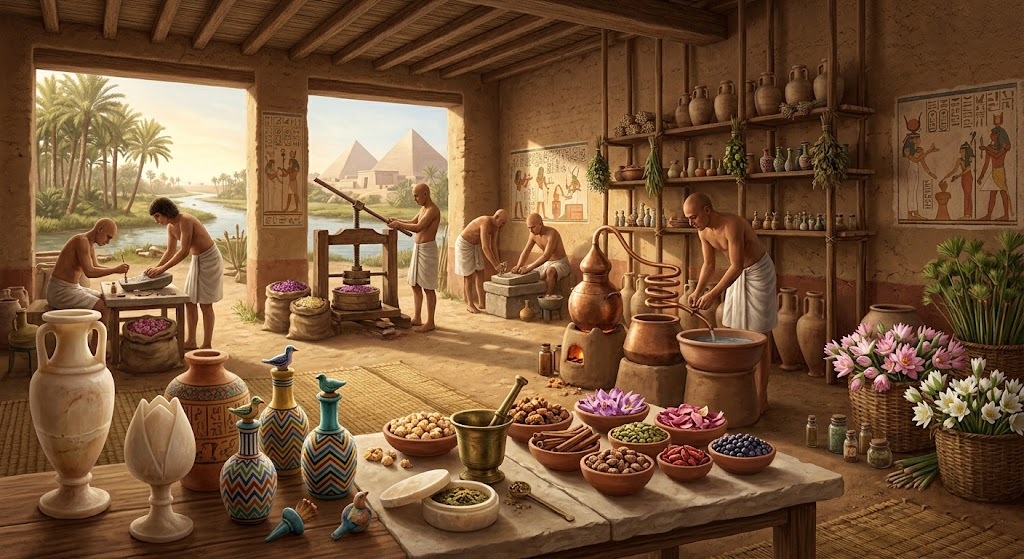
Ancient Egypt is one of the most important chapters in perfume history. Egyptians used fragrant preparations made from ingredients such as myrrh, frankincense, cinnamon, juniper, and various flowers and herbs.
Perfume wasn’t simply about smelling pleasant. Fragrance played a role in religious ceremonies, cosmetics, burial rituals, and everyday life. Aromatic substances were valuable enough to become symbols of status and wealth.
One famous Egyptian fragrance tradition involved kyphi, a complex aromatic preparation associated with religious and ceremonial use. Historical recipes suggest that ingredients could include honey, wine, raisins, resins, herbs, and spices.
Archaeological discoveries have also revealed evidence of ancient perfume production. At Pyrgos on Cyprus, researchers found an ancient perfume-making installation dating back roughly 4,000 years.
That is an extraordinary reminder that organized fragrance production existed long before modern laboratories or luxury perfume boutiques.
Mesopotamia, Greece, and Rome
Perfume culture also flourished beyond Egypt. Ancient Mesopotamia produced aromatic preparations, while Greek and Roman societies expanded the use of scented oils.
The Greeks adopted and developed fragrance practices from cultures around the Mediterranean. Romans later incorporated perfumes into bathing, grooming, celebrations, and social life.
Fragrant oils could be applied to the body, hair, clothing, and even household spaces. Wealthy Romans were known for extravagant use of perfume, demonstrating how fragrance had already become associated with luxury.
At this stage, however, perfume generally looked very different from today’s alcohol-based sprays. Oils, balms, ointments, and aromatic smoke dominated.
That would eventually change through advances in distillation and extraction.
The Evolution of Perfume From Oils to Modern Fragrance
The biggest changes in perfume history didn’t happen overnight. Instead, different cultures gradually developed better ways to extract, preserve, transport, and combine aromatic materials.
The Islamic Golden Age and Distillation
The development of distillation was a major milestone in fragrance history. During the Islamic Golden Age, scholars and artisans refined distillation techniques and explored aromatic materials with remarkable sophistication.
The Persian polymath Ibn Sina, also known as Avicenna, is often associated with improvements in the distillation of rose petals to produce rose water. Rose water became an important aromatic product throughout parts of the Islamic world.
Distillation offered something valuable: a more efficient way to capture fragrant compounds from botanical materials.
This helped perfume-making become more precise. Instead of relying solely on macerated oils or burned materials, perfumers could experiment with distilled aromatic waters and essential oils.
Trade networks also helped ingredients travel farther. Spices, resins, flowers, woods, and other aromatic materials could move between regions, giving perfumers access to an increasingly diverse palette.
Consequently, fragrance became an intersection of science, craftsmanship, agriculture, and international trade.
Renaissance Europe and the Rise of Luxury Perfume
By the Renaissance, fragrance had become increasingly fashionable among European elites.
Italy played an important role in European perfume culture, particularly through trading cities with connections to the wider Mediterranean world. As fragrance techniques spread, perfumers developed scented gloves, pomanders, aromatic waters, and personal fragrances.
The French city of Grasse eventually became particularly famous for perfume and flowers. Its favorable climate supported the cultivation of aromatic plants, including jasmine, rose, and later other important perfumery crops.
Grasse remains strongly associated with French perfume today.
Meanwhile, European courts helped turn fragrance into a symbol of refinement. Perfumed clothing, gloves, powders, and personal scents became fashionable among wealthy consumers.
However, fragrance was still largely a luxury. High-quality natural ingredients required considerable labor, land, transportation, and craftsmanship.
The arrival of modern chemistry would dramatically expand the possibilities.
Synthetic Ingredients Change Everything
The 19th century brought one of the most important revolutions in perfume: synthetic aroma molecules.
Chemists learned how to create aromatic compounds in laboratories, giving perfumers ingredients that could reproduce, modify, or extend certain scent effects.
This didn’t simply replace natural materials. Instead, it expanded the perfumer’s palette.
One landmark example is coumarin, a sweet, hay-like aroma compound used in Fougère Royale, launched by Houbigant in 1882. Its success helped establish the fougère fragrance family and demonstrated how chemistry could influence perfume style.
Another turning point came with aldehydes. These materials contributed to the distinctive sparkling character of Chanel No. 5, launched in 1921.
The result was a new era of creativity.
Perfumers could now combine natural extracts with synthetic molecules to create scents that were fresh, abstract, long-lasting, unusual, or simply impossible to achieve with traditional ingredients alone.
How Perfume Became the Modern Fragrance We Know
The transition from historical perfume to today’s fragrance industry involved several major developments. If you want to understand why modern perfume counters look the way they do, follow this simple timeline.
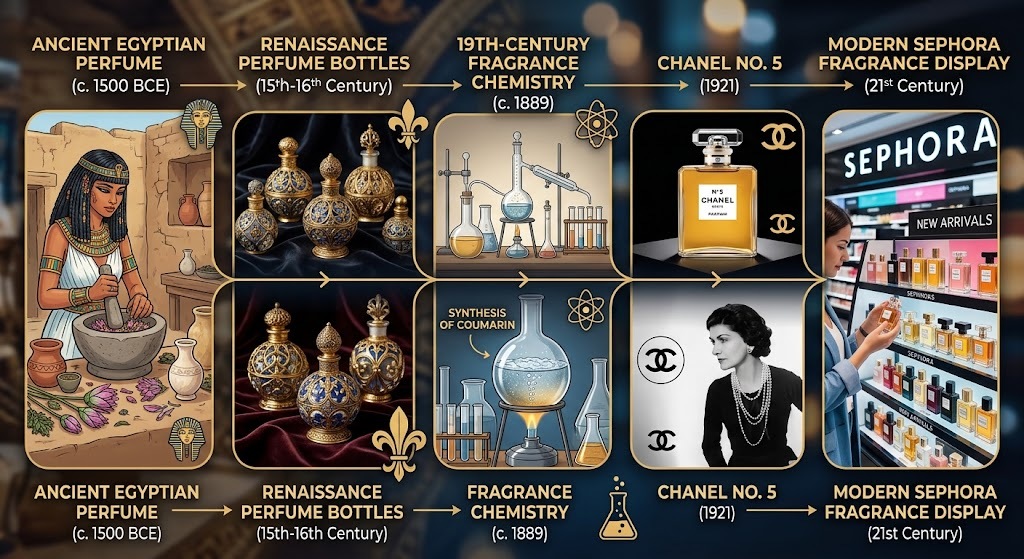
1. Ancient foundations
Early civilizations used fragrant resins, oils, flowers, woods, herbs, and spices. Fragrance was closely connected to ritual, grooming, hospitality, and status.
2. Better extraction
Distillation and other techniques allowed perfumers to capture aromatic materials more effectively.
3. European perfume centers
Cities and regions such as Grasse became important centers of fragrance production and botanical cultivation.
4. The chemistry revolution
Synthetic aroma molecules expanded the perfumer’s toolkit during the 19th century.
5. The rise of designer perfume
Fashion houses began treating fragrance as an important part of their brand identity. Chanel No. 5 became one of the most famous examples after its 1921 launch.
6. The fragrance industry goes mainstream
Department stores, advertising, celebrity endorsements, travel retail, beauty chains, and online shopping made perfume increasingly accessible.
7. The Sephora era
Modern retailers such as Sephora changed how consumers discover fragrance. Instead of simply purchasing one perfume recommended by a salesperson, shoppers can compare dozens of brands, read reviews, explore fragrance families, sample discovery sets, and learn about notes.
Today, someone might walk into a store looking for a fresh citrus fragrance and leave with a woody amber perfume they discovered through sampling.
That freedom to explore is one of the defining characteristics of modern fragrance culture.
Common Myths About The History of Perfume
Perfume history is full of fascinating stories, but not every popular claim is accurate. Here are several myths worth clearing up.
1: Perfume was invented in France
France became enormously influential in perfume, but it did not invent fragrance.
Ancient civilizations were creating aromatic preparations thousands of years before modern French perfumery developed.
France’s contribution was enormous, particularly through Grasse, luxury fashion houses, and the development of sophisticated commercial perfumery. Still, perfume has a much broader international history.
2: Natural perfume is always better
Natural ingredients can smell beautiful, but “natural” does not automatically mean higher quality.
Modern perfumers use both natural and synthetic materials for good reasons. Synthetic ingredients can offer consistency, stability, unique textures, and access to scent profiles that may be difficult or environmentally challenging to obtain from natural sources.
For example, modern perfumery uses aroma molecules to create airy, musky, woody, amber-like, and marine effects.
3: Expensive perfume always smells better
Price reflects many factors, including ingredients, concentration, packaging, marketing, distribution, and brand positioning.
A $250 bottle may be beautifully composed, but that doesn’t guarantee you will prefer it to a $50 fragrance.
Your skin chemistry, taste, climate, and preferred fragrance family matter more than the price tag.
4: Perfume should smell exactly the same from start to finish
Actually, many perfumes are designed to evolve.
A fragrance may open with bright citrus, transition into flowers or spices, and eventually settle into woods, musk, vanilla, or amber.
This development is called the fragrance’s dry-down, and it is one reason experienced fragrance lovers wait before deciding whether they truly like a perfume.
Expert Tips for Exploring Perfume History Through Your Collection
Learning perfume history becomes much more interesting when you connect historical ideas to fragrances you can actually smell.
If you enjoy exploring perfume, try building a small “fragrance history” collection rather than buying bottles randomly.
Start with a classic fragrance associated with an important era. Chanel No. 5, for example, is useful for understanding the early 20th-century relationship between fashion, aldehydes, and perfume branding.
Then explore a classic Guerlain fragrance to experience the influence of French luxury perfumery. From there, try a modern fragrance that uses a prominent synthetic musk, woody molecule, or amber accord.
Notice how different the fragrances feel.
Pay attention to the opening, heart, and dry-down. Write down what you smell rather than relying entirely on the marketing description.
For example:
- First spray: Identify the strongest impression. Is it citrusy, green, spicy, sweet, or fresh?
- After 15 minutes: Notice which ingredients seem softer or more prominent.
- After one hour: Look for floral, fruity, woody, powdery, or aromatic characteristics.
- At the dry-down: Pay attention to musk, vanilla, woods, amber, or other long-lasting impressions.
- Record your reaction: Note whether you would actually wear it.
Most importantly, sample perfume on skin when possible. Paper strips are useful, but skin provides a more realistic experience of how a fragrance develops.
For more fragrance education,
From Ancient Ritual to Modern Sephora: The Big Picture
The story of perfume is ultimately a story about human curiosity.
Ancient Egyptians transformed aromatic materials into ritual and personal luxuries. Greek and Roman societies embraced scented oils. Scholars refined distillation. European courts turned fragrance into a symbol of sophistication. Grasse developed into a legendary center of perfume culture.
Then chemistry opened an entirely new chapter.
Fashion houses such as Chanel, Dior, and Guerlain helped turn perfume into a powerful expression of identity and luxury. Later, mass retail and digital commerce made fragrance easier for millions of people to explore.
Today, Sephora represents a very different fragrance environment from the perfume workshops of antiquity. Yet the basic desire remains surprisingly similar: we want to surround ourselves with beautiful smells and use scent to express something about ourselves.
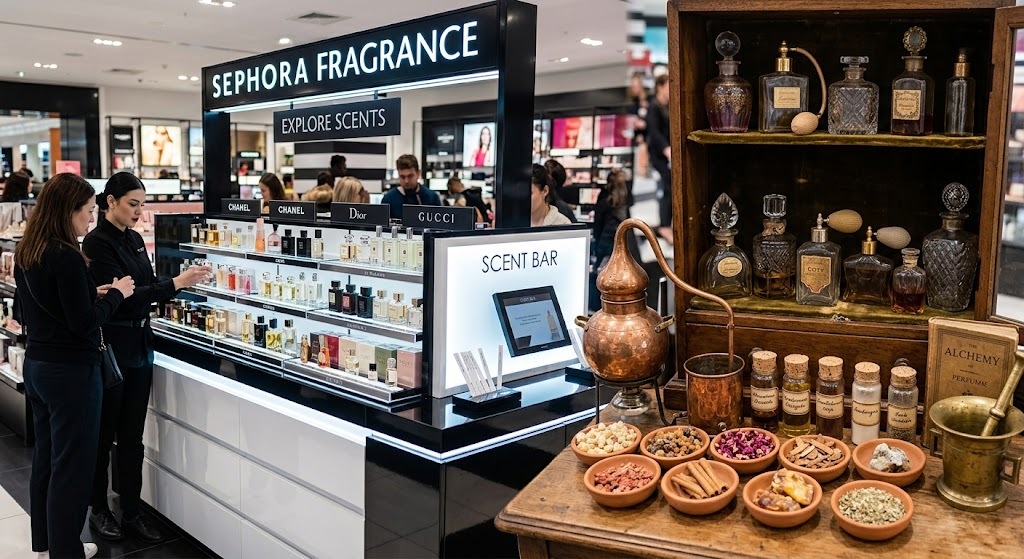
Whether you prefer a crisp citrus cologne, a powdery floral, a warm vanilla gourmand, a smoky oud, or a clean woody musk, you’re participating in a tradition that stretches across thousands of years.
Conclusion
The History of Perfume reveals far more than a timeline of bottles and beauty brands. It shows how fragrance moved from ancient rituals and aromatic oils to sophisticated modern compositions available in stores around the world.
Along the way, distillation, international trade, botanical cultivation, synthetic chemistry, fashion, advertising, and retail all transformed the way we experience scent.
And yet, perfume still feels wonderfully personal. One person may fall for a sparkling citrus fragrance, while another prefers something dark, woody, powdery, or sweet.
That is part of the magic.
Next time you spray your favorite fragrance, take a moment to appreciate the centuries of experimentation behind that tiny bottle. The History of Perfume is still being written every time a new perfumer creates something unexpected.
Did you find this helpful? Drop a comment below or share this with a fellow fragrance lover!
Frequently Asked Questions
Q1: What is The History of Perfume in simple terms?
A: The History of Perfume begins with ancient civilizations that used fragrant plants, resins, oils, and spices for rituals, grooming, and ceremonies. Egypt played an important early role, while Mesopotamia, Greece, Rome, the Islamic world, and Europe each contributed new techniques. Distillation improved fragrance production, and 19th-century synthetic chemistry dramatically expanded the perfumer’s palette. Modern perfume combines centuries-old traditions with advanced chemistry and global retail.
Q2: When was modern perfume invented?
A: There is no single invention date for modern perfume. Fragrance has existed for thousands of years, but modern perfumery developed gradually. Distillation techniques improved the extraction of aromatic materials, while synthetic chemistry during the 19th century introduced new possibilities. The launch of fragrances such as Fougère Royale in 1882 and Chanel No. 5 in 1921 helped define important stages of modern perfume.
Q3: Why is ancient Egypt important to perfume history?
A: Ancient Egypt is important because fragrance played a major role in religious ceremonies, personal grooming, cosmetics, and burial traditions. Egyptians worked with aromatic materials including resins, herbs, spices, flowers, and oils. Archaeological evidence also shows that perfume production was organized on a significant scale thousands of years ago. Their sophisticated use of fragrance helped establish traditions that influenced later perfume cultures.
Q4: How did synthetic ingredients change perfume?
A: Synthetic ingredients gave perfumers a much larger creative palette. Instead of relying exclusively on natural flowers, woods, resins, spices, and animal-derived materials, perfumers could use laboratory-created aroma molecules. These materials can provide consistency, improve performance, create abstract effects, and reproduce scent characteristics that may be difficult to extract naturally. Synthetic chemistry therefore became an important part of modern perfumery rather than simply replacing natural ingredients.
Q5: Why is Chanel No. 5 important in the history of perfume?
A: Chanel No. 5, launched in 1921, became an iconic example of how perfume could combine fragrance, fashion, branding, and luxury. Its composition helped popularize the distinctive use of aldehydic effects in fine fragrance, while its association with the Chanel fashion house gave perfume a powerful identity beyond the scent itself. Its enduring reputation makes it an important reference point when studying 20th-century perfume.
Q6: Why do perfumes smell different over time?
A: Perfumes contain materials that evaporate at different rates, so their scent can change after application. Bright citrus or aromatic materials may be noticeable first, followed by floral, fruity, spicy, or herbal characteristics. Later, slower-evaporating materials such as woods, musk, vanilla, and amber-like accords may become more prominent. This gradual evolution is commonly described as the fragrance’s opening, heart, and dry-down.
