Author: Piya

  • The 2026 Zara Fragrance Cheat Sheet: Your Guide to Budget High-End Scents

    What you’ll learn

    • How to spot the absolute best luxury-smelling alternatives hiding on Zara shelves right now.
    • The exact olfactory notes connecting budget bottles to historic, high-end French perfume houses.
    • Pro application secrets that instantly double the longevity and sillage of affordable scents.
    • A definitive master list mapping out Zara’s iconic releases to their classic, premium twins.

    Introduction

    Imagine stepping into an exclusive rooftop lounge or an elite corporate boardroom, enveloped in a rich cloud of warm saffron, woody ambergris, and sweet jasmine. Everyone assumes you are wearing a classic three-hundred-dollar niche perfume. In reality, your secret weapon cost less than a casual weekend brunch. High-end, boutique fragrances possess an undeniable allure, but the premium price tags can easily dent your monthly budget.

    Thankfully, you do not have to drain your bank account to curate an enviable, sophisticated olfactory wardrobe. The global beauty industry has shifted dramatically, and smart consumers are turning to high-street alternatives that deliver exceptional depth, complex performance, and unforgettable trails.

    Our comprehensive guide, The 2026 Zara Fragrance Cheat Sheet, is designed to decode the confusing perfume aisles and reveal the finest pocket-friendly juice available today. Whether you are searching for a fresh citrus morning mist or a deep, dark gourmand for date night, we have mapped out the ultimate options for you. Let’s dive in.

    The Evolution of Affordable Luxury Perfumery

    The global fragrance market is currently experiencing a massive democratization wave. Historically, luxury fragrance houses maintained a strict monopoly on complex formulation, utilizing exclusive master perfumers and rare, protected ingredients. However, modern analytical chemistry allows expert creators to reconstruct intricate scent profiles with astonishing accuracy.

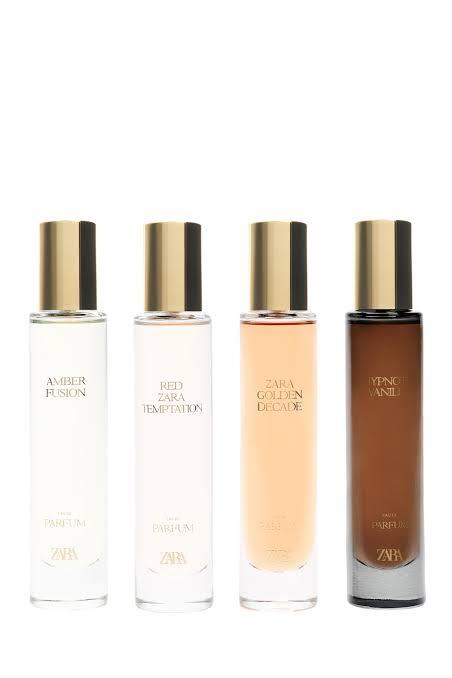
    Zara has capitalized on this technical revolution by collaborating directly with legendary master noses. For instance, their highly acclaimed partnerships with Jo Malone CBE have completely redefined what consumers expect from high-street collections. They no longer produce simple, linear, one-note synthetic sprays. Instead, they are delivering beautifully evolving scents that feature authentic development from top notes to the dry-down.
    The Evolution of Affordable Luxury Perfumery

    Consumers are noticing the shift. Recent cosmetics industry metrics reveal that over 65% of fragrance shoppers actively seek out high-quality alternatives to expand their scent rotations. By shifting budgets away from heavy glass bottle manufacturing and multi-million-dollar celebrity marketing campaigns, Zara channels its resources directly into high-tier juice stabilization. The result is a world-class collection of fragrances that sit proudly alongside niche bottles.

    The Master Breakdown of the 2026 Zara Fragrance Cheat Sheet

    Navigating a massive wall of identical glass bottles can feel incredibly overwhelming when you are shopping in-store. To make your life easier, we have broken down the absolute best performers in the collection, categorized by their distinct scent families and their premium aesthetic counterparts.

    The Sensational Ambers and Sweet Gourmands

    If you love warm, resinous, and deeply sweet aromatic trails, Zara Red Temptation is the undisputed crown jewel of the collection. This scent has captured the hearts of beauty creators worldwide, offering an uncanny aromatic profile to the legendary Maison Francis Kurkdjian Baccarat Rouge 540. It opens with an airy, metallic burst of precious saffron and bitter orange, before settling into a warm heart of ambergris and sugary praline.

    For fans of decadent, romantic profiles, Zara Rose Gourmand stands out as a beautiful alternative to Mancera Roses Vanille. This heavy hitter avoids the vintage, powdery trap of traditional florals by pairing a bold, honeyed red rose note with creamy, warm bourbon vanilla and a deeply sensual, clean white musk base.

    Similarly, if you are drawn to the golden, majestic aura of Yves Saint Laurent Libre, Zara Golden Decade is a non-negotiable addition to your vanity. It masterfully balances clean, relaxing French lavender with a bright, sparkling mandarin opening, leading into a rich heart of Moroccan orange blossom that smells profoundly expensive.

    The Fresh, Crisp, and Aromatic Icons

    When the temperature rises, heavy gourmands can feel suffocating, making crisp, sparkling notes essential. Zara Applejuice is a masterclass in clean, casual elegance, widely celebrated for mirroring the bright, joyful spirit of Chanel Chance Eau Tendre. It greets your senses with a refreshing burst of crisp green apple, zesty grapefruit, and cooling cucumber, before softening into a delicate heart of pink peony and sophisticated white woods.

    If you prefer something textured, earthy, and distinctly coastal, Zara Ebony Wood is an absolute masterpiece from the Jo Malone collaboration line. It beautifully channels the rugged, wind-swept ambiance of Jo Malone London Wood Sage & Sea Salt. The composition blends rich, smoky ebony wood with a sharp, invigorating dash of pink peppercorn and aromatic clove, creating a comforting, unisex cloud that lasts for hours.

    For those who love clean, photorealistic citrus profiles, Zara Vetiver Pamplemousse serves as a fantastic alternative to high-end aromatic essentials like Tom Ford Grey Vetiver. This stunning juice hits you instantly with a vivid, incredibly juicy explosion of freshly squeezed pink grapefruit and bitter lemon rind, grounded gracefully by a crisp, sharp base of earthy vetiver.

    The Mysterious Woods and Rich Ouds

    As the sun sets, a sophisticated fragrance collection requires deeper, complex, and more mysterious notes that command attention. Zara Energetically New York offers a stunningly chic nod to the urban minimalist classic, Le Labo Santal 33. This unisex powerhouse leans heavily on dry, aromatic cardamom and rich, smoky cedarwood, delivering that iconic, clean papyrus and rich sandalwood aesthetic that defines fashionable city living.

    The Mysterious Woods and Rich Ouds

    If you crave something smoky, comforting, and deeply nostalgic, Zara Bohemian Oud provides a spectacular look into niche territory, closely resembling Maison Margiela Replica By The Fireplace. It wraps you tightly in an intoxicating winter blanket of burning firewood notes, sweet toasted chestnuts, warm vanilla bean, and just a subtle hint of exotic incense.

    Finally, for those who appreciate old-school, deep luxury with a dark, modern edge, Zara Orchid delivers an accessible take on the moody sophistication of Tom Ford Black Orchid. By blending deep, dark fruity accords with earthy, grounding patchouli and smooth, dark vanilla, it creates a slightly dangerous, gothic charm that is absolutely perfect for black-tie winter events or intimate evening dates.

    How to Maximize the Performance of High-Street Scents

    Affordable perfumes are frequently criticized for lacking the extreme longevity of their multi-hundred-dollar counterparts. Because Zara fragrances are typically formulated as Eau de Parfum (EDP) or Eau de Toilette (EDT) with slightly lighter oil concentrations to keep costs low, they require tactical application methods to truly shine.

    By understanding the basic science of how aromatic compounds interact with human skin, heat, and fabrics, you can easily stretch a modest six-hour high-street scent into a powerhouse performance that commands attention from morning until late into the night.

    1.Prep with Deep Moisture:Apply immediately post-shower.

    Fragrance molecules require moisture to anchor properly. Dry skin acts like a sponge, absorbing the essential oils and diminishing projection. Apply an unscented lotion or a thin layer of pure petroleum jelly directly to your skin before spraying to lock the perfume down.

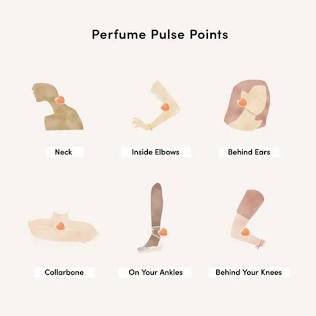
    2.Target Strategic Pulse Points:Do not rub your wrists together.

    Focus your sprays on regions where blood vessels sit closest to the surface, creating natural warmth. Target the base of your throat, behind the ears, and the inside of your elbows. Crucially, avoid rubbing your wrists together, as the friction breaks down fragile top notes prematurely.

    3.Spray Your Wardrobe Inundated:Utilize fabrics for extended sillage.

    While skin chemistry warms a perfume up, natural fabrics hold onto scent molecules for days. Generously mist your clothing, winter coats, or scarves. Because fabrics do not produce sweat or high heat, the fragrance notes evaporate much slower, leaving a beautiful lingering trail.

    Common Pitfalls and Myths of Affordable Perfumery

    One of the most persistent, widespread myths in the beauty industry is that an affordable price tag automatically translates to a cheap, synthetic, or unsafe formulation. Many consumers assume that high luxury pricing is tied entirely to superior, pure ingredients. In reality, modern fragrance production is heavily regulated by global governing bodies like the International Fragrance Association (IFRA). Every bottle on a mainstream high-street shelf complies with strict safety, purity, and formulation standards.

    Another frequent mistake shoppers make is evaluating a budget fragrance solely based on its initial spray inside a crowded, hectic retail environment. When you first mist a perfume onto a paper strip, your nose is hit with a rapid rush of volatile top-note alcohol.

    Affordable formulations often feature a more intense top-note opening that takes three to five minutes to evaporate completely. To judge a scent accurately, you must spray it onto your own skin, walk away from the store, and allow it to mingle with your personal body chemistry for at least thirty minutes to observe how the true heart and base notes unfold.

    Finally, many fragrance enthusiasts make the mistake of blind-buying massive quantities of budget bottles simply because they are affordable. While spending thirty dollars feels negligible compared to a luxury splurge, collecting ten underperforming bottles that you do not truly love leads to clutter and wasted money. Focus on testing, identifying your preferred fragrance families, and investing only in the specific high-street bottles that bring you genuine joy.

    The Professional Art of Fragrance Layering

    If you want to unlock the absolute highest level of value from your collection, you should actively experiment with custom fragrance layering. Layering involves combining two or more distinct perfumes to create a completely bespoke signature scent profile that nobody else can replicate. High-street options are uniquely suited for this technique because their straightforward, clean base notes provide a perfect canvas for creative experimentation.

    The Pro Layering Strategy: Always apply your heaviest, deepest scent first — such as a woody oud, dark amber, or rich sandalwood. Allow it to sit on your skin for two minutes, then mist your lighter, fresher citrus or floral fragrance directly on top.

    To help you get started with your custom blending journey, we have compiled our three favorite tested combinations using bottles from our master cheat sheet:

    Base Scent (Apply First)Top Scent (Apply Second)Overall Vibe & Result
    Zara Energetically New York
    (Dry, spicy sandalwood)
    Zara Applejuice
    (Crisp, clean green apple)
    The Modern Luminary: A crisp, professional daytime corporate scent with a complex, expensive woody depth.
    Zara Rose Gourmand
    (Sweet, honeyed vanilla rose)
    Zara Red Temptation
    (Warm, airy saffron amber)
    The Midnight Empress: An incredibly rich, sultry evening profile that turns heads and commands attention.
    Zara Ebony Wood
    (Smoky, warm pink pepper)
    Zara Vetiver Pamplemousse
    (Vivid, juicy fresh grapefruit)
    The Coastal Nomad: A perfectly balanced, unisex aromatic masterpiece that feels simultaneously icy fresh and warm.

    Essential Curation and Longevity Practices

    Curating a stellar collection of affordable luxury scents is only half the battle; you also need to store your bottles properly to protect the delicate aromatic compounds inside. Fragrance oils are highly sensitive to environmental factors, and improper storage can cause your favorite juice to oxidize, lose its potency, or turn sour in less than a year.
    Essential Curation and Longevity Practices

    Never store your perfume collection on a bathroom counter or a sunny window sill. The intense humidity from your daily showers and the harsh ultraviolet rays from natural sunlight accelerate chemical breakdown rapidly. Instead, store your bottles inside a cool, dry closet, a vanity drawer, or even inside their original cardboard packaging.

    Additionally, avoid unnecessarily shaking your bottles. Many people mistakenly believe that shaking mixes the oils, but it actually introduces microscopic air bubbles into the juice, speeding up the oxidation process. Keep your bottles stationary, cool, and dark to preserve their magnificent sillage for years to come.

    Conclusion

    Stepping into the vast world of perfumery does not mean you have to compromise your financial well-being or sacrifice luxury. As we have unmasked throughout The 2026 Zara Fragrance Cheat Sheet, high-street shelves are packed with complex, world-class formulations that stand toe-to-toe with elite heritage brands. By mastering the art of skin preparation, understanding notes, and experimenting with custom layering, you can build a magnificent, high-performing wardrobe on a realistic budget.

    True luxury is never defined by a premium price tag or a fancy designer logo. It is found in how a scent transforms your confidence, elevates your mood, and leaves an unforgettable impression as you move through the world. Take a trip to your local store, test out a few options on your skin, and discover your new affordable signature scent today.

    Did you find this helpful? Drop a comment below or share this with a fellow fragrance lover!

    Frequently Asked Questions

    Q1: Do perfumes on the Zara Fragrance Cheat Sheet last as long as designer brands?

    A: Generally, high-street fragrances offer slightly shorter longevity than ultra-premium niche brands due to lower concentration percentages of rare raw oils. However, many prominent options like Red Temptation or Rose Gourmand boast incredible six-to-eight-hour performance. You can easily close the longevity gap completely by properly prepping your skin with unscented lotion and applying the juice directly onto your clothing.

    Q2: Why do some affordable perfumes smell highly synthetic when first sprayed?

    A: Mass-market formulations often utilize a slightly higher initial ratio of perfumer’s alcohol to stabilize the mixture efficiently. This can create a sharp, synthetic burst during the first sixty seconds. Give the fragrance three to five minutes to settle on a paper strip or your skin; once the top-note alcohol evaporates, the authentic, beautiful heart notes will emerge clearly.

    Q3: Can men wear fragrances from the women’s section of the cheat sheet?

    A: Absolutely. Modern perfumery is completely genderless, and scent boundaries are entirely artificial. Many option profiles on our list, particularly woody, spicy, or resinous standouts like Ebony Wood, Energetically New York, and Red Temptation, possess immense unisex appeal and smell absolutely phenomenal on masculine skin types. Choose what makes you feel confident.

    Q4: How often does Zara refresh their collection or discontinue popular scents?

    A: Zara operates on a fast-fashion model, meaning their fragrance inventory rotates frequently throughout the calendar year. While iconic best-sellers like Golden Decade remain permanent staples, seasonal limited editions disappear quickly. If you fall completely in love with a specific seasonal release, it is highly recommended to purchase a backup bottle before it leaves production.

    Q5: Are cheap fragrance alternatives safe to spray directly onto sensitive skin?

    A: Yes, they are entirely safe. Mainstream high-street beauty products are held to the exact same stringent international manufacturing, testing, and safety regulations as elite luxury houses. They utilize safe, dermatologically approved synthetic and natural aroma compounds. However, if you possess hyper-sensitive skin, always perform a quick, small patch test on your inner arm first.

    Q6: What is the main difference between an Eau de Parfum and an Eau de Toilette?

    A: The primary difference lies directly in the concentration percentage of aromatic perfume oils mixed into the alcohol base. An Eau de Parfum typically contains between fifteen and twenty percent oil concentration, yielding a deeper, richer trail that lasts longer. An Eau de Toilette features a lighter five to fifteen percent concentration, making it ideal for casual, airy daytime wear.

    Don’t Pay Designer Prices: 10 Zara Perfumes That Smell Exactly Like Luxury Brands
  • How to Pick a Wedding Fragrance You’ll Never Forget

    What you’ll learn:

    • Why your wedding fragrance matters more than you think
    • How scent memory works and why it makes this choice so powerful
    • A step-by-step process for finding “the one”
    • Common mistakes brides and grooms make when choosing a wedding scent

    Introduction

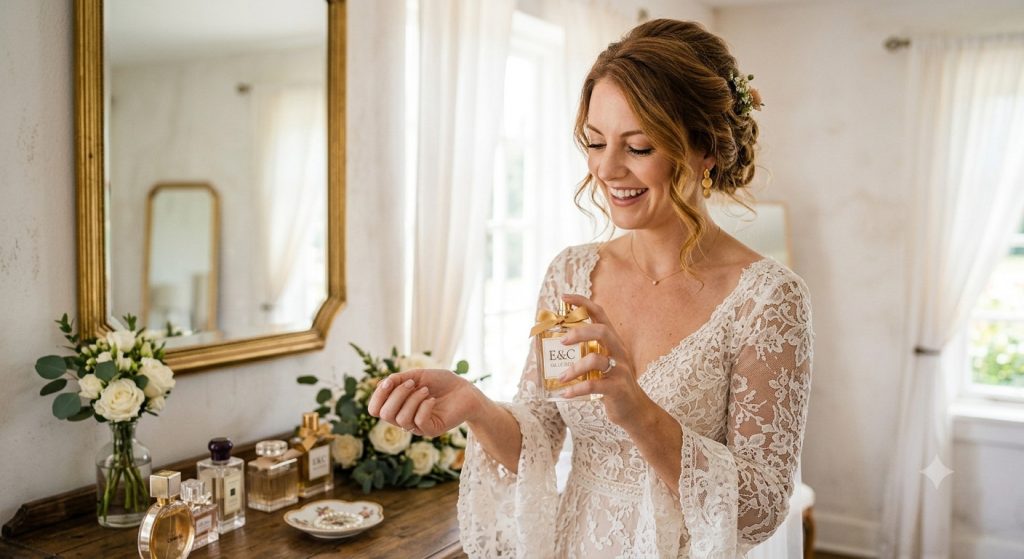
    Picking a wedding fragrance is one of those small decisions that quietly becomes one of the most meaningful. Years from now, a single spritz of that scent can pull you right back to your first dance, your vows, that moment your partner saw you at the end of the aisle.

    Most couples spend months on flowers, cake flavors, and playlists, but barely a thought on the wedding fragrance that will actually anchor those memories in their brain. That’s a shame, because scent is tied more directly to memory than any other sense.

    If you’ve ever caught a whiff of something and been instantly transported back to a specific place or person, you already know how powerful this is. Choosing the right wedding fragrance means giving your future self that same gift.

    Let’s dive in.

    Why Your Wedding Day Scent Matters More Than You Think

    Scent is processed by the olfactory bulb, which sits right next to the brain’s memory and emotion centers — the amygdala and hippocampus. That’s a big reason why smell triggers memory so much faster and more vividly than sight or sound.

    This is why choosing a bridal perfume isn’t just about smelling nice for photos. It’s about creating a sensory anchor. Every time you wear that scent again — an anniversary, a hard day, a moment you need comfort — it can bring back a flood of wedding-day emotion.

    According to the Fragrance Foundation, the global fragrance market is valued at tens of billions of dollars annually, with “special occasion” scent purchases, including bridal fragrance, representing a fast-growing niche within that industry.

    That growth makes sense. More couples are realizing a wedding day scent deserves the same intention as their dress or their vows.

    Think about the fragrances you already associate with people you love. Maybe it’s a parent’s cologne, a grandmother’s perfume, or the scent a partner always wore in the early days of dating. Those associations weren’t planned, yet they became permanent. A wedding fragrance is your chance to create one of those associations on purpose, tied to the happiest day of your life instead of leaving it to chance.

    Why Your Wedding Day Scent Matters More Than You Think

    Finding the Right Wedding Fragrance: What Actually Matters

    Picking a signature wedding scent isn’t about grabbing whatever’s trending at Sephora. It’s a layered decision, and getting it right means thinking through a few key factors.

    1: Match the Scent to the Season and Setting

    A heavy, spicy oriental perfume can feel overwhelming at a summer garden wedding. Meanwhile, a light citrus scent might get lost in a cozy winter ballroom with candles and fireplaces going.

    For spring and summer weddings, lean toward fresh, floral, or green notes — think jasmine, peony, or a crisp neroli. These feel light on skin that’s already warm from dancing and sunshine.

    For fall and winter weddings, richer notes like amber, vanilla, sandalwood, or warm spices tend to feel more at home. They match the coziness of the season and tend to have better projection in cooler air.

    2: Consider How It Wears Over an Entire Day

    Your wedding day is long. Hair, makeup, ceremony, photos, dinner, dancing — you’ll be wearing this scent for twelve-plus hours, often under stage lighting and body heat.

    This is why testing longevity matters so much more than usual. A fragrance that smells lovely for two hours but fades by the ceremony isn’t doing its job. Look for eau de parfum concentrations rather than eau de toilette, since they generally hold up longer.

    Brands like Chanel, Jo Malone, and Maison Francis Kurkdjian are popular for weddings partly because their formulations are known for solid staying power, not just a beautiful opening.

    If you tend to run warm or feel nervous energy easily, factor that in too. Heat accelerates how fast a fragrance evaporates, so what smells moderate on a calm afternoon at the counter might bloom much stronger under wedding-day adrenaline and dance-floor energy. A good way to check this is to test your finalists on a day when you’re doing something active, like running errands, rather than only sniffing them while sitting still at home.

    3: Think About Photos, Not Just Smell

    This sounds strange for a scent decision, but hear it out: a fragrance that makes you feel confident changes your posture, your smile, the way you hold yourself in photos.

    Brides who wear a scent that feels distinctly “them” tend to report feeling calmer and more present during the ceremony. It’s a small psychological anchor in an overwhelming day, and photographers often notice the difference in how relaxed someone looks.

    There’s also a ritual element worth considering. The moment of applying your wedding fragrance, whether it’s alone in a quiet room before getting dressed or shared with bridesmaids getting ready together, can become its own small ceremony. Many brides describe that final spritz as the moment everything feels real, right before the whirlwind of the day begins.

    How to Choose Your Wedding Fragrance: Step-by-Step

    Finding your signature wedding scent doesn’t have to be overwhelming. Here’s a simple process to follow.

    1. Start testing at least 3 months out. Fragrance needs time to be tested properly — you can’t rush this the week before your wedding.
    2. Test on skin, not paper. Perfume reacts with your body chemistry. A scent that’s magic on your best friend might smell completely different on you.
    3. Wear each contender for a full day. Spritz it in the morning and pay attention to how it evolves by evening. That dry-down is often the truest version of the scent.
    4. Narrow to your top 3. Don’t try to decide between ten fragrances at once — your nose gets fatigued and everything starts smelling the same.
    5. Wear the finalists to a dress fitting or rehearsal. See how the scent interacts with the actual setting and your excitement level.
    6. Buy a backup bottle. Discontinuations happen. If you find “the one,” grab an extra bottle to have on hand for anniversaries.
    How to Choose Your Wedding Fragrance Step-by-Step

    Common Mistakes People Make Choosing a Wedding Fragrance

    Choosing a brand-new scent the week of the wedding. Fragrance can smell different after a few hours of wear versus the first spritz. Give yourself time to be sure you love it.

    Picking something too trendy. A scent that’s everywhere right now might feel dated in ten years, and it won’t feel as personal or unique to your memory.

    Over-applying out of nervousness. More isn’t better. Two to three sprays on pulse points is usually plenty for a full day of wear.

    Ignoring your partner’s preferences entirely. Many couples find it meaningful to pick complementary scents, or even a shared note, that ties their individual fragrances together.

    Forgetting to test it alongside your wedding day products. Hairspray, lotion, and sunscreen can all interact with fragrance. Test your full routine together, not the perfume alone.

    Choosing a scent solely because it’s expensive or prestigious. A high price tag doesn’t guarantee it’s right for your skin chemistry or the mood you want on your wedding day. Some of the most memorable bridal fragrances are surprisingly affordable, and the price shouldn’t be the deciding factor over how it actually smells on you.

    Expert Tips for a Wedding Scent You’ll Cherish Forever

    Fragrance specialists often recommend layering scented products, like a matching body lotion under your perfume, to help the fragrance last longer and smell more nuanced throughout the day.

    Another pro tip: apply fragrance to pulse points where blood flow generates warmth — wrists, neck, behind the ears — since heat helps release the scent gradually throughout the day.

    Some brides also love the tradition of choosing a scent their grandmother or mother once wore, creating a generational connection. If sentimentality matters to you, that’s worth exploring alongside the practical details.

    For more inspiration,is a great next read if longevity is your top priority.

    It also helps to think about scent in layers rather than a single product. A matching scented shower gel the morning of the wedding, a light body lotion underneath, and the perfume itself on top of that create a fuller, longer-lasting effect than perfume alone. This layering technique is a favorite trick among fragrance enthusiasts for exactly this reason: it builds a scent that feels rounder and lasts through even the longest reception.

    If you’re torn between two finalists and can’t decide, ask someone close to you, like your partner or a bridesmaid, to smell both without knowing which is which. Sometimes an outside opinion cuts through the indecision faster than another round of testing on your own skin.

    Final Recommendation: Making Your Wedding Fragrance Choice

    At the end of the day, the “right” wedding fragrance is the one that feels unmistakably like you. It should feel like a natural extension of who you are, not a costume you’re borrowing for the occasion.

    Start early, test thoroughly, and trust your gut over trends. The scent that makes you feel most like yourself, on your most important day, is almost always the right answer.

    Making Your Wedding Fragrance Choice

    Conclusion

    Choosing a wedding fragrance is about far more than smelling good for a few hours. It’s about creating a scent memory that will follow you for the rest of your life, one that can bring back the joy of your wedding day with a single breath, years down the road.

    Give yourself time to test, trust how a fragrance evolves on your own skin, and choose something that feels true to you rather than whatever’s trending. Whatever you choose, make it intentional.

    Did you find this helpful? Drop a comment below or share this with a fellow fragrance lover!

    Frequently Asked Questions

    Q1: When should I start looking for my wedding fragrance? A: Start testing at least three months before your wedding. Fragrance needs time to be worn, evaluated over a full day, and reconsidered before you commit. Rushing this decision the week of your wedding often leads to regret, since scents can smell different after several hours of wear than they do on first application.

    Q2: Should my wedding fragrance be different from my everyday perfume? A: Not necessarily, but many brides choose something distinct to make the memory more special. Wearing a completely new scent creates a unique sensory anchor tied only to your wedding day, while sticking with a beloved signature scent keeps things familiar and comforting.

    Q3: How many sprays of perfume should I wear on my wedding day? A: Two to three sprays on pulse points, like wrists and neck, is typically enough for all-day wear. Over-applying can overwhelm guests during hugs and close moments, and a well-chosen eau de parfum shouldn’t need heavy reapplication to last.

    Q4: What’s the best fragrance type for an outdoor summer wedding? A: Light, fresh notes like citrus, green florals, or airy musks tend to work best in summer heat. Heavier oriental or gourmand scents can feel overwhelming once body heat and sunshine intensify their projection.

    Q5: Can my partner and I wear complementary wedding fragrances? A: Absolutely, and many couples love this idea. You might choose scents that share a common note, like a shared vanilla or sandalwood base, so the fragrances feel connected without being identical.

    Q6: What if my signature scent gets discontinued someday? A: This is exactly why it’s worth buying a backup bottle once you’ve found your wedding fragrance. Store it properly, away from heat and sunlight, and it can last for years, ready for future anniversaries.

    How to Choose a Perfume for an Interview

  • How to Choose a Perfume for an Interview

    What you’ll learn

    • The psychology of scent in professional environments and how it influences hiring decisions.
    • How to evaluate fragrance families and concentrations to select a safe, subtle option.
    • A foolproof, step-by-step application method that ensures your scent whispers rather than screams.
    • The critical mistakes candidates make with workplace fragrances and how to avoid them entirely.

    Introduction

    The interview suit is pressed, your resume is flawless, and your answers are practiced to perfection. Yet, as you prepare to make that crucial first impression, one invisible element could silently work for or against you. Learning how to choose a perfume for a high-stakes job interview is an art form that balances personal style with professional restraint.

    Smell is our most primal sense, directly linked to the brain’s limbic system, which governs memory and emotion. A harsh, overwhelming cloud of fragrance can create an instant barrier before you even shake hands. Conversely, the right scent can subtly project cleanliness, organization, and calm confidence.

    Navigating the vast world of fragrance to find that perfect, office-safe scent profile requires a bit of strategy. You want your skills to take center stage, not your cologne. Let’s dive in.

    The Power of Olfactory First Impressions

    Before booking a slot at your local beauty counter, it helps to understand why fragrance carries so much weight in a professional setting. Human beings process smells instantly, and a 2018 study published in the journal Cognitive Research: Principles and Implications highlighted how ambient and personal scents deeply influence our cognitive evaluations of others. When an interviewer meets you, their brain processes your visual appearance, body language, and olfactory signature simultaneously.

    Choosing the wrong fragrance can trigger negative subconscious reactions. Your interviewer might have an allergy, an aversion to heavy vanilla, or a vivid, unpleasant memory associated with a specific heavy musk. In the tight quarters of an interview room or a corporate boardroom, a polarizing scent leaves nowhere to hide.

    Therefore, your primary goal when learning how to choose a perfume for this specific scenario is risk mitigation. You are not trying to stand out as the most avant-garde fragrance connoisseur in the building. Instead, you are aiming for an aura of crisp, well-groomed professionalism that complements your professional attire.

    The Power of Olfactory First Impressions

    Navigating Scent Profiles for the Workplace

    The heart of fragrance selection lies in understanding scent families. Perfumes are broadly categorized into groups like citrus, floral, woody, oriental, and fresh. For an interview, you want to steer clear of heavy, opulent, or overly sweet categories and gravitate toward clean, minimalist profiles.

    The Fresh and Citrus Category

    Citrus-based fragrances are generally considered the safest bet for corporate environments. Notes of bergamot, lemon, mandarin, and orange blossom evoke a sense of cleanliness, energy, and alertness. These scents are inherently uplifting and rarely offend the senses, making them excellent choices for early morning meetings.

    Excellent real-world examples include Jo Malone London Lime Basil & Mandarin or Chanel Chance Eau Fraîche. These fragrances open with a bright, crisp sparkle that fades into a polite, clean skin scent. They give the impression that you just stepped out of a luxury shower, which is exactly the vibe you want to project.

    The Soft Woody and Earthy Category

    If citrus feels a bit too fleeting for your taste, soft woody fragrances offer a grounded, stable alternative. Look for scents featuring light cedarwood, sandalwood, or vetiver. These notes project maturity, calm, and reliability without the aggressive projection of heavier resins or dark patchouli.

    Consider a fragrance like Molecule 01 by Escentric Molecules, which relies on a single aroma-chemical ($Iso\ E\ Super$) to create a subtle, cedar-like aura that melts into your natural skin chemistry. Another fantastic option is Prada L’Homme, which beautifully blends clean iris with a smooth, powdery wood base that smells remarkably like high-end soap.

    The Clean Musk and Powdery Category

    Clean white musks and powdery notes mimic the aroma of fresh laundry, starched cotton shirts, and fine talcum powder. They create a soft bubble around you that feels comforting yet thoroughly professional. This category avoids the sweet, gourmand traps of caramel and vanilla, which can come across as too casual or playful for an interview.

    Glossier You is a stellar example of this category, relying on iris root and ambrette seeds to create a personal, low-projection scent. It smells familiar, soft, and completely non-threatening, ensuring that your interviewer focuses entirely on your answers rather than your perfume.

    The Step-by-Step Guide to Scent Selection and Application

    Mastering how to choose a perfume is only half the battle; how you wear it matters just as much. Follow this strategic approach to ensure your fragrance choices enhance, rather than detract from, your professional presentation.

    1. Analyze the Company Culture: A tech startup in Silicon Valley demands a different approach than a traditional law firm on Wall Street. Match your scent density to the company’s overall vibe. When in doubt, always err on the side of lighter options.
    2. Check the Concentration: Avoid Parfums or Eaux de Parfum (EDP) with heavy oil concentrations, as they linger in the air for hours. Instead, opt for an Eau de Toilette (EDT) or an Eau de Cologne (EDC), which naturally have lower longevity and softer sillage.
    3. The 24-Hour Test Run: Never wear a brand-new perfume to an interview. Test it the day before. Track how it evolves on your skin over four hours to ensure the base notes do not turn overly sweet, sour, or heavy.
    4. Time Your Application Perfectly: Apply your fragrance at least 30 to 45 minutes before your scheduled interview time. This allows the volatile top notes to dissipate, leaving behind the softer, more subdued heart and base notes by the time you shake hands.
    5. Practice Strategic Placement: Restrict your application to just one or two sprays maximum. Spray your wrists or the back of your neck. Avoid spraying your clothes, as fabric holds onto the intense top notes of a perfume much longer than warm skin.
    The Step-by-Step Guide to Scent Selection and Application

    Critical Scent Mistakes Candidates Make

    Even the most qualified candidates can accidentally sabotage their chances by falling into common fragrance traps. The most frequent mistake is simply over-applying. Because we quickly become habituated to our own signature scents (a phenomenon known as olfactory fatigue), we often assume others cannot smell us. You might think your perfume is subtle, while your interviewer feels trapped in a cloud of it.

    Another major misstep is choosing gourmand or overtly seductive fragrances. Scents heavy in dark chocolate, coffee, thick vanilla, heavy amber, or deep oud are magnificent for a romantic dinner or a night out with friends, but they are completely out of place in a professional office setting. They can come across as overly casual, distracting, or overly dramatic.

    Finally, do not try to use perfume to mask other odors, such as cigarette smoke, strong food spices, or sweat. Mixing a fresh citrus perfume with heavy smoke creates a highly unpleasant, chaotic aroma that is instantly noticeable. If you are worried about freshness, rely on an unscented deodorant, crisp clothing, and a mint before you walk through the door.

    Pro Insights on Fragrance Longevity and Sillage

    When evaluating perfumes for professional wear, experts focus heavily on two specific terms: sillage and projection. Sillage refers to the trail of scent left behind by someone walking past, while projection dictates how far the scent travels from your body while you are stationary. For an interview, you want a scent with intimate projection—meaning it can only be detected within an arm’s length.

    If you struggle with fragrances fading too quickly but don’t want a heavy scent, try applying an unscented lotion to your pulse points before spraying your perfume. Hydrated skin holds onto light citrus and fresh notes much better than dry skin, extending the life of an Eau de Toilette without increasing its volume or making it louder.

    Remember, you can also explore alternative fragrance formats. A scented hair mist, a luxury body wash, or a lightly fragranced body lotion can provide a whisper of clean aroma that never feels overpowering. For more tips on building a functional scent wardrobe for daily office life, check out our comprehensive guide on.

    Final Recommendations for Interview Success

    When you are figuring out how to choose a perfume for your next big career move, simplicity remains your greatest asset. Your scent should act like a classic wristwatch or a tailored blazer—a subtle finishing touch that rounds out your presentation without demanding its own round of applause.

    If you are genuinely feeling anxious about choosing a fragrance, the safest choice is to skip perfume entirely. Clean clothes washed in a mild detergent and a reliable, unscented antiperspirant are more than enough to ensure you smell clean, fresh, and professional. However, if a light spray of a favorite crisp citrus or soft wood gives you a much-needed boost of personal confidence, go for it with restraint.

    Final Recommendations for Interview Success

    Conclusion

    Landing your dream job requires aligning every detail of your presentation, from your opening handshake to your final follow-up email. Taking the time to understand how to choose a perfume that respects professional boundaries shows a high level of social awareness and emotional intelligence. By selecting light, clean, and low-projection scent profiles, you ensure that your personality and professional qualifications remain the absolute star of the show. Trust your preparation, keep your application light, and walk into that room with complete peace of mind.

    Did you find this helpful? Drop a comment below or share this with a fellow fragrance lover who is currently hunting for a new job!

    Frequently Asked Questions

    Q1: Can I wear my daily signature perfume to a job interview?

    A: It depends entirely on the scent profile of your daily favorite. If your signature perfume is a light, clean citrus, a soft white musk, or a powdery iris, it is likely safe for an interview if applied sparingly. However, if your daily go-to is a rich oriental, a heavy gourmand, or a deep, smoky oud, it is best to leave it at home and opt for a much lighter alternative.

    Q2: How many sprays of perfume are acceptable for a professional interview?

    A: One to two sprays maximum is the golden rule for any professional setting. Apply a single spray to your wrists and gently dab them together, or apply one spray to the back of your neck. This ensures your fragrance stays within your immediate personal space bubble and does not overwhelm the entire room.

    Q3: What should I do if I accidentally apply too much perfume before an interview?

    A: Do not panic. If you realize your fragrance is too strong, take a cotton ball soaked in rubbing alcohol or warm soapy water and firmly wipe down the skin where you applied the scent. This will break down the fragrance oils effectively. If you sprayed your clothes, your best option is to change into a fresh shirt before heading out.

    Q4: Are solid perfumes a good choice for job interviews?

    A: Absolutely. Solid perfumes, which are wax-based, are fantastic for interviews because they naturally have a much lower projection than alcohol-based sprays. They sit incredibly close to the skin, creating an intimate scent bubble that can typically only be noticed by someone sitting right next to you or leaning in for a handshake.

    Q5: Should men wear heavy colognes or aftershaves to an interview?

    A: No, men should avoid heavy, traditional barbershop colognes, strong marine scents, or intense leathery aftershaves for interviews. Instead, men should look for clean, soapy, or light woody options, such as vetiver or light cedar. The goal is to smell freshly showered and groomed, rather than heavily perfumed.

    Q6: Is it better to wear no perfume at all to an interview?

    A: If you are interviewing in the healthcare sector, a medical facility, or an environment with strict fragrance-free policies, you should absolutely wear zero perfume. For other industries, if you are unsure about how to choose a perfume or worry your choice might be too strong, going scent-free is always the safest, most professional decision.

    How to Get Rid of Perfume Smell From Clothes Fast

  • How to Get Rid of Perfume Smell From Clothes Fast

    What you’ll learn

    • Why synthetic fragrance molecules cling so tightly to your clothes.
    • Quick, no-wash remedies for delicate and dry-clean-only fabrics.
    • Highly effective laundry techniques using common household pantry items.
    • Crucial mistakes to avoid so you don’t lock the scent in forever.

    Introduction

    We have all been there before. You walk into a luxury department store, get overzealous with a tester bottle of a rich, warm winter scent like Tom Ford Black Orchid, and suddenly your favorite sweater is trapped in a cloud of heavy fragrance. While a beautiful perfume makes a wonderful signature statement, an overpowering aroma can quickly become suffocating, trigger headaches, or clash aggressively with your next day’s choice of scent.

    Learning how to get rid of perfume from your wardrobe doesn’t have to mean throwing things into an endless cycle of harsh washes. Fragrance molecules are specifically designed to last, binding tightly to both natural and synthetic fibers.

    Fortunately, you can reclaim your clothes and restore their fresh, clean neutrality with a few simple, strategic laundry hacks and clever household ingredients. Whether you are dealing with a spilled decant or a lingering thrift store find, this ultimate guide will walk you through the process step-by-step. Let’s dive in.

    Understanding How to Get Rid of Perfume: Why Scents Stick

    To beat the aroma, you need to understand exactly what you are fighting against. The global fragrance industry relies heavily on complex chemical engineering to ensure that perfumes linger on skin and textiles for as long as possible. In fact, many modern high-end Eau de Parfums boast oil concentrations between 15% and 20%, featuring heavy synthetic base notes like Ambroxan, ISO E Super, and crystalline musks that resist evaporation.

    These fixatives function like an invisible anchor. When you spray a fragrance, the bright, volatile top notes like citrus or light florals dissipate within an hour. However, the heavy, resinous, or powdery base notes sink deep into the microscopic pores of your clothing fibers.

    Synthetic fabrics like polyester, nylon, and acrylic are especially notorious for gripping onto oil-based fragrance compounds. Because these materials are petroleum-based, they share a chemical affinity with perfume oils, making a standard quick wash cycle virtually useless against them.

    Understanding How to Get Rid of Perfume Why Scents Stick

    The Best Laundry Methods to Eliminate Fragrance Molecules

    If your garment is machine washable, the laundry room is your first line of defense. Standard commercial detergents often contain optical brighteners and synthetic scents that merely mask odors rather than stripping them away. To truly neutralize the fragrance, you need to reach for targeted, deep-cleaning agents.

    The Power of White Vinegar and Baking Soda

    Household baking soda is a natural amphoteric substance, meaning it chemically reacts with both strong acids and bases to neutralize odors rather than masking them. To start, fill a clean sink or basin with warm water and submerge your scented garment.

    Add one full cup of baking soda to the water, stirring gently to ensure it dissolves completely. Allow the clothing to soak for at least four to six hours, or ideally overnight, giving the sodium bicarbonate ample time to draw the trapped oils out of the fabric weave.

    After soaking, thoroughly rinse the garment and place it into your washing machine. Instead of standard fabric softener, which leaves behind a waxy coating that traps odors, pour half a cup of distilled white vinegar into the fabric softener dispenser. The acetic acid in the vinegar works to break down the remaining perfume bonds while naturally softening the fibers.

    Utilizing Heavy-Duty Odor Eliminators

    When dealing with incredibly stubborn, syrupy sweet gourmand perfumes or heavy oud fragrances, everyday pantry items might need a boost. This is where specialized laundry additives like OxiClean Odor Blasters or sport-specific detergents come into play. These formulas utilize complex enzyme blends specifically engineered to digest organic compounds and oily residues.

    Always select the warmest water temperature setting recommended on your garment’s care label. Warm water expands the fabric fibers, allowing the enzymatic cleaners to penetrate deep into the core of the yarn.

    For an extra boost, pause your washing machine cycle once the drum has filled and agitated for five minutes. Let the clothes sit submerged in the enzyme-rich soapy water for 30 minutes before allowing the machine to complete its regular cycle.

    The Double-Wash Technique for Persistent Scents

    For vintage clothing items or jackets soaked in decades of powdery aldehydes, a single wash cycle rarely does the trick. You will need to implement a dedicated two-step washing protocol to guarantee complete scent removal.

    First, run the clothing through a cycle using a completely unscented, clear liquid detergent alongside an odor-eliminating booster. Do not use commercial dryer sheets or scented pods during this stage.

    Once the first cycle finishes, immediately start a second consecutive wash cycle. This time, add only one cup of white vinegar to the drum and run a thoroughly deep rinse cycle to flush out every last microscopic trace of liberated perfume oil.

    How to Get Rid of Perfume Without Washing Your Clothes

    Not every clothing item can survive a trip through the washing machine. Tailored blazers, delicate silk blouses, and structured wool coats require alternative, dry-cleaning-safe interventions to lift away unwanted aromas safely.

    Harnessing the Power of Fresh Air and UV Rays

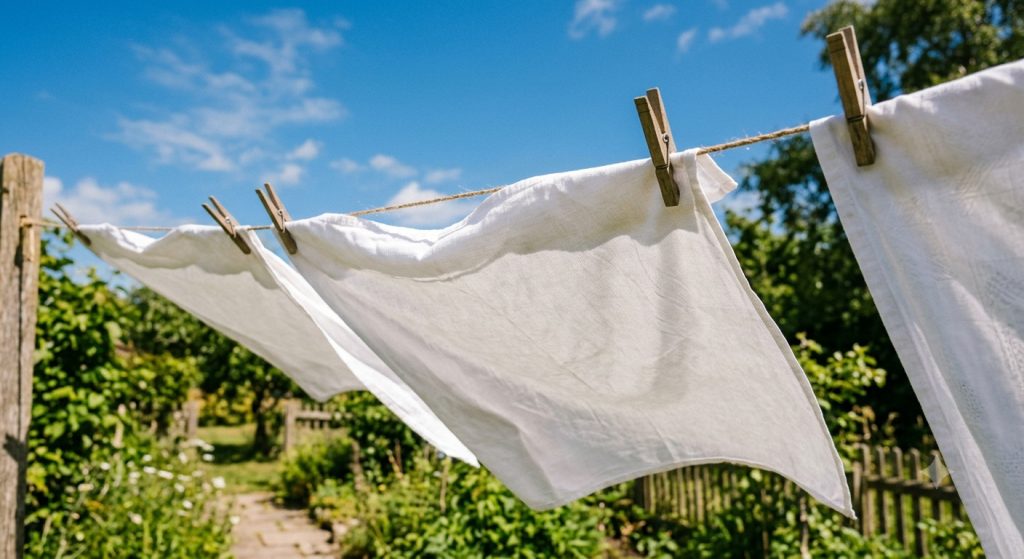
    Nature provides one of the absolute most powerful odor-eliminating tools completely free of charge. Sunlight emits natural ultraviolet (UV) rays that actively break down the chemical bonds of complex fragrance compounds. Combined with a gentle moving breeze, outdoor airing can work absolute wonders on heavily scented items.

    Hang your perfume-laden clothing on a sturdy wooden or plastic hanger and place it outdoors in a well-ventilated, shaded area. Direct, intense sunlight can fade vibrant dyes, so a bright, breezy covered porch or a shady spot beneath a tree canopy is ideal.

    Leave the garment outside for a full day. The moving air acts as a natural volatilizer, carrying away the stubborn molecules as they slowly release from the fabric.

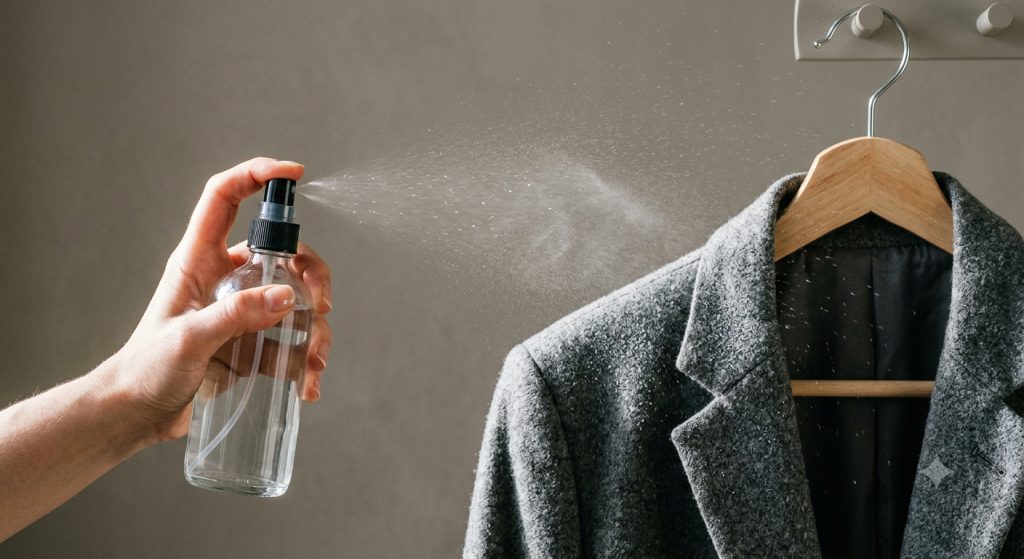
    The Rubbing Alcohol or Vodka Spray Method

    If you need a rapid solution before heading out the door, look no further than your liquor cabinet or first aid kit. Cheap, high-proof unflavored vodka or standard 70% isopropyl rubbing alcohol serves as an excellent solvent for perfume oils.

    As the alcohol evaporates into the air, it chemically binds with the perfume oils, lifting them away from the textile fibers without leaving any lingering scent or residue behind.

    The Rubbing Alcohol or Vodka Spray Method

    Activated Charcoal and Enclosed Spaces

    For structured garments like heavy winter coats or delicate vintage knits that cannot tolerate moisture, passive absorption is the safest path forward. Activated charcoal possesses an incredibly porous molecular structure, creating a massive surface area that acts like a magnet for airborne odors and volatile organic compounds.

    Place your scented clothing inside a large, sealable plastic storage bin or a heavy-duty garment bag. Tuck three to four breathable fabric pouches filled with activated charcoal briquettes into the bottom of the container.

    Seal the box tightly and leave it undisturbed for five to seven days. The charcoal will slowly and steadily draw the ambient fragrance molecules out of the fabric matrix, trapping them permanently within its carbon pores.

    The Steam Treatment for Quick Refreshing

    Heat and moisture can work together to open up tight fabric weaves, releasing stubborn oils that are locked deep inside the threads. A high-quality handheld garment steamer is perfect for this task.

    Hang your garment up and slowly pass the steaming nozzle down the length of the fabric, keeping a distance of two to three inches to avoid water spotting. The hot vapor relaxes the fibers, effectively liquefying the heavy base notes of the perfume.

    Immediately after steaming, hang the item directly in front of an open window or an oscillating fan to ensure the loosened fragrance molecules are blown away rather than settling right back into the cooling cloth.

    Fabric-Specific Guides: Delicate vs. Sturdy Materials

    Different fabrics require drastically different levels of care. Using a method designed for sturdy denim on a delicate silk blouse could permanently ruin the texture or integrity of your garment.

    Fabric TypePrimary RiskBest Removal Method
    Silk & SatinWater spotting, fiber frictionVodka spray or charcoal box
    Wool & CashmereFelting, shrinkageOutdoor air drying & gentle steaming
    Leather & SuedeDrying out, discolorationCornstarch extraction & professional care
    Cotton & LinenColor bleedingBaking soda soak & vinegar rinse
    Polyester & NylonOil retentionHeavy-duty enzyme wash

    Saving Silk, Wool, and Cashmere From Overpowering Scents

    Natural protein fibers like silk, wool, and cashmere are highly sensitive to pH extremes. This means heavy applications of acidic vinegar or alkaline baking soda can occasionally degrade their delicate structures.

    For wool and cashmere knits, opt for a long, slow airing out process in a room with high humidity, such as a bathroom after a hot shower. The ambient steam gently coaxes the scent out without risking shrinkage. For precious silks, stick exclusively to the dry activated charcoal box method to preserve the fabric’s luminous sheen and fluid drape.

    Clearing Fragrances Out of Leather and Suede Jackets

    Leather and suede are highly porous animal skins that eagerly absorb oils, making perfume removal a delicate balancing act. Never spray liquid solutions directly onto suede, as this will instantly ruin the soft nap.

    Instead, dust a generous layer of fine cornstarch or arrowroot powder directly over the affected areas of the jacket. Allow the powder to sit for 24 hours to absorb the surface oils, then gently brush it away with a soft-bristled suede brush. For deep-set odors in heavy leather, hanging the jacket in a closet alongside an open container of baking soda is the safest hands-off approach.

    Purging Perfumes From Denim and Heavy Cottons

    Heavy cottons, canvas, and denim are incredibly durable, meaning you can utilize more aggressive treatments without fear of structural damage. These hardier textiles respond beautifully to the hot water double-wash technique.

    If a pair of jeans still carries a stubborn fragrance after washing, try tossing them into the dryer on a low heat setting accompanied by a clean, dry terry cloth towel. The friction of the towel helps pull remaining residues off the denim, though you must ensure the scent is mostly gone before applying dryer heat.

    Common Mistakes to Avoid When Removing Scent

    When people discover their favorite shirt smells overwhelmingly like a perfume counter, panic often sets in. Unfortunately, rushing the cleaning process usually leads to common tactical errors that end up setting the fragrance permanently.

    • 1: Shoving the garment straight into a hot dryer. Applying high, dry heat to a garment that still smells of perfume will thermally bake the synthetic oil molecules directly into the core of the fabric fibers. Once a fragrance is heat-set, removing it becomes exponentially more difficult, if not impossible. Always verify the scent is 100% gone while the garment is still damp.
    • 2: Overloading on scented fabric softeners and dryer sheets. Trying to mask an intense perfume like Maison Francis Kurkdjian Baccarat Rouge 540 with a “Mountain Spring” fabric softener creates a chaotic, unpleasant olfactory soup. Furthermore, fabric softeners leave a slippery silicone coating over the fabric, sealing the bad odors beneath a fresh chemical barrier.
    • 3: Rubbing the fabric vigorously with damp cloths. If you accidentally spray too much perfume on your sleeve, your immediate reaction might be to scrub the spot with a wet paper towel. This friction pushes the oil molecules deeper into the textile weave and can easily pill or fray delicate threads. Instead, always blot the area firmly with a dry, clean microfiber cloth.

    Pro Tips from Perfumers to Keep Fabrics Fresh

    The absolute best way to manage heavy fragrance buildup on your wardrobe is to prevent it from happening in the first place. Professional perfumers understand how scents interact with various mediums and utilize clever application habits to protect their clothing.

    First, make it an ironclad rule to apply your fragrance directly to your bare skin before putting on your clothes. Focus on your classic warm pulse points—like the wrists, the base of the throat, and behind the ears.

    Allow the perfume to dry down completely for three to five minutes before pulling your shirt over your head. This gives the alcohol base time to evaporate fully, leaving the oils bound to your skin’s natural lipids rather than absorbing directly into your clothing’s dry yarn.

    Additionally, consider creating a dedicated “fragrance barrier” if you love wearing incredibly heavy, resinous, or oriental scents. Wearing a simple, lightweight cotton undershirt or camisole protects your expensive wool sweaters and dry-clean-only silks from absorbing your personal scent signature.

    Summary of the Ultimate Scents-Off Strategy

    Getting rid of a stubborn, lingering perfume aroma requires matching the right counter-measure to your specific fabric type. For your everyday washable wardrobe pieces, a simple overnight soak in a warm baking soda bath followed by a crisp white vinegar rinse will easily clear out the most resilient fragrance anchors.

    When dealing with structured luxury items, tailored evening wear, or delicate vintage treasures, rely on passive absorption methods like activated charcoal boxes or a light, refreshing mist of high-proof vodka.

    Always resist the temptation to mask the smell with heavily scented commercial detergents, and never let a fragrant item enter the dry cycle until you are completely certain the fabric has returned to a perfectly neutral state.

    Summary of the Ultimate Scents-Off Strategy

    Conclusion

    An accidental over-spraying of a potent luxury perfume doesn’t mean your favorite wardrobe pieces are ruined forever. By understanding the oil-based chemistry of modern fragrances and employing gentle, targeted neutralizing agents like white vinegar, baking soda, and fresh open air, you can easily restore your clothes to their original, pristine condition. Take your time, treat your delicate fabrics with care, and always air-dry your items whenever you are in doubt.

    Did you find this helpful? Drop a comment below or share this with a fellow fragrance lover who needs to rescue their wardrobe!

    Frequently Asked Questions

    Q1: How do I get rid of perfume smell from clothes that are dry clean only?A: The safest method for dry-clean-only items is to place them inside a sealed plastic bin with several pouches of activated charcoal for three to five days. Alternatively, you can hang the garment in a breezy, shaded outdoor area for 24 hours, or lightly mist the inside of the item with high-proof unflavored vodka, which dissolves and lifts perfume oils as it evaporates.

    Q2: Will white vinegar ruin my colored clothes if I use it to remove fragrance?A: No, distilled white vinegar is completely safe for standard colored laundry when used correctly. In fact, vinegar actually helps set fabric dyes and removes dulling soap scum residues. Simply add half a cup of white vinegar directly to your washing machine’s fabric softener dispenser during the rinse cycle to neutralize stubborn perfume oils safely.

    Q3: Can I use baking soda on delicate fabrics like wool or silk?A: You should use caution when applying baking soda to delicate animal fibers like silk and wool. Baking soda is mildly alkaline, and prolonged exposure can occasionally coarsen or weaken these delicate protein-based materials. For wool and silk, it is much safer to use dry activated charcoal absorption or a gentle, localized steaming method instead.

    Q4: Why does my shirt still smell like perfume even after being washed twice?A: This usually happens because the perfume contains heavy synthetic fixatives like Ambroxan or crystalline musks, which bond tenaciously to petroleum-based synthetic fabrics like polyester. If you used standard detergent, it likely just coated the fibers. Try a pre-soak in baking soda followed by an enzymatic sports detergent wash to break down the resilient oils.

    Q5: How do you remove spilled perfume liquid directly from a fabric surface?A: Instantly blot the spill firmly with a clean, dry microfiber cloth to absorb as much excess liquid oil as possible—never rub the spot. Once blotted, dust the area heavily with cornstarch or talcum powder to draw out the remaining dampness. Let it sit for four hours, brush the powder away, and then treat the spot with an unscented liquid dish soap.

    Q6: Does hanging clothes in the sun always remove fragrance?A: Sunlight is incredibly effective because UV rays break down the complex chemical structures of perfume molecules. However, while a bright, breezy day will drastically fade most scents within a few hours, you should keep vibrant or dark clothes in a shaded, well-ventilated spot instead, as direct sunlight can cause fabric dyes to prematurely fade.

    How to Test Perfume Before You Buy (Online & In-Store)

  • How to Test Perfume Before You Buy (Online & In-Store)

    What you’ll learn

    • How to navigate department store counters without getting olfactory fatigue.
    • The best websites and subscription services for sourcing cheap, authentic fragrance samples.
    • How to properly wear and analyze a scent on your skin over a 24-hour period.
    • Common testing mistakes that lead to costly buyer’s remorse.

    Introduction

    We have all been there. You walk into a luxury boutique, catch a whiff of a gorgeous bottle, and immediately fall in love. You buy it on the spot, take it home, and apply it the next morning. Within an hour, that bright, sparkling opening vanishes, leaving behind a heavy, cloying base note that gives you an instant headache.

    Learning how to test perfume before you buy is the only foolproof way to protect your wallet and curate a fragrance wardrobe you actually adore. Perfume behaves like a living entity on your skin, shifting and evolving over several hours. Because a high-quality bottle can easily cost anywhere from $100 to over $350, guessing is a luxury few can afford.

    Fortunately, the modern fragrance landscape makes it incredibly easy to sample scents before committing to a full-sized bottle. Whether you prefer strolling through high-end boutiques or shopping from the comfort of your couch, strategic sampling ensures you always make the right choice. Let’s dive in.

    Why You Should Never Blind Buy a Fragrance

    The global fragrance market is booming, expected to surpass $70 billion within the next few years. With hundreds of new designer and niche releases hitting the shelves annually, the temptation to “blind buy”—purchasing a bottle based solely on online reviews or beautiful packaging—is higher than ever. However, relying on a marketing description or a friend’s recommendation is a risky gamble.

    The primary reason to master how to test perfume before you buy comes down to unique skin chemistry. Every individual has a distinct skin pH, lipid level, and body temperature. A fragrance that smells like a crisp, green paradise on your friend might turn unpleasantly sour or metallic on your skin.

    Furthermore, perfumes are constructed around a three-tier pyramid structure: top notes, heart notes, and base notes. The top notes are what you smell during the first 15 minutes, but they quickly evaporate. Buying a fragrance based entirely on that initial burst often leads to major disappointment later in the day.

    Why You Should Never Blind Buy a Fragrance

    Master the Art of In-Store Perfume Testing

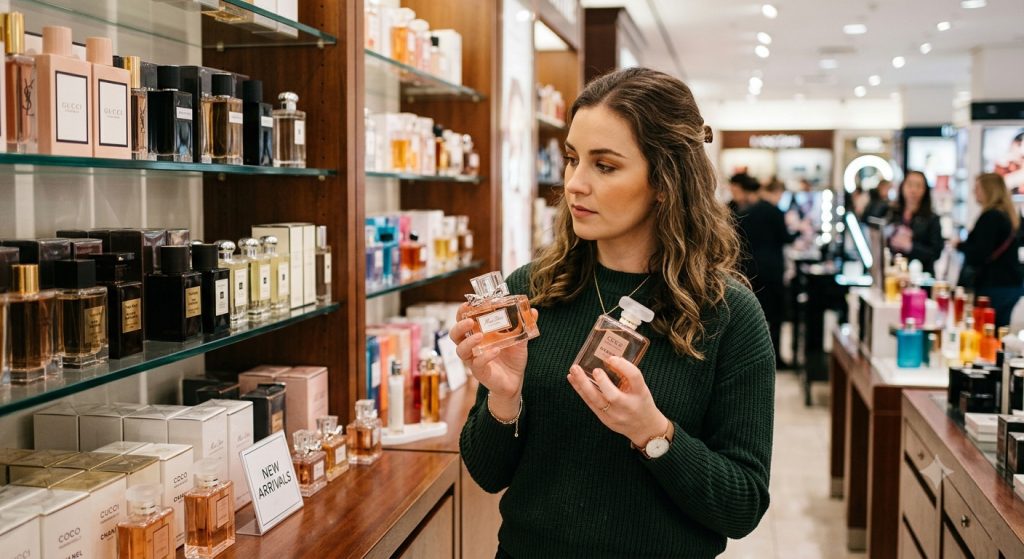
    Visiting a physical retailer remains the traditional way to discover new scents. However, walking into a perfume department without a game plan can quickly overwhelm your senses. To get the most out of your trip, you need to approach the fragrance counter like a seasoned professional.

    The Blotter Paper Strategy

    When you first approach a display, your initial tool should always be the paper blotter strip. Spray the perfume onto the paper from a distance of about six inches, let it air-dry for ten seconds, and then take a gentle sniff. This allows the harsh alcohol content to dissipate so you can experience the true top notes.

    Write the name of the fragrance on the back of the card immediately. If you skip this step, you will inevitably end up with a pocket full of mystery papers and no idea which scent belongs to which brand. Carry these strips with you as you walk around the mall to see how they evolve over an hour.

    The Skin Test Limitation

    Once you have narrowed your choices down from the paper strips, it is time to test the frontrunners on your skin. This is a crucial step in learning how to test perfume before you buy. Never test more than two fragrances on your skin at any given time.

    Apply one spray of the first scent to your left wrist and one spray of the second scent to your right wrist. If you want to test two more, you can use the inside of your elbows. Anything beyond four sprays will bleed together in the air, completely confusing your nose and ruining your evaluation.

    Managing Olfactory Fatigue

    Your nose has natural limits. After smelling three or four strong fragrances back-to-back, your olfactory receptors become desensitized. This phenomenon, known as olfactory fatigue, makes everything smell muddy or muted.

    To reset your nose, look for small jars of coffee beans often placed on fragrance counters, though a better trick is simply to smell your own clean skin or a wool sleeve. The familiar scent of your own body resets your nasal passages far more effectively than pungent coffee beans ever could.

    How to Test Perfume Before You Buy Online

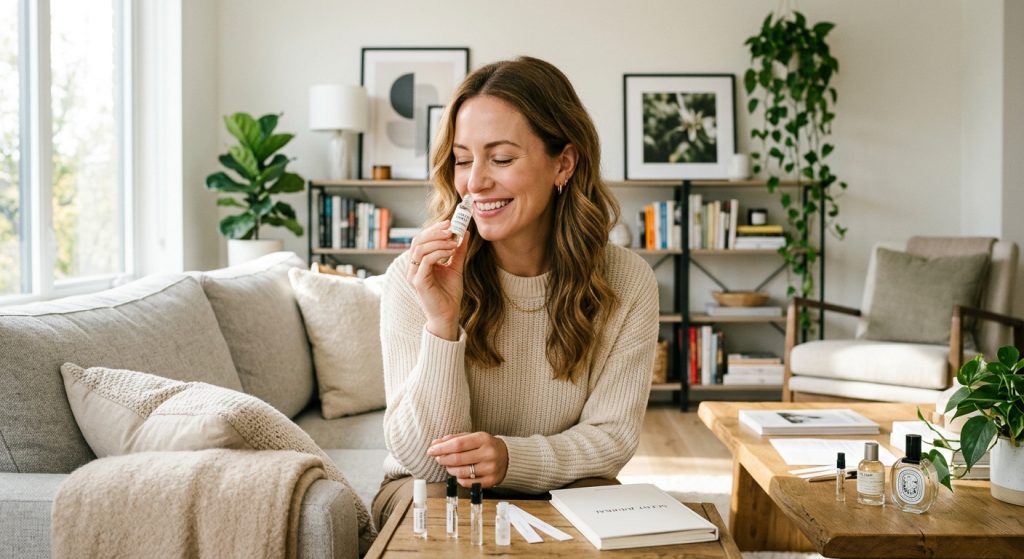
    The digital age has completely revolutionized the way we shop for luxury scents. You no longer need to deal with aggressive salespeople to find your next signature scent. Testing perfumes at home has become the preferred method for modern fragrance enthusiasts.

    How to Test Perfume Before You Buy Online
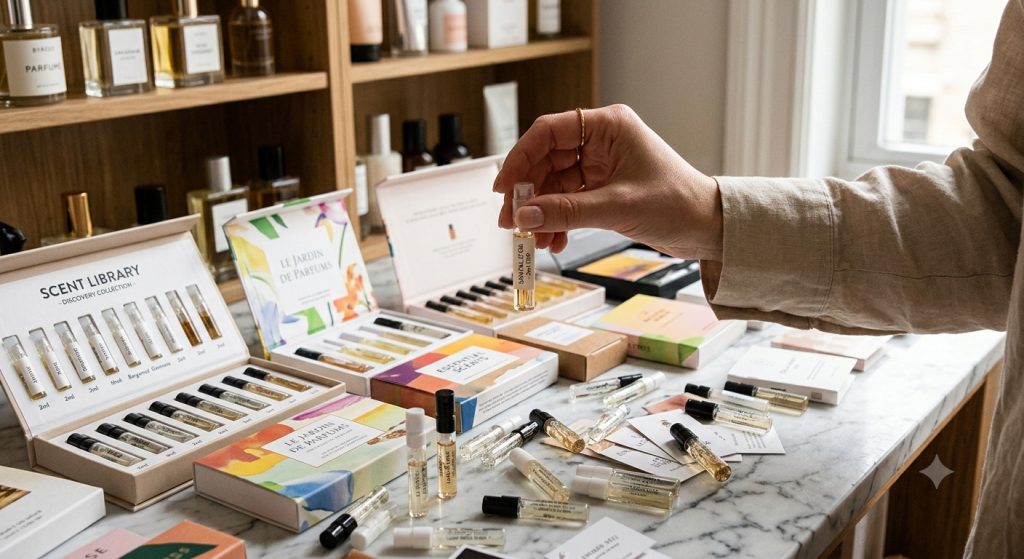
    1. Purchase Decants from Reputable Sites: Websites like Surrender to Chance, The Perfumed Court, and Scent Split buy authentic, full-sized bottles of designer and niche fragrances and transfer them into tiny glass spray vials. You can buy 1ml or 2ml samples for a fraction of the cost of a full bottle.
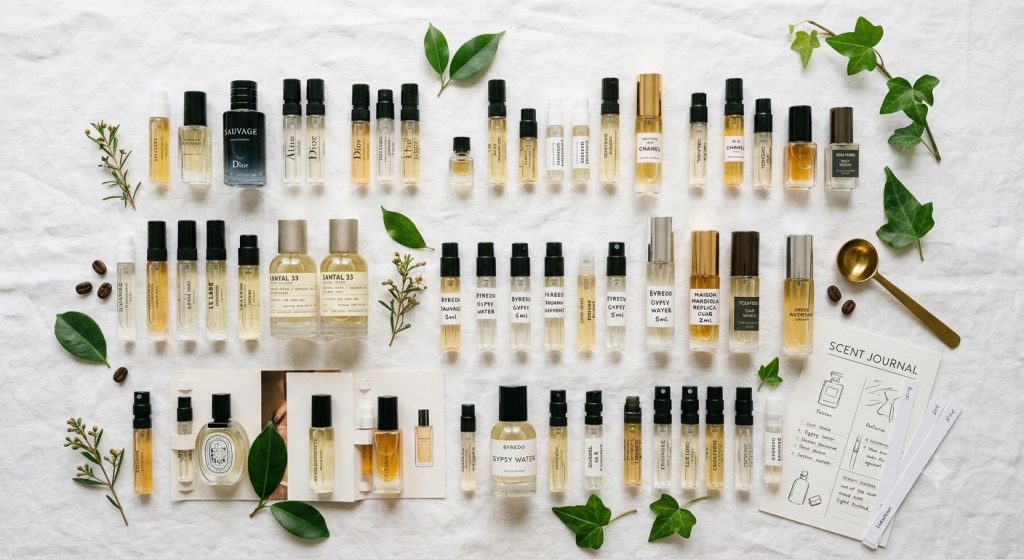
    2. Order Official Brand Discovery Sets: Luxury houses like Maison Francis Kurkdjian, Byredo, and Creed sell official discovery boxes containing mini vials of their bestselling scents. These sets often come with a digital coupon that refunds the cost of the set against a future full-sized purchase.
    3. Utilize Fragrance Subscription Services: Joining a monthly subscription club allows you to choose an 8ml travel atomizer of a premium scent every 30 days. This gives you roughly 120 sprays, which is more than enough to thoroughly test a perfume before buying a large bottle.
    4. Leverage Free Samples at Online Checkout: Whenever you purchase cosmetics, skincare, or grooming items online, always select fragrance vials as your free samples at checkout. Over time, you will build a diverse sampling library without spending an extra dime.

    Common Perfume Testing Mistakes to Avoid

    Even seasoned beauty shoppers fall victim to bad habits at the fragrance counter. Avoiding these common pitfalls will drastically improve your accuracy when evaluating a new scent and save you from making expensive mistakes.

    The biggest mistake people make is rubbing their wrists together after applying a perfume. You have likely seen dozens of people do this, but it actually ruins the fragrance. Rubbing creates friction and heat, which crushes the delicate top notes and forces the perfume to skip straight to its base notes, altering the intended scent profile.

    Another frequent error is wearing scented body lotions or heavy deodorants on the day you go fragrance shopping. If your skin is already covered in a coconut-vanilla body butter, any perfume you spray on top will mix with that lotion. You will not get an accurate reading of how the perfume smells on its own.

    Finally, never buy a perfume based on how it smells on another person. Skin chemistry is deeply influenced by diet, hormone levels, and even stress levels. A perfume that smells like warm, cozy amber on a coworker might turn into a sharp, synthetic mess on your own skin.

    The 24-Hour Wear Test Protocol

    To truly understand a fragrance, you must put it through a comprehensive wear test. This step-by-step process allows you to evaluate the longevity, projection, and overall wearability of a scent in your real life.

    Start by applying the sample to clean, moisturized skin in the morning. Use a fragrance-free lotion, as well-hydrated skin holds onto scent particles much longer than dry skin. Spray the perfume onto your pulse points—the wrists and the base of the neck—where body heat naturally radiates and projects the aroma.

    Check in with the scent at three specific intervals throughout the day:

    Time ElapsedFragrance StageWhat to Evaluate
    First 15 MinutesThe OpeningEnjoy the bright, volatile top notes like citrus, mint, or light fruits.
    2 to 3 HoursThe HeartThe core identity emerges. Notice the floral, spicy, or green notes.
    6+ HoursThe Dry DownThe true base remains. Look for rich woods, musk, vanilla, or resins.

    Pay close attention to how the scent makes you feel during these different stages. Does it complement your mood, or does it start to annoy you by afternoon? A great fragrance should bring you joy from the initial spray until it fades away into a faint skin scent.

    Final Recommendations for Smart Shopping

    Now that you know exactly how to test perfume before you buy, you can approach your next fragrance purchase with total confidence. Treat sampling as a fun, low-pressure exploration rather than a rushed chore. The journey of discovering how different notes interact with your skin is half the fun of being a fragrance lover.

    Always keep a small notebook or a digital memo on your phone to track your thoughts on different samples. Note down the brand, the name of the scent, and your simple impressions. Over time, you will start to notice clear patterns in the specific fragrance families and individual notes that consistently work well for you.

    Final Recommendations for Smart Shopping

    Conclusion

    Finding a new signature scent should be an exciting, sensory adventure rather than a financial gamble. By taking the time to understand how to test perfume before you buy, you protect your beauty budget and build a curated collection of scents that truly reflect your personality. Whether you explore physical department store counters with paper blotters or order convenient sample decants directly to your doorstep, patience is your best asset. Allow every fragrance the time to tell its full story on your skin before you hand over your credit card. Did you find this helpful? Drop a comment below or share this with a fellow fragrance lover!

    Frequently Asked Questions

    Q1: How many perfumes can I accurately test in a single day?

    A: You can accurately test up to four perfumes on your skin at one time by utilizing your wrists and the inner crooks of your elbows. However, if you are testing on paper blotter strips, you can smell up to six or seven different options before your nose experiences significant olfactory fatigue. Always take short breaks and reset your nasal passages between scents.

    Q2: Why does a perfume smell amazing in the store but terrible when I get home?

    A: Department stores are filled with a cocktail of floating fragrance particles, heavy lighting, and air conditioning, which distorts your perception. Additionally, you likely only smelled the volatile top notes before making your purchase. Once you get home, the fragrance enters its true dry-down phase, which might clash with your natural skin chemistry or personal environment.

    Q3: Where is the best place to buy authentic perfume samples online?

    A: The safest places to purchase authentic fragrance samples are official brand websites, which frequently offer curated discovery sets. For niche or hard-to-find scents, independent decanting websites like Scent Split, Surrender to Chance, and MicroPerfumes are excellent, highly trusted choices. These services partition genuine bottles into small, affordable trial vials.

    Q4: How can I clear my nose when testing too many fragrances at once?

    A: While many department stores provide jars of coffee beans, the best way to clear your nasal passages is to smell something completely neutral. Sniffing your own clean, unperfumed skin or a piece of natural fabric like a cotton shirt or wool sleeve works beautifully. This neutralizes your olfactory receptors and prepares your nose for the next scent profile.

    Q5: Can I test perfume accurately by spraying it directly onto my clothes?

    A: Testing perfume on clothing tells you how a scent smells on fabric, but it will not give you an accurate picture of how it interacts with your body chemistry. Fabrics hold onto top notes much longer and prevent the perfume from warming up. To know how to test perfume before you buy correctly, always perform your final evaluations directly on your skin.

    Q6: What is the difference between an Eau de Toilette and an Eau de Parfum when testing?

    A: The main difference lies in the concentration of pure fragrance oils. An Eau de Toilette typically contains 5% to 15% oil and evolves quickly, making it lighter and shorter-lasting. An Eau de Parfum contains 15% to 20% oil, offering a deeper, richer profile that develops more slowly on the skin. Always check the concentration type while you are conducting your wear test.

    How to Build a Perfume Collection From Scratch: The Ultimate Beginner’s Guide

  • How to Build a Perfume Collection From Scratch: The Ultimate Beginner’s Guide

    What you’ll learn

    • How to identify your personal fragrance preferences using the fragrance wheel.
    • The essential bottle categories needed to build a versatile scent wardrobe.
    • Practical budgeting strategies to acquire luxury scents without breaking the bank.
    • Proper storage techniques to maximize the shelf life of your investment.

    Introduction

    Stepping into the world of luxury fragrance can feel incredibly overwhelming. With thousands of beautiful bottles lining department store shelves, learning how to build a perfume collection that truly reflects your personality is an art form. You might love a scent on a friend, only to find it smells completely different on your own skin. This happens because fragrance interacts uniquely with your personal skin chemistry, turning every bottle into a deeply personal experience.

    Fortunately, curation does not require a massive bank account or an overnight shopping spree. Building a fragrance wardrobe is a joyful, slow journey of self-expression and sensory exploration. By understanding the basics of scent families and concentration levels, you can confidently select bottles that suit your lifestyle. Ready to transform the way you dress your senses every morning? Let’s dive in.

    Hidden Psychology: Why a Fragrance Wardrobe Matters

    Before buying your first bottle, it helps to understand why we wear fragrance in the first place. Smell is our most primitive sense, hardwired directly into the limbic system of the brain. This is the exact region where memories are formed and emotions are processed. Therefore, learning how to build a perfume collection is actually about creating an emotional toolkit for your daily life.

    The global perfume industry is booming, with analysts reporting that the luxury fragrance market is projected to surpass $70 billion in the coming years. People are moving away from the old concept of a single “signature scent” and are embracing scent wardrobes instead. A well-curated collection allows you to match your mood, dress for specific occasions, and alter how others perceive you. A crisp citrus scent can make you feel alert before a big meeting, while a warm amber wrap can make you feel cozy on a rainy evening.

     Why a Fragrance Wardrobe Matters

    Decoding the Fragrance Wheel: Understanding Scent Families

    The absolute foundation of building a great fragrance wardrobe is understanding scent families. Perfumers use a classification system known as the fragrance wheel to group aromas based on their dominant characteristics. Recognizing these groups helps you identify patterns in the scents you naturally prefer.

    Fresh and Citrusy Scents

    Fresh fragrances are bright, uplifting, and energetic. They prominently feature notes of bergamot, lemon, green tea, and marine accords. These scents mimic the crisp air of the ocean or a sun-drenched Mediterranean grove. They are perfect for daytime wear, casual outings, and hot summer months when you want to feel clean and revitalized.

    Floral and Sweet Accords

    Florals represent the largest and most popular family in modern perfumery. This category ranges from single-note linear creations, like a crisp red rose, to complex bouquets of jasmine, tuberose, peony, and gardenia. If you enjoy powdery, sweet, or romantic aromas, the floral family will likely form the backbone of your collection.

    Warm, Woody, and Earthy Profiles

    Woody fragrances are grounding, sophisticated, and deeply comforting. They utilize rich base notes of sandalwood, cedarwood, patchouli, and vetiver. These perfumes often feel dry, smoky, or mossy, making them incredible choices for professional settings or autumn evenings when you want to project an aura of calm confidence.

    Rich, Spicy, and Amber Scents

    Formerly known as the oriental family, amber fragrances are sensual, opulent, and exotic. They feature heavy notes of vanilla, cinnamon, clove, frankincense, and warm resins. These perfumes possess incredible longevity and sillage, meaning they leave a captivating trail behind you. Save these rich creations for date nights, formal events, and cold winter weather.

    Step-by-Step Guide to Curating Your Collection from Scratch

    Now that you know the major scent profiles, you can begin the physical process of selecting your bottles. Follow this systematic approach to ensure every purchase is a intentional success.

    Step-by-Step Guide to Curating Your Collection from Scratch

    Set a Strict Budget and Start Small

    Resist the urge to buy five full-sized bottles during your first month of exploration. High-quality raw materials make luxury perfumery expensive, and buyers remorse is real. Decide on a comfortable monthly or quarterly budget for your new hobby. Treat the process of discovering how to build a perfume stash as a marathon, not a sprint. One exceptional bottle you adore is worth vastly more than ten mediocre blind buys.

    Utilize Samples and Discovery Sets

    Never buy a full bottle based purely on a paper strip test at a retail counter. A perfume changes dramatically over several hours as the top notes evaporate to reveal the heart and base notes. Instead, purchase discovery sets directly from houses like Maison Francis Kurkdjian, Jo Malone, or Byredo. Wear a single sample on your skin for an entire day to see how it evolves and lasts.

    Cover the Three Essential Pillars

    To achieve maximum versatility early on, aim to own three distinct styles of fragrance. First, select an “Everyday Casual” scent that is light, clean, and workplace-safe. Second, choose a “Date Night/Evening” scent that is deeper, mysterious, and seductive. Finally, invest in a “Wildcard Statement” bottle—something unique that makes you feel incredibly confident and stands out in a crowd.

    4 Common Mistakes Beginners Make With Fragrance

    Avoiding common pitfalls will save you hundreds of dollars and keep your collection organized. Here are the traps most rookies fall into when starting out.

    Buying Into Social Media Hype

    It is easy to watch an influencer rave about a trending bottle and assume you will love it too. However, fragrance taste is entirely subjective. A scent that feels luxurious to one person might smell cloying or synthetic to you. Always trust your own nose over online hype and algorithmic trends.

    Purchasing the Wrong Concentrations

    Pay close attention to the abbreviations on the labels. Eau de Cologne (EDC) and Eau de Toilette (EDT) contain lower concentrations of perfume oils, making them fresh but short-lived. Eau de Parfum (EDP) and Extrait de Parfum are highly concentrated, offering superior longevity and depth. Ensure you know what strength you are paying for.

    Blind Buying Full Bottles Online

    Discounts on gray-market websites can make blind buying incredibly tempting. However, purchasing a perfume without smelling it first is a massive gamble. Unless you are purchasing a tiny travel spray, skip the blind buys and sample the juice on your skin beforehand.

    Neglecting Proper Storage Environments

    Light, heat, and humidity are the ultimate enemies of delicate perfume molecules. Storing your beautiful bottles on a humid bathroom counter or a sunny windowsill will cause the top notes to oxidize and spoil within months. Keep your collection safe by storing bottles in a cool, dark drawer or closet.

    Pro Insider Tips to Elevate Your Scent Game

    Once you have mastered the basics of how to build a perfume lineup, you can apply professional techniques to stand out. These strategies will help you get the absolute most out of every drop you own.

    Master the Art of Fragrance Layering

    You do not have to wear just one perfume at a time. Create a completely custom signature aroma by layering two complementary scents. Try spraying a heavy, woody base fragrance first, then topping it with a light, bright citrus spray. This creates a fascinating, multidimensional trail that belongs entirely to you.

    Understand Scent Projection Points

    To maximize the longevity of your application, spray your pulse points where the blood vessels run closest to the skin. The wrists, the base of the throat, and behind the ears generate natural body heat, which continuously diffuses the fragrance throughout the day. Remember to never rub your wrists together, as this friction breaks down the delicate top notes prematurely.

    Explore Niche and Indie Houses

    While designer giants like Chanel, Dior, and Tom Ford make incredible fragrances, don’t overlook indie brands. Houses like Imaginary Authors, DS & Durga, and Zoologist offer avant-garde creations that tell vivid stories. Exploring indie brands expands your olfactory palate and guarantees you won’t smell like everyone else in the room.

    Summary of the Ideal Starter Wardrobe Layout

    To make your journey simple, aim for a balanced collection that covers all your bases. Use this quick-reference table to visualize a perfectly rounded, four-bottle starter wardrobe.

    CategoryRecommended Scent FamilyIdeal SettingBest Example Notes
    The WorkhorseFresh / Citrus / GreenOffice, Errands, GymBergamot, Neroli, White Musk
    The ProfessionalWoody / Light FloralMeetings, InterviewsCedarwood, Iris, Sandalwood
    The Night OutAmber / Spicy / GourmandDates, Parties, DinnersVanilla, Amber, Cardamom
    The Seasonal SpecialMarine or Heavy LeatherSummer Vacations or WinterSea Salt, Coconut, Tobacco, Leather
    Summary of the Ideal Starter Wardrobe Layout

    Conclusion

    Building a meaningful fragrance collection from scratch is a deeply rewarding personal journey. It allows you to explore your tastes, play with memories, and curate a unique sensory identity. By understanding scent families, testing on your skin, and avoiding common storage mistakes, you can easily master how to build a perfume wardrobe that brings you joy every single morning.

    Take your time with the process and enjoy every sample along the way. Your perfect collection is out there waiting to be discovered, one sniff at a time.

    Did you find this helpful? Drop a comment below or share this with a fellow fragrance lover!

    Frequently Asked Questions

    Q1: How many bottles do I actually need to build a versatile perfume collection?

    A: You only need three to four well-chosen bottles to create a fully versatile wardrobe. Aim for one fresh daytime scent, one sophisticated professional scent, and one deep evening fragrance. Quality always beats quantity when learning how to build a perfume collection that lasts.

    Q2: What is the true difference between Eau de Toilette and Eau de Parfum?

    A: The main difference lies in the concentration of pure perfume oils. Eau de Toilette typically contains between 5% and 15% oil, lasting about three to five hours. Eau de Parfum contains 15% to 20% oil, providing a richer experience that lasts six to eight hours.

    Q3: Why does a perfume smell amazing on my friend but terrible on me?

    A: This variations occurs because of your unique skin chemistry. Factors like your skin’s pH level, natural oiliness, diet, and even hormone levels interact directly with the fragrance notes, altering how the perfume develops and smells on your body.

    Q4: Do perfumes eventually expire or go bad over time?

    A: Yes, perfumes can degrade over time, but they don’t expire like food. A typical bottle lasts between three to five years if stored properly. You will know a fragrance has gone bad if the juice changes color dramatically or smells sour and metallic.

    Q5: Where is the absolute best place to store my perfume bottles?

    A: The best place to store your collection is in a cool, dark, and dry environment. A bedroom closet, a dresser drawer, or the original cardboard boxes are ideal. Avoid bathrooms and windowsills, as extreme temperature changes and humidity destroy the delicate oils.

    Q6: Is it safe to buy fragrance bottles from online discount websites?

    A: Yes, it is generally safe if you use highly reputable, well-known gray-market retailers. However, always read customer reviews carefully and check return policies before buying, as counterfeit luxury perfumes are unfortunately common on unverified third-party marketplaces.

    How to Make Your Perfume Last All Day — 10 Proven Tips

  • How to Tell If a Perfume Is Fake — 7 Warning Signs

    What you’ll learn:

    • The physical clues that separate authentic bottles from counterfeits
    • How scent, color, and longevity differ between real and fake perfume
    • Where counterfeiters most often slip up
    • Practical steps to protect yourself before and after you buy

    Introduction

    You finally scored your favorite fragrance for half the retail price, but something feels off the moment you open the box. Knowing how to tell if a perfume is fake can save you from wasted money and a scent that just doesn’t smell right. Counterfeit perfume is a bigger business than most shoppers realize, and it’s not limited to shady street vendors anymore — fakes show up on major marketplaces, in discount stores, and even at pop-up kiosks in malls.

    The good news is that counterfeiters, no matter how good they get, almost always leave clues behind. Once you know what to look for, spotting a fake becomes second nature. In this guide, we’ll walk through the packaging details, scent characteristics, and seller red flags that give away a counterfeit fragrance.

    Let’s dive in.

    Why This Matters: The Real Cost of Counterfeit Perfume

    Fake fragrance isn’t just a “cheaper version” of the real thing. Many counterfeit perfumes use synthetic fillers, denatured alcohol, or unregulated ingredients that can irritate skin or trigger allergic reactions. The global counterfeit goods trade, including cosmetics and fragrance, is estimated to cost legitimate brands billions of dollars in lost revenue every year, which is part of why authentication has become such a hot topic among fragrance collectors.

    Beyond the safety concerns, buying counterfeit perfume also means you’re not actually getting the fragrance you paid for. The top notes might smell similar, but the depth, longevity, and drydown almost never match up. If you’ve ever wondered why your “designer” perfume fades in twenty minutes, a fake bottle could be the reason.

    The Real Cost of Counterfeit Perfume

    The Main Signs of a Fake Perfume

    Counterfeiters have gotten better at mimicking packaging, but they still make consistent mistakes. Here are the areas to inspect closely.

    1. Check the Batch Code and Cellophane Wrap

    Every authentic bottle has a batch code, usually a small engraving or sticker on the bottom of the box or the base of the bottle. You can plug this code into a batch code checker site to confirm the manufacturing date and country of origin.

    Fakes often have batch codes that are smudged, missing, or don’t match any real production run. The cellophane wrapping is another giveaway. Authentic brands like Chanel and Dior use precise, tightly sealed wrap with a factory-fold pattern, while counterfeit wrap is often loose, wrinkled, or sealed with visible tape.

    2. Examine the Bottle and Cap Quality

    Luxury fragrance houses invest heavily in bottle design, and it shows in the weight, glass clarity, and finish. A fake Tom Ford or Yves Saint Laurent bottle often feels noticeably lighter, with a cap that clicks loosely or doesn’t align perfectly with the bottle’s neck.

    Look closely at the printed logo and text. Authentic bottles use crisp, evenly spaced lettering. Counterfeits frequently show slightly blurry fonts, uneven spacing, or logos that are just a touch off in size or color compared to the real thing.

    3. Compare the Scent and Sillage

    This is where fakes fall apart fastest. A counterfeit perfume might nail the initial spray, but the middle and base notes typically smell thin, harsh, or overly alcoholic. Authentic perfume evolves in layers over several hours; fake perfume tends to smell almost identical from spray to fade.

    Sillage, the trail a scent leaves behind, is another clue. Genuine eau de parfum concentrations should project for at least a few hours. If your “EDP” disappears within 30 minutes, or smells like rubbing alcohol up close, that’s a strong signal you’re dealing with a fake.

    Practical Steps to Verify Authenticity

    Follow these steps whenever you’re unsure about a bottle:

    1. Buy from authorized retailers — department stores, brand websites, or verified sellers on major platforms.
    2. Check the price — if it’s dramatically below retail (more than 40-50% off) without a clear promotion, treat it as a red flag.
    3. Inspect the box art — compare fonts, color saturation, and logo placement against official product photos.
    4. Verify the batch code — use an online batch code checker and cross-reference the country of origin.
    5. Test the spray pattern — authentic atomizers produce a fine, even mist; fakes often spray unevenly or leak.
    6. Trust your nose — if the dry-down smells nothing like reviews or your past bottles, that’s meaningful evidence.
    Practical Steps to Verify Authenticity

    Common Mistakes People Make When Spotting Fakes

    1: Assuming a good deal is a good deal. Steep discounts happen during real sales, but a $150 bottle for $30 with no explanation is almost always a warning sign.

    2: Judging only by smell on the first spray. Top notes are the easiest part of a fragrance to replicate. Always wait to judge the drydown.

    3: Ignoring the seller’s reputation. A seller with no reviews, vague return policy, or stock photos instead of real product images deserves extra scrutiny.

    4: Trusting “factory overrun” or “tester” claims blindly. These terms are sometimes used honestly, but they’re also common cover stories for counterfeit stock.

    Expert Tips for Serious Fragrance Buyers

    Collectors and fragrance enthusiasts often keep a reference bottle purchased directly from a boutique or department store specifically to compare future purchases against. This side-by-side comparison, glass color, cap weight, spray pattern, is one of the most reliable authentication tricks available.

    It also helps to familiarize yourself with a brand’s typical packaging updates. Houses like Guerlain and Chanel periodically refresh box designs, and knowing the current design cycle helps you spot an outdated or incorrect box style immediately.

    Final Recommendation: Trust the Details, Not Just the Deal

    Spotting a counterfeit comes down to patience and attention to detail. No single clue guarantees a fake, but when several red flags appear together, batch code issues, a lightweight bottle, and a scent that fades fast, you’re likely holding a counterfeit.

    Trust the Details, Not Just the Deal

    Conclusion

    Learning how to tell if a perfume is fake takes a bit of practice, but it becomes intuitive once you know what to check. Pay attention to the batch code, bottle weight, box printing, and how the scent develops over several hours. Buying from authorized retailers remains your best protection, but these inspection habits will serve you well no matter where you shop.

    Did you find this helpful? Drop a comment below or share this with a fellow fragrance lover!

    Frequently Asked Questions

    Q1: How can I tell if a perfume is fake just by smell? Fake perfumes often smell sharp or alcoholic up close and fade quickly compared to authentic versions. Genuine fragrances develop in layers over several hours, while counterfeits tend to smell flat and similar from the first spray to the last.

    Q2: Do fake perfumes use real ingredients? Counterfeit perfumes typically use cheaper synthetic substitutes and lower-grade alcohol. This is why they can smell “close” at first spray but lack the depth and longevity of the original formula.

    Q3: Can I check if a perfume is fake using the batch code? Yes. Most authentic bottles have an engraved or printed batch code you can look up through an online batch code checker to confirm production details and origin.

    Q4: Are discounted perfumes always fake? Not always. Legitimate sales and clearance stock exist, but discounts of 50% or more with no clear reason should prompt extra verification before you buy.

    Q5: Why does my perfume smell different from the one in stores? This could mean you have a counterfeit, a different batch with slight formula variations, or a bottle that’s been improperly stored in heat or sunlight, which can alter the scent over time.

    Q6: Is it safe to use a fake perfume on my skin? It’s best to avoid it. Counterfeit perfumes may contain unregulated ingredients or contaminants that can cause skin irritation or allergic reactions, since they aren’t subject to the same safety testing as authentic products.

    How to Store Perfume So It Doesn’t Go Bad

  • The Ultimate Zara Perfume Dupe List: Every Luxury Match Revealed

    What you’ll learn

    • How to identify high-end designer fragrance notes inside budget-friendly Zara bottles.
    • A comprehensive breakdown of the most popular Zara perfume alternatives saving you thousands.
    • The science behind scent creation and why retail dupes smell incredibly similar to luxury icons.
    • Pro application tips to make your affordable fragrances last twice as long on skin.

    Introduction

    Imagine walking into a high-end department store, spritzing a legendary designer bottle on your wrist, and falling instantly in love. Then, you glance at the price tag and feel your heart sink. Buying a signature luxury scent shouldn’t require sacrificing your monthly savings. That is exactly why The Ultimate Zara Perfume Dupe List has become the worst-kept secret among beauty editors and savvy fragrance enthusiasts worldwide.

    The global fragrance market is experiencing a massive shift toward affordable luxury. Consumers are discovering that smelling expensive doesn’t actually require an astronomical budget. Zara has masterfully capitalized on this trend by collaborating with world-class master perfumers to design a highly sophisticated collection of scents. Many of these bottles mirror the scent profiles of perfumes that retail for ten times their price.

    www.lemon8-app.com

    You don’t need to spend hundreds of dollars to possess a wardrobe filled with rich, alluring aromas. By understanding note formulation, anyone can curate an olfactory collection that screams luxury on a high-street budget. Let’s dive in.

    Why Zara Fragrances Dominate the Dupe Market

    To truly appreciate The Ultimate Zara Perfume Dupe List, it helps to understand why this fashion giant excels at recreating iconic aroma profiles. The global perfume industry is notoriously secretive, yet the core chemical building blocks of most scents are universally accessible to seasoned formulation specialists. Zara does not simply copy fragrances; they carefully isolate the primary, recognizable accords of high-demand niche juices and integrate them into clean, minimalist bottles.

    A major driver behind the prestige quality of Zara perfume dupes is their direct partnership with elite fragrance houses. For instance, Zara frequently collaborates with Jo Malone CBE, the iconic founder of Jo Loves. This structural access to elite nose talent allows the brand to bypass the cheap, synthetic-smelling mistakes typical of standard dollar-store imitations. Instead, you get complex, multi-layered releases that evolve beautifully on the skin over several hours.

    www.womenshealthmag.com

    Furthermore, high-end fragrance houses spend up to 80% of their budgets on celebrity marketing campaigns, custom glass bottles, and elite real estate placement. Zara completely eliminates these massive overhead costs. They rely on minimalist, uniform packaging and organic social media buzz. This business structure allows them to funnel capital straight into the juice inside the bottle, keeping consumer prices unbelievably low.The sleek, uniform look of Zara's accessible fragrance collections, AI generated

    The sleek, uniform look of Zara’s accessible fragrance collections. Source: Patrick McMullan / Patrick McMullan via Getty Images

    The Ultimate Zara Perfume Dupe List

    This curated breakdown reveals exactly which Zara bottles match up with the world’s most coveted luxury juices. Use this definitive guide to swap out your empty designer bottles for hyper-affordable alternatives.

    The Warm Orientals and Viral Sensations

    No discussion of The Ultimate Zara Perfume Dupe List is complete without addressing Zara Red Temptation. This legendary formulation serves as an identical match to the world-famous Maison Francis Kurkdjian Baccarat Rouge 540. It captures that signature, airy sweetness using heavy concentrations of saffron, jasmine, and warm ambergris. The initial spray delivers that iconic, burnt-sugar mystique that has come to define modern luxury street style.

    beautinow.com

    Another major heavyweight in this category is Zara Golden Decade, which mirrors the opulent, warm profile of YSL Libre Intense. This fragrance relies heavily on a deeply seductive blend of lavender, mandarin orange, and a incredibly rich, powdery vanilla base. It carries immense projection power and radiates a sense of bold, golden authority that makes it an absolute favorite for elegant evening wear and colder winter months.

    www.lemon8-app.com

    If you are a fan of dark, mysterious gourmands, Zara Gardenia is widely celebrated as an excellent alternative to YSL Black Opium. While the name hints at a pure floral, the fragrance actually leans heavily into a deeply comforting, addictive blend of warm coffee, sweet vanilla, and orange blossom. It offers that classic, dark-academia energy perfect for cozy evening events.

    www.thefragranceatelier.co.ukZara Red Temptation: The internet's favorite alternative to high-end amber scents, AI generated

    Zara Red Temptation: The internet’s favorite alternative to high-end amber scents. Source: www.ccfamct.us

    The Fresh, Crisp, and Clean Classics

    For those who prefer a vibrant, energetic aura, Zara Applejuice is an absolute must-have. This juice acts as a near-perfect double for Chanel Chance Eau Tendre. It bursts open with a bright, crisp cocktail of green apple, refreshing cucumber, and zesty grapefruit. As it dries down, it reveals a soft, clean heart of jasmine and white musk, creating an immaculate “just-stepped-out-of-the-shower” vibe.

    www.lemon8-app.com

    If you love earthy, wood-centric profiles, Zara Ebony Wood stands out as a triumph in modern high-street perfumery. Developed alongside Jo Malone, this stunning fragrance bears a striking resemblance to Jo Malone Wood Sage & Sea Salt, though it carries a slightly warmer, deeper finish. The scent beautifully marries rich ebony wood with cloves and pink pepper, giving the wearer an adventurous, outdoorsy presence.

    www.womenshealthmag.com

    We also have to highlight Zara Waterlily Tea Dress, which fragrance insiders frequently compare to the ultra-niche Byredo Gypsy Water. This clean masterpiece utilizes soft mint, green notes, and subtle musk to evoke the peaceful mood of a crisp, misty morning. It avoids heavy, sugary notes completely, making it an exceptional signature scent for corporate office settings or casual summer daytime outings.

    www.scribd.com

    Seductive Sweets and Rich Gourmands

    If you are obsessed with bold, head-turning fruit notes, Zara Cherry Smoothie will immediately win you over. This formulation is a famously accurate match for Tom Ford Lost Cherry. It features an intensely boozy, syrupy cherry top note mixed with bitter almond and rich plum. The dry-down settles into a deeply comforting bed of warm vanilla and Peruvian balsam, mimicking that signature, luxurious Tom Ford depth.

    www.womenshealthmag.com

    For those who gravitate toward decadent, sugary roses, Zara Rose Gourmand serves as a spectacular alternative to Mancera Roses Vanille. It opens with an unapologetically sweet, jammy rose note before melting into a rich layer of creamy vanilla and deep, sensual musk. It is an intensely romantic, long-lasting scent that leaves a mesmerizing scent trail wherever you walk.

    living360.uk

    Zara FragranceLuxury Designer MatchCore Olfactory NotesBest Season to Wear
    Red TemptationMFK Baccarat Rouge 540Saffron, Ambergris, JasmineFall / Winter / Night
    Golden DecadeYSL Libre IntenseLavender, Jasmine, VanillaWinter / Night
    GardeniaYSL Black OpiumCoffee, Vanilla, Orange BlossomFall / Winter
    ApplejuiceChanel Chance Eau TendreGreen Apple, Rose, MuskSpring / Summer
    Ebony WoodJo Malone Wood Sage & Sea SaltEbony Wood, Clove, Pink PepperYear-Round
    Cherry SmoothieTom Ford Lost CherryCherry, Almond, VanillaWinter / Date Night
    Rose GourmandMancera Roses VanilleJammy Rose, Vanilla, MuskFall / Spring

    How to Build Your Zara Fragrance Wardrobe

    Transitioning to high-quality alternatives requires a bit of strategy to maximize your results. Follow this step-by-step methodology to curate an expensive-smelling fragrance collection without overspending.

    Identify Your Core Scent Profile

    Look at your current high-end favorites and classify them into clear olfactory families like fresh citrus, warm oriental, sweet gourmand, or woody earthy. This structural clarity helps you target the exact section of the Zara store that contains your preferred notes.

    Test the Fragrances Directly on Skin

    Never buy a bottle based solely on how it smells on a paper testing strip. Synthetic and natural aroma compounds react uniquely with your personal skin chemistry and body heat. Spray the target juice onto your wrist and allow it to sit for at least two hours to observe how the mid and base notes develop.

    Organize by Occasion and Season

    Divide your new affordable collection into clear functional categories. Use light, fresh profiles like Applejuice for casual daytime activities and office wear. Save deep, potent alternatives like Golden Decade or Red Temptation for formal events, night outings, and colder seasons.

    www.marieclaire.com

    Myths and Misconceptions About Budget Scents

    A major myth circulating in the beauty community is that lower-priced perfumes automatically utilize unsafe or low-grade toxic ingredients. In reality, all fragrances sold by major international retailers must comply with incredibly strict global safety guidelines managed by the International Fragrance Association (IFRA). Zara juices use safe, highly regulated synthetic and natural molecules just like luxury houses.

    Another common misconception is that budget alternatives are completely linear and fail to change over time. While cheap body sprays often lack depth, Zara’s elevated collections display distinct top, heart, and base notes. A bottle might open with a bright burst of citrus, but if you wait thirty minutes, it gracefully shifts into its true, warm woody or rich floral core.

    Industry Fact: The global perfume industry generates billions of dollars annually, with massive markups applied to designer bottles simply for brand prestige. Studies reveal that the physical juice inside a $300 luxury bottle rarely costs more than $10 to structurally manufacture.

    Pro Tips to Maximize Scent Longevity

    Because high-street brands contain a slightly lower concentration of pure perfume oils compared to $300 Extrait de Parfum variants, application technique is everything. To make your budget-friendly fragrances last all day long, you must master the art of scent anchoring.

    Start by applying a generous layer of an unscented, oil-based moisturizer or pure petroleum jelly to your skin immediately after stepping out of the shower. Perfume molecules require a deeply hydrated, oily base to hold onto; dry skin will quickly absorb the alcohol and cause the fragrance to evaporate within a couple of hours.

    Next, target your body’s natural pulse points where blood vessels run closest to the skin’s surface: your wrists, the base of your neck, behind your ears, and inside your elbows. The continuous natural warmth generated by these specific areas works to slowly heat and diffuse the aroma throughout the day.

    Finally, break the habit of rubbing your wrists together after spraying. This friction generates excess heat that physically shears and breaks down the delicate top-note molecules, instantly shortening the life of your perfume. Instead, spray your pulse points cleanly and allow the liquid to air-dry naturally on your skin.

    Final Recommendations for Savvy Shoppers

    If you are completely new to this journey, we highly recommend launching your collection with Zara Red Temptation or Zara Ebony Wood. These specific formulations have earned their massive viral internet fame because their scent profiles are practically indistinguishable from their luxury inspirations. They represent the absolute pinnacle of what affordable modern perfumery can achieve.

    Remember that fragrance should always be a personal source of joy and self-expression, not a financial burden. Embracing high-quality alternatives allows you to experiment with wildly diverse scent profiles every single day of the week without a hint of buyer’s remorse.Zara Golden Decade offers an opulent, long-lasting luxury experience for a fraction of designer prices, AI generated

    Zara Golden Decade offers an opulent, long-lasting luxury experience for a fraction of designer prices. Source: Closet Cloud

    Conclusion

    Stepping into the world of affordable fragrance opens up endless creative possibilities. The Ultimate Zara Perfume Dupe List proves that you do not need an endless bank account to smell deeply sophisticated, alluring, and expensive. By focusing heavily on core ingredient notes and applying smart longevity techniques, you can enjoy premium luxury experiences every day while keeping your hard-earned savings intact.

    Did you find this helpful? Drop a comment below or share this with a fellow fragrance lover who wants to build an elite perfume collection on a smart budget!

    Frequently Asked Questions

    Q1: How long do fragrances on The Ultimate Zara Perfume Dupe List typically last on the skin?

    A: On average, Zara perfumes provide excellent projection for around 4 to 6 hours. While high-end niche bottles sometimes last longer due to higher concentrations of pure oil, you can easily match that longevity by prepping your skin with an unscented moisturizer and targeting your pulse points. Given the affordable price tag, re-spraying throughout the afternoon is completely worry-free.

    Q2: Are Zara perfume dupes completely safe to spray directly onto sensitive skin?

    A: Yes, they are entirely safe. Zara manufactures all of its beauty products in strict compliance with IFRA regulations and rigorous global safety protocols. They utilize high-grade synthetic and natural ingredients that undergo extensive dermatological vetting, ensuring they are just as safe for daily wear as any premium department store brand.

    Q3: Why do some Zara scent matches smell slightly different right after you spray them?

    A: This happens because budget-friendly fragrances sometimes utilize a slightly higher concentration of cosmetic-grade alcohol in their initial openings. This can mask the underlying notes for the first 30 seconds. If you let the liquid air-dry on your skin for a minute, the alcohol will completely evaporate, unveiling the true, luxurious designer-matched accords.

    Q4: Can I purchase these Zara fragrance alternatives online all year round?

    A: Zara keeps its staple viral sensations, like Red Temptation and Rose Gourmand, in stock throughout the year due to massive consumer demand. However, they also rotate seasonal collections quite frequently. If you discover a limited-edition alternative that perfectly matches your favorite designer scent, it is wise to secure a backup bottle before the stock rotates.

    Q5: Does Zara offer high-quality dupe collections for men’s colognes as well?

    A: Absolutely. Zara features an extensive, highly rated men’s fragrance line that includes iconic matches for legendary colognes. For example, Zara Vibrant Leather is famously celebrated in the fragrance community as an incredible, crisp alternative to Creed Aventus, while Zara Night Pour Homme delivers the rich, magnetic woody-citrus depth of Bleu de Chanel.

    Q6: What is the most effective way to store my affordable perfume collection to prevent it from expiring?

    A: To preserve the delicate aromatic compounds inside your bottles, store them in a cool, dark, and dry environment completely away from direct sunlight and heavy humidity. Avoid keeping your collection on bathroom counters where hot shower steam can rapidly fluctuate temperatures. A dark bedroom closet or a temperature-controlled vanity drawer is ideal for keeping your juices fresh for years.

    Best Zara Perfumes in 2026: 15 Affordable Fragrances Worth Buying

  • How to Store Perfume So It Doesn’t Go Bad

    What you’ll learn

    • The exact environmental triggers that destroy your expensive fragrance notes.
    • The best and worst places in your home to keep your signature scents.
    • How to spot the warning signs of a perfume that has completely gone bad.
    • Practical, stylish, and safe storage solutions for any size collection.

    Introduction

    Imagine investing hundreds of dollars in a luxurious, velvety bottle of Tom Ford Black Orchid or a crisp, effervescent splash of Chanel Chance, only to have it smell like sour rubbing alcohol a year later. Knowing how to store perfume correctly is the absolute single most important factor in protecting your hard-earned olfactory investments from a premature death. Fragrances are complex, delicate chemical cocktails that require a specific environment to remain stable, vibrant, and true to their original scent profiles.

    Many fragrance lovers unknowingly destroy their favorite colognes and perfumes simply by keeping them on the wrong shelf or in the wrong room entirely. When you understand the science of juice preservation, you can easily extend the lifespan of your bottles by years, if not decades. Protecting your collection doesn’t require expensive, industrial-grade equipment, but it does require a bit of strategic intentionality. Let’s dive in.

    Why Fragrance Preservation Matters: The Science of Scent

    Before exploring the practical steps of scent preservation, we must first understand the delicate chemistry hidden inside those gorgeous glass flacons. Perfumes are composed of essential oils, synthetic aroma compounds, fixatives, and alcohol carriers blended in a precise harmony. Every single bottle contains top notes, heart notes, and base notes that evaporate at intentionally different rates to give you a beautiful olfactory journey throughout the day.

    However, these organic and chemical bonds are not permanent. When exposed to negative environmental catalysts, the molecules begin to break apart, recombining into entirely new chemical structures that smell sharp, metallic, or stale. This degradation process is known as oxidation. The International Fragrance Association highlights that while a standard fragrance formulation technically has an official average shelf life of roughly three to five years, optimal climate control can stretch that timeline significantly.

    Why Fragrance Preservation Matters The Science of Scent

    When oxidation occurs, the bright, sparkling top notes, like bergamot, lemon, or mandarin, are always the very first to vanish into thin air. You are then left with a flat, distorted version of the scent that completely lacks its original character and depth. By mastering how to store perfume, you actively shield these microscopic volatile compounds from breaking down, ensuring that every spray smells just as intoxicating as the first day you brought it home from the boutique.

    The Three Ultimate Enemies of Your Perfume Collection

    To keep your fragrances pristine, you must wage war against three specific environmental elements that actively degrade your scent molecules every second.

    Heat and Extreme Temperature Fluctuations

    Heat is the absolute fastest way to ruin a premium fragrance. High temperatures accelerate chemical reactions, causing the fragile essential oils to break down rapidly and cook inside the bottle. Just as you wouldn’t leave a fine bottle of wine sitting in a roasting hot car, you should never allow your precious scents to bake in a warm environment.

    Equally destructive are rapid temperature swings. When a room constantly fluctuates from freezing cold to boiling hot, it causes the liquid inside the glass to expand and contract repeatedly. This constant physical stress destabilizes the delicate chemical equilibrium of the juice, forcing the aromatic compounds to separate and spoiling the smooth transition from top notes to base notes.

    Direct Sunlight and UV Ray Exposure

    Sunlight may look absolutely stunning when it filters through a beautifully faceted crystal perfume bottle on a vanity, but it is pure poison for the liquid inside. Ultraviolet (UV) rays are incredibly energetic and destructive, capable of breaking down the chemical bonds of fragrance ingredients with shocking speed.

    Clear glass bottles offer virtually zero protection against this aggressive UV radiation. Within just a few weeks of direct sun exposure, a vibrant, light pink juice can turn into a muddy amber color, and a fresh, zesty citrus scent can mutate into something that resembles burnt plastic. Even dark or opaque bottles will absorb the radiant heat of the sun, causing internal damage.

    High Humidity and Ambient Moisture

    Moisture is a silent, creeping killer of luxury scents. When a bottle lives in an environment saturated with water vapor, that ambient moisture can actually find its way underneath the spray nozzle and inside the delicate collar mechanism over time. Once water introduces itself into the alcohol-based solution, it disrupts the formula completely.

    High humidity also breeds mold and mildew on the outer packaging, destroying collectible boxes and loosening labels. If water manages to contaminate the interior reservoir, it cloudy-fies the liquid and can introduce bacteria that ruin the spray. Keeping things completely dry is non-negotiable for scent longevity.

    Step-by-Step Guide to Perfect Perfume Storage

    Now that we know exactly what we are fighting against, here is the ultimate, foolproof blueprint for safely organizing and protecting your treasured scent collection.

    1. Select a Cool, Dark, Climate-Controlled Space: Identify a specific location in your home that maintains a steady, cool temperature year-round, ideally between 60°F and 68°F.
    2. Keep Bottles Tucked Away in the Dark: Place your fragrances inside a dedicated drawer, a dark wardrobe, or an enclosed storage cabinet where light cannot reach them.
    3. Utilize the Original Boxes for Ultimate Safety: Never throw away the heavy cardboard boxes your perfumes arrive in. These boxes are custom-engineered to block out all damaging UV light and provide an extra layer of thermal insulation against temperature shifts.
    4. Maintain Low Elevation Levels: Always store your bottles on lower shelves or bottom drawers rather than high up near the ceiling. Because heat naturally rises, the air near your floor is consistently cooler and more stable.
    5. Leave the Original Caps Securely Placed: Make a habit of pushing the cap firmly back onto the spray nozzle immediately after every single application. This simple action limits the amount of ambient oxygen that can creep into the pump mechanism.
    Step-by-Step Guide to Perfect Perfume Storage

    Common Mistakes People Make with Perfume Storage

    Even the most passionate fragrance collectors frequently fall into destructive habits that drastically shorten the life expectancy of their perfumes.

    The absolute biggest and most widespread mistake is storing your collection on a bathroom counter or vanity shelf. It seems incredibly convenient to grab your bottle of Creed Aventus or Dior Sauvage right after you step out of the shower, but the bathroom is a hostile wasteland for perfume. The steam from hot showers creates a destructive cycle of intense heat and extreme humidity that will ruin a bottle in record time.

    Another major error is transferring the liquid into decorative, non-original crystal decanters. Antique glass bottles with open stoppers or squeeze-bulb atomizers look highly romantic, but they are not airtight. They allow massive amounts of oxygen to constantly mingle with the juice, evaporating the alcohol carrier and drying out the precious oils until the scent is completely dead.

    Finally, never violently shake your perfume bottle before applying it. Unlike certain beauty products or paints, perfume is a perfectly homogeneous solution that never separates. Shaking the bottle forcefully does nothing but introduce micro-bubbles of trapped air throughout the liquid, which accelerates the unwanted process of internal oxidation.

    Pro Secrets: Refrigerator Storage and Traveling Safely

    If you want to elevate your preservation game to a truly professional level, you can explore the advanced concept of dedicated fragrance refrigeration.

    Many seasoned collectors and perfume houses utilize a specialized cosmetic fridge to keep their delicate summer colognes, rich extraits, and vintage formulations perfectly chilled. Keeping your fragrances at a constant, cool temperature slows down chemical degradation to a absolute crawl. If you decide to try this, make sure the fridge is not set to freezing temperatures, and never store your perfumes alongside open food items, which can pass strong odors to the bottles.

    When it comes to traveling with your favorite scents, safety should be your top priority. Avoid tossing a massive, heavy glass bottle directly into your hot luggage or purse where it will be subject to friction and extreme heat. Instead, purchase high-quality, airtight travel atomizers that allow you to decant a few milliliters of juice safely. This keeps your main, expensive bottles safe and sound at home in their controlled environment while you enjoy your trip.

    How to Tell If Your Perfume Has Gone Bad

    Despite your best efforts, or if you are dealing with an older vintage purchase, there comes a time when you need to evaluate if a fragrance has crossed the point of no return.

    The first major red flag is a distinct, dramatic shift in color. If your beautiful, crystal-clear liquid suddenly looks dark, cloudy, milky, or has developed a strange green or amber tint, it is a definitive sign that chemical bonds have broken down. You might also notice a layer of dark sediment or oily separation resting at the bottom of the glass.

    The ultimate test, however, is always the smell. Spritz the perfume onto a piece of clean paper; if the initial blast smells violently like sour vinegar, intense rubbing alcohol, or stale cooking oil, the top notes have completely oxidized. While an oxidized perfume isn’t necessarily toxic or dangerous to spray onto your clothes, it will lose its beautiful complexity and fade away into nothingness within just a few minutes of application.

    Summary of Ultimate Perfume Storage Rules

    Protecting your fragrance investment doesn’t have to be complicated if you commit to a few basic principles. Keep your collection away from the bathroom, store your bottles in their original packaging, and choose dark, cool closets over bright window sills. By taking control of the temperature, light, and humidity around your collection, you ensure that your signature scents remain incredibly vibrant, crisp, and beautifully intoxicating for many wonderful years to come.

    Summary of Ultimate Perfume Storage Rules

    Conclusion

    Investing time into learning how to store perfume is the ultimate way to respect both the artistry of the master perfumer and your own financial budget. Your fragrance collection is a deeply personal extension of your style, mood, and memories, and it deserves to be protected with care. By implementing these simple, climate-controlled storage habits today, you can confidently preserve every single precious spray for the future.

    Did you find this helpful? Drop a comment below or share this with a fellow fragrance lover!

    Frequently Asked Questions

    Q1: Can I store my perfume in the bedroom closet safely? A: Yes, a dark bedroom closet is actually one of the absolute best places to implement proper techniques on how to store perfume. Closets naturally stay dark, dry, and insulated from the harsh temperature spikes and high humidity levels found in kitchens or bathrooms, providing an ideal oasis for your collection.

    Q2: Does perfume expire if it is never opened? A: An unopened, sealed bottle of perfume has a much longer shelf life than an opened one because it hasn’t been exposed to oxygen. However, it can still degrade over time if left in a hot room or under direct sunlight, so safe storage is still mandatory.

    Q3: Why does my perfume smell like alcohol all of a sudden? A: If your fragrance suddenly shocks your nose with a heavy smell of rubbing alcohol, it means the delicate top notes have completely oxidized and evaporated due to heat or light damage. The remaining juice is mostly the alcohol base carrier with degraded essential oils.

    Q4: Is a standard kitchen refrigerator safe for perfume storage? A: While the cool temperature is beneficial, a standard kitchen refrigerator is generally too cold and can cause delicate oils to crystallize. Furthermore, the constant opening and closing of the door causes light and temperature fluctuations, and food odors can potentially permeate the bottle seals.

    Q5: Can extreme cold ruin a perfume bottle? A: Yes, freezing temperatures can be highly damaging. If a fragrance freezes completely, the water and alcohol content can expand significantly, which puts extreme pressure on the pump mechanism and can potentially crack or shatter the glass bottle entirely.

    Q6: Does the color of the perfume bottle glass affect its shelf life? A: Absolutely. Dark amber, opaque black, or deep blue glass bottles naturally filter out significantly more harmful UV radiation than clear or translucent glass flacons. Clear glass bottles require much more strict storage inside dark drawers or original cardboard boxes to prevent spoilage.

    How to Make Your Perfume Last All Day — 10 Proven Tips